


Quick Answer: What Do Dian, Tang and Ge Mean?
Dian (殿, diàn), tang (堂, táng) and ge (阁, gé) are words in the names of traditional Chinese buildings or rooms. Their English translations can overlap, so the character and the building’s setting help identify what a name means.
- Dian: Often a principal hall of a palace or temple.
- Tang: A hall or named room, such as a garden hall or a study.
- Ge: Often a pavilion or tower, sometimes housing a collection.
The Hall of Supreme Harmony, the Three Rarities Study and the Wenyuan Pavilion illustrate the range of meanings in the Forbidden City. Check the documented use of each place alongside the name.
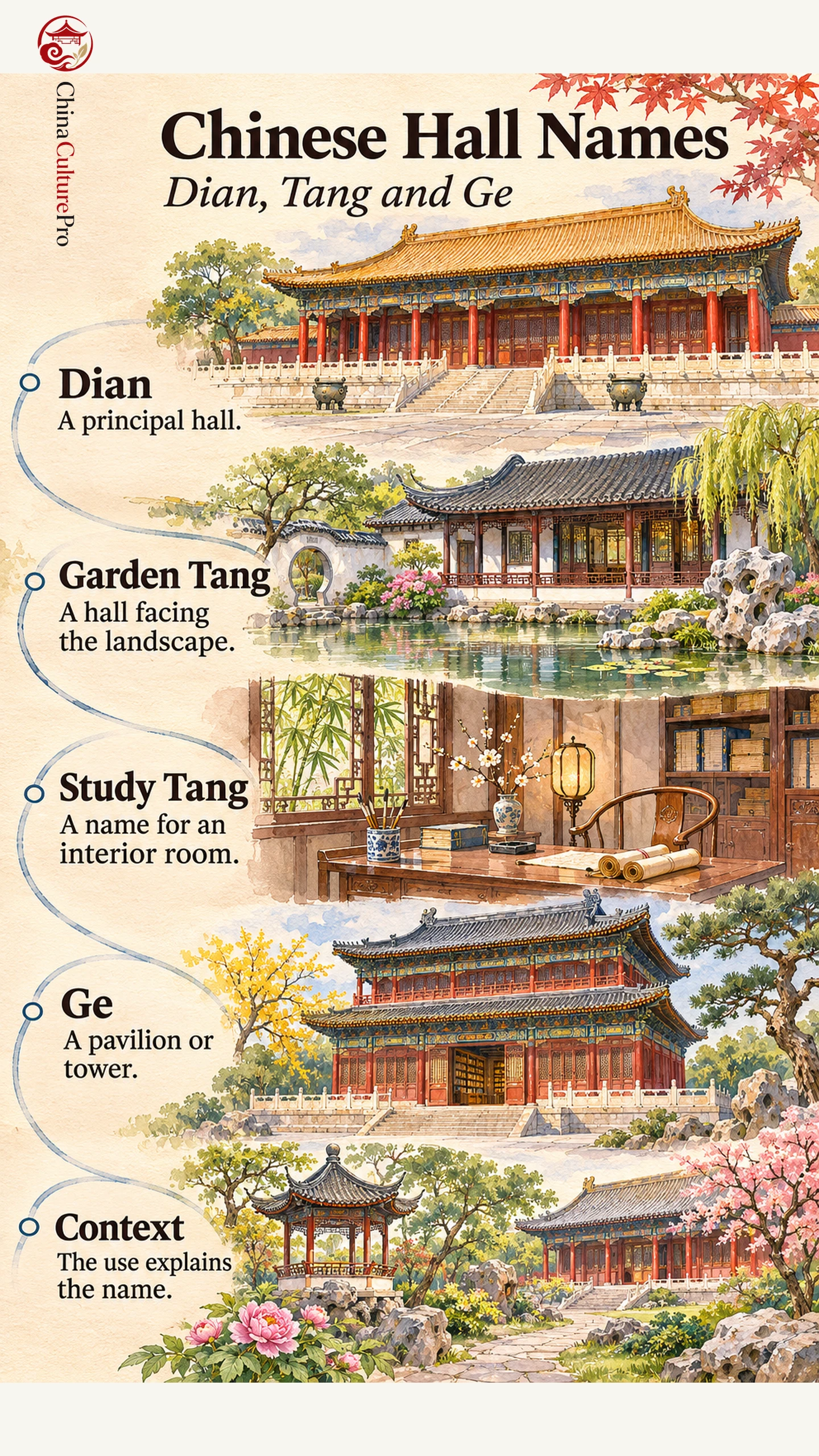
Two names on a palace map may both end in “Hall” in English, even though their Chinese names use different characters. Other buildings called pavilions may contain multiple floors. Reading the original ending helps explain some of the variety.
Dian: A Principal Hall
The Getty Research Institute associates dian and the compound diantang (殿堂, diàntáng) with high-ranking buildings in palaces and temples. Its vocabulary notes that diantang can also refer collectively to important buildings in a complex.[1] The name directs attention to a building’s place in the group.
The Hall of Supreme Harmony (太和殿, Tàihé Diàn) stands on the Forbidden City’s central axis. The Palace Museum records major ceremonies there and describes it as the largest hall in the palace.[2] Its broad facade, raised platform and position facing a ceremonial court reinforce the importance suggested by the name.
A principal hall’s width and depth can be expressed in building bays. Position, bay count and documented activity offer separate clues about the building. The name is one clue among those features.
Tang: From Garden Hall to Private Study
The Hall of Distant Fragrance (远香堂, Yuǎnxiāng Táng) faces the main water scene at Suzhou’s Humble Administrator’s Garden. The local garden authority identifies the expanse north of the hall as the center of the garden’s connected water composition.[3] Here the name identifies a garden building whose relationship to the pond and its banks is part of its identity.
The Three Rarities Study (三希堂, Sānxī Táng) is much smaller in scope. According to the Palace Museum, it was the Qianlong emperor’s study within the Hall of Mental Cultivation (养心殿, Yǎngxīn Diàn), where he kept three prized works of calligraphy.[4] Tang here names an interior room, so “study” communicates the purpose more clearly than “hall.”
The examples help explain why the same word appears on buildings of different sizes. Tang can name a large place for gathering or a private room within another structure.
Ge: Pavilions, Towers and a Palace Library
Ge often suggests a pavilion or a tower, but the name alone tells little about its interior. The Palace Museum identifies Wenyuan Pavilion (文渊阁, Wényuān Gé), completed in 1776, as the library built to house the imperial collection known as the Complete Library of the Four Treasuries.[5] The English word “pavilion” appears in the name of a building designed to hold books.
The museum describes two visible stories and a concealed intermediate level.[5] The outside view and the floor arrangement tell different parts of the story. Other pavilions may take advantage of a high position, as in imperial garden rockeries. Check whether the name refers to a building, an elevated room or a particular use.
FAQs About Chinese Hall Names
Can dian and tang both mean hall?
Yes. The English word is broad enough for both. Dian often points to a principal palace or temple hall, while tang covers a wider range of halls and named rooms.[1]
Does ge always mean a two-story building?
No fixed count follows from the word. Wenyuan Pavilion appears to have two stories but contains a concealed intermediate level.[5]
Can a building name establish its original use?
A name offers a clue. A site plan, historical record or museum account can establish how a particular building or room was used.
Fuentes
[1] Getty Research Institute. Art and Architecture Thesaurus entry for diantang
[2] The Palace Museum. Hall of Supreme Harmony
[3] Suzhou Gardens and Landscaping Administration. Water Design in Suzhou Gardens
[4] The Palace Museum. Three Rarities Study
[5] The Palace Museum. Wenyuan Pavilion