

Quick Answer: What Was the Chinese Censorate?
The Chinese Censorate was an imperial oversight institution. Censors examined officials’ conduct, inspected offices and reported suspected misconduct to the ruler. Their assignments and authority varied across dynasties. A report could bring an official under investigation or lead to dismissal, but the report itself was a separate step from a decision.[1][2][3]
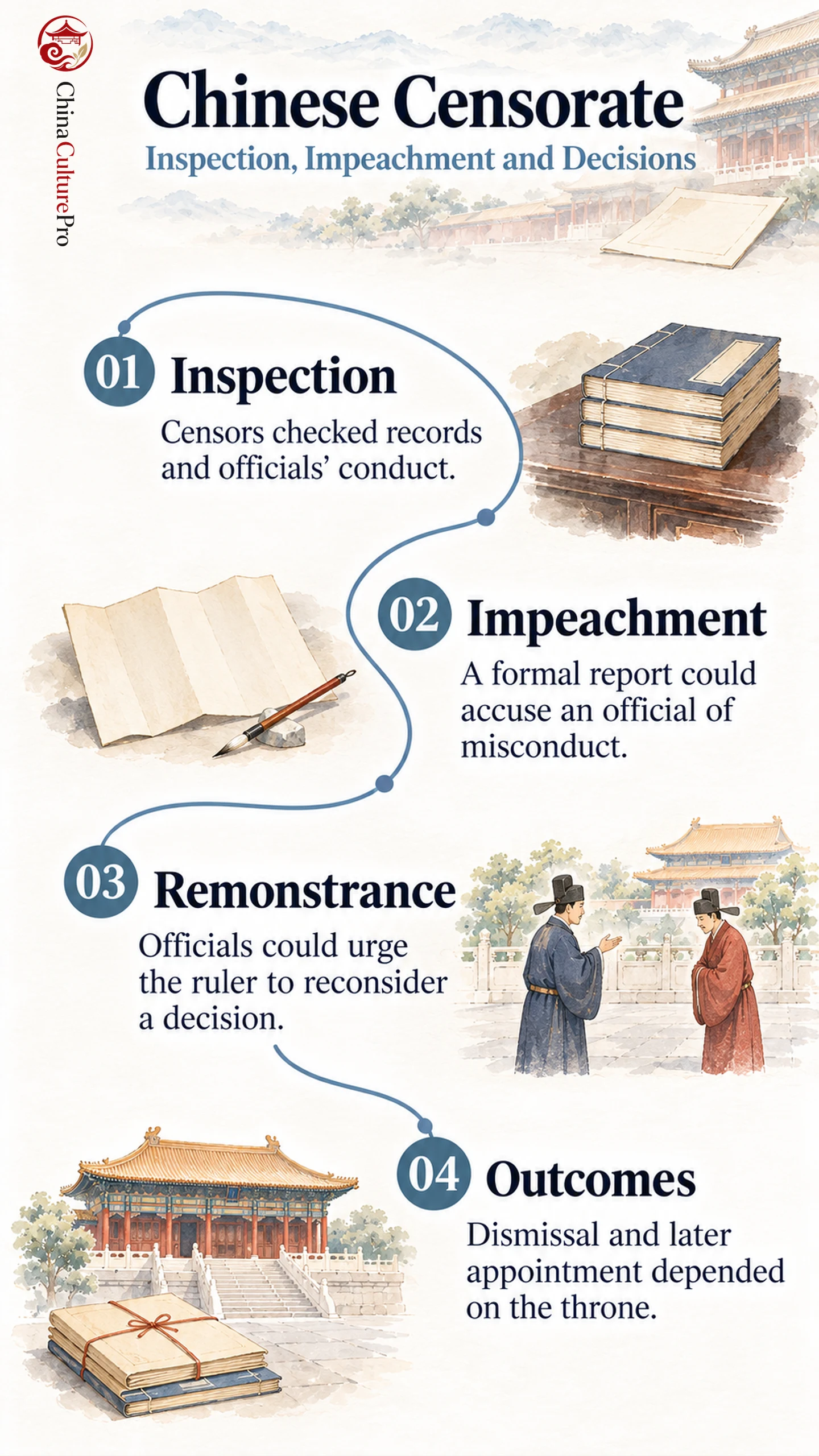
- Inspection: Check records or observe how officials perform their duties.
- Impeachment: Submit a formal accusation of misconduct.
- Decision: The throne or the relevant authorities determine what follows.
Read the title of an office with its dynasty and duties in view.
An imperial censor could examine prison records, report on grain stores or accuse a senior minister of misconduct. A case from the Qing shows how far a report could reach and why the result depended on the emperor’s response.
The Tang Yushitai and Its Duties
The Tang dynasty had a Censorate called the Yushitai (御史台, Yùshǐtái). The Tang Liudian describes officers responsible for reporting misconduct, observing court proceedings and inspecting different parts of the administration. Its account also distinguishes censors’ investigations from the handling of cases by other officials.[1]
In one procedure, a censor who identified grounds for an accusation drew up a statement. Senior censorial officers transmitted it. The code distinguishes an investigation commissioned by edict from an ordinary case sent after investigation to the Court of Judicial Review for decision. For an ordinary case, the office that examined the allegations and the one that issued a decision could be different.[1]
How Ming Inspectors Worked Across Offices
The Ming dynasty organized its principal censorial office as the Duchayuan (都察院, Dūcháyuàn). The History of Ming lists supervisory censors assigned by circuits and distinguishes duties at the capitals from inspections outside them. A visiting censor could review prisoners’ cases and examine court files, warehouses and accounts. The treatise describes important matters being reported for decision and smaller matters being resolved on the spot. Some major judicial matters called for the Censorate to work with the Ministry of Punishments and the Court of Judicial Review.[2]
The same treatise places supervisory censors in the upper seventh grade and chief censors in the upper second. A relatively low personal grade could still come with broad authority on an inspection assignment. The civil service rank system helps explain what the grade conveys. The assigned duties tell us what the grade alone cannot, including what the official could inspect or decide.[2]
Impeachment and Remonstrance Addressed Different Problems
An impeachment formally accused an official. The Ming offices treatise called for factual particulars and dates in such a report. Remonstrance (谏, jiàn) meant offering corrective advice or criticism, often directed at the ruler’s choices. Some officials engaged in both, but the immediate purpose of each communication differed.[2][3][4]
To interpret a surviving memorial, identify its target and what it asks the throne to do. A complaint about official misconduct and a request to change a decision can overlap. A memorial gives the writer’s argument. An imperial response, personnel record or later account may be needed to establish the outcome.[3][4]
Guo Xiu and the Limits of Qing Censorial Power
Under the Qing dynasty, Jiangnan censor Guo Xiu submitted accusations in 1688 against senior officials including Jin Fu, who oversaw river conservancy, and the grand secretary Mingzhu. The emperor dismissed both. Jin Fu returned to office in 1689. Guo himself left office in 1689 after others made accusations against him, and returned to office in 1700.[3]
Guo’s memorials reached the throne and put the conduct of powerful officials under scrutiny. The subsequent appointments are separate evidence. They show that an accusation could have immediate effects while leaving the emperor free to make a different staffing decision later.[3]
FAQs About the Chinese Censorate
Did imperial censors mainly censor books?
The institution’s characteristic work was oversight of officials and government administration. Modern uses of the word censor can obscure that historical job.
Could a censor remove an official from office?
Censors could accuse officials and report findings. A dismissal depended on the emperor or the relevant decision process, which varied by dynasty and case.
What is the difference between Yushitai and Duchayuan?
Both names are rendered as Censorate in English. Yushitai is the name used for the Tang institution discussed here, while Duchayuan names the Ming and Qing institution.
Fuentes
[1] Tang Administrative Code, Wikisource. Tang Liudian, juan 13, Censorate
[2] History of Ming, Wikisource. History of Ming, juan 73, Treatise on Offices
[3] R. Kent Guy, Asia Major, Academia Sinica. The Qing Censorate
[4] Journal of Chinese History, Cambridge University Press. Corpse Admonition: Wu Kedu and Bureaucratic Protest in Late Qing China