

Quick Answer: How Do You Read Buddhist Hand Gestures?
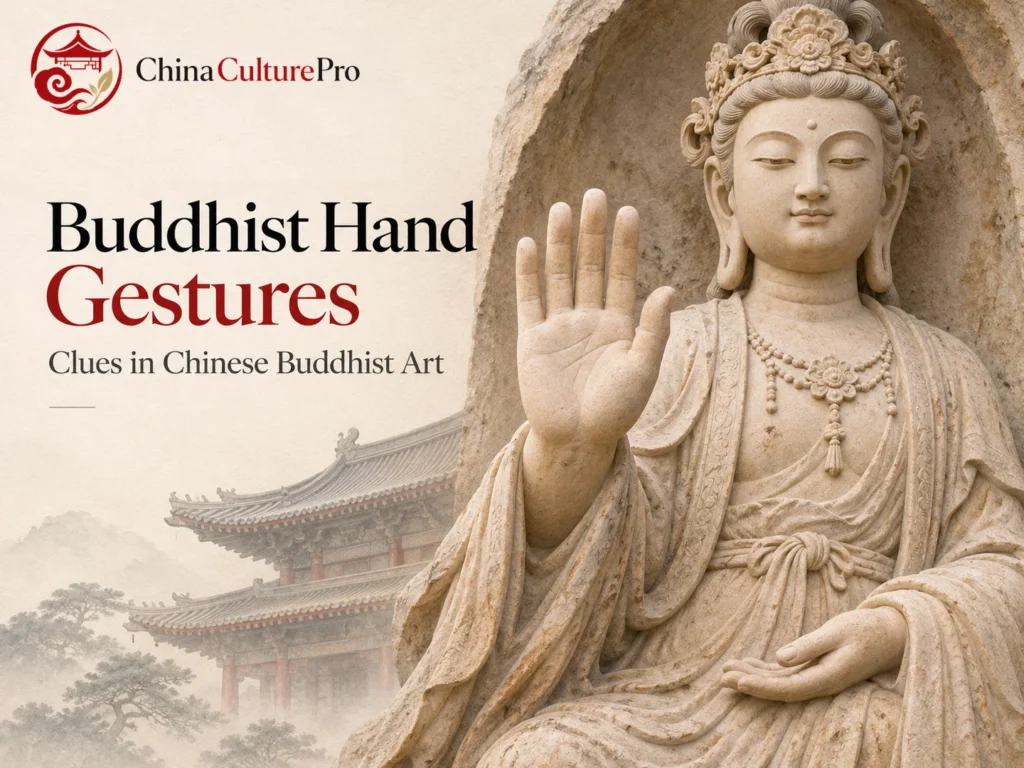
Buddhist hand gestures (手印, shǒuyìn), often called mudras, can show what a figure is doing or recall an event in a Buddhist story. In Chinese art, the palm, fingers and position of the hands are the first things to check.[1][2][3]
- Raised palm: An outward-facing palm held upright can express reassurance.[1]
- Fingers down: A hand reaching toward the ground can recall the Buddha calling the earth to witness his awakening.[2][3]
- Hands in the lap: Hands resting together may mark meditation.[4]
A gesture can narrow the possibilities. Use the pose, attributes, inscription or figures nearby to check which Buddha or bodhisattva you are looking at.

The same statue can give information through both hands. One may reach toward the ground while the other rests in the lap. Note where both hands sit before matching the pose to a label.
Start With the Palm, Fingers and Height
Upright Palm: Reassurance
A Northern Wei sandstone figure at the Met, dated about 470–480, holds its right palm upright and outward in a gesture of reassurance (施无畏印, shī wúwèi yìn). The museum identifies the figure as probably Maitreya by comparing the crossed ankles and crown with other early statues as well as looking at the hand.[1]
Fingers Toward the Ground: Earth Witness
A gilt figure from the Yongle reign of the Ming shows Shakyamuni lowering his right hand in the earth-touching gesture (触地印, chùdì yìn). The gesture recalls the moment of awakening in Buddhist tradition. On this object, an inscription on the throne helps establish the date. The surrounding mandorla is a separate part of the image.[2][3]
Compare Meditation and Teaching
A sixth- or seventh-century painted panel from the Khotan kingdom shows a Buddha with the hands resting together in the lap. The position is known as the meditation gesture. The figure sits within a flaming body halo, which frames the seated figure.[4]
In the Guangsheng Temple mural of the Medicine Buddha, the right hand is higher, near the chest. The palm turns upward and the thumb and index finger come close. A study of the mural reads this as a variation of the teaching gesture. The hand’s level and palm direction help separate it from the low hands in the Khotan painting.[5]
When the Hands Help Name a Figure
An eleventh-century Liao gilt bronze shows the left hand closed around the upright index finger of the right. The Met identifies this as a wisdom fist and uses the configuration to identify Vairocana. Here both hands work together to create the clue. The gestures that artists depict can also be compared with hand seals used in Chinese Buddhist ritual.[6]
FAQs About Buddhist Hand Gestures
Can a raised palm identify the Buddha by itself?
The outward-facing palm expresses reassurance in many images. The rest of the pose and attributes help identify a figure. On the Northern Wei sculpture described here, the crossed ankles and crown also matter.
Are meditation and earth touching the same pose?
Both can appear on seated figures. In meditation both hands can rest together in the lap. In the earth-touching gesture one hand extends toward the ground.
What should I do if a sculpture’s fingers are missing?
Record the surviving hand position and check for an inscription, attributes or companions. A missing finger can erase the detail that distinguishes two otherwise similar gestures.
Fuentes
[1] The Metropolitan Museum of Art. Bodhisattva (Maitreya) with Crossed Ankles
[2] The Metropolitan Museum of Art. Seated Buddha
[3] Smithsonian National Museum of Asian Art. Bhumisparsha Mudra
[4] The Metropolitan Museum of Art. Buddha with a Halo and Flaming Body Mandorla
[5] Angela F. Howard. A Yuan Buddhist Mural of the Paradise of Bhaisajyaguru
[6] The Metropolitan Museum of Art. Buddha Vairocana (Dari)