
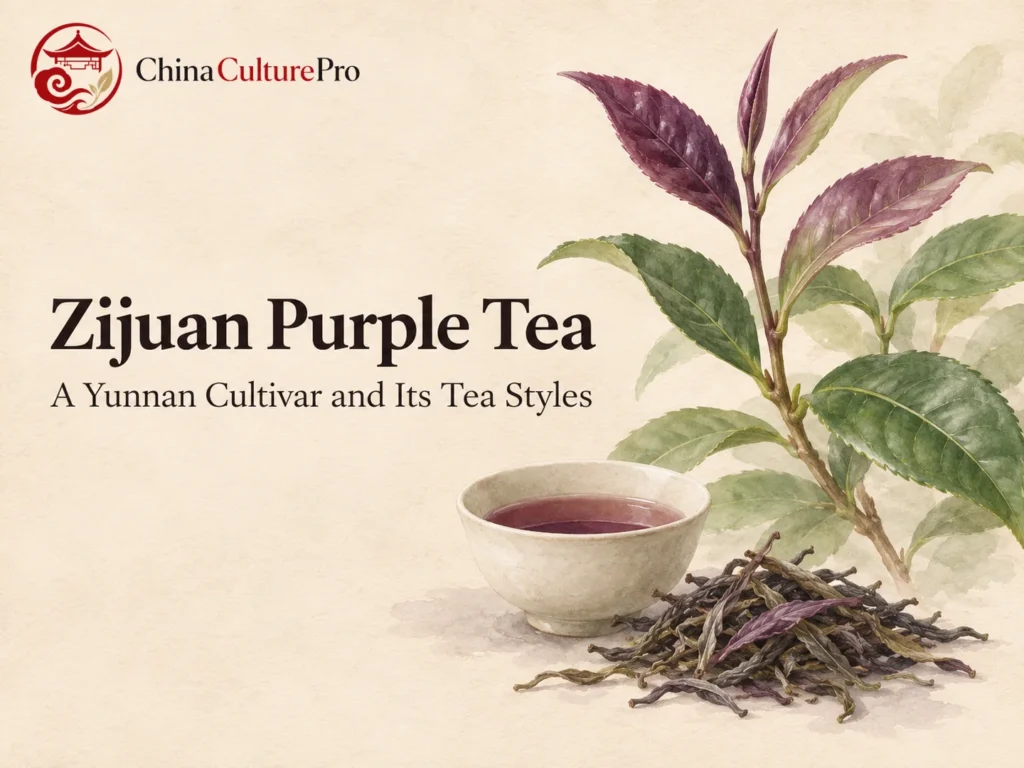

Quick Answer: What Is Zijuan Purple Tea?
Zijuan (紫娟, zǐjuān) is a cultivated tea plant from Yunnan in the large-leaf Assam variety of Camellia sinensis. Its tender buds, young leaves and shoots have a pronounced purple colour. The plant name can appear on green tea, black tea or raw pu’er (生普洱, shēng pǔ’ěr) made from its leaves. [1][2][3][4][6]
- Plant: Zijuan names a specific cultivar.
- Leaf appearance: Purple buds (紫芽, zǐyá) describe a visual trait shared by more than one tea plant.
- Finished tea: Check a second term such as green, black or sheng to learn how the leaves were processed. [2][3][4][5][6]
A distinctly coloured dry leaf or cup can be a clue to the material. Use the declared cultivar and processing information to identify the tea. [1][2][3][5]

A label that says Zijuan raw pu’er carries two pieces of information. Zijuan identifies the plant. Raw pu’er describes the producer’s finished tea. The same cultivar can appear on a bag of green tea. The words after Zijuan tell you which tea the maker produced. [1][3][6]
Where the Zijuan Cultivar Comes From
Yunnan tea researchers selected Zijuan from a purple-shoot plant in a population of Yunnan large-leaf tea. A research account describes work beginning in 1985 to stabilize the purple trait. The International Camellia Register lists the cultivar as Camellia sinensis var. assamica ‘Zijuan’. The cultivar name identifies the selected material within a much broader botanical variety. For the role of cultivar names in other teas, see Chinese tea cultivars. [1][2][7]
A Yunnan agricultural reference records national plant variety protection in 2005 under number 20050031. The register also preserves 紫鹃 as an alternate spelling and lists 紫娟 from a recent Chinese cultivar reference. Both appear in catalogues about this cultivar. [1][7]
What Purple Buds Do and Do Not Identify
The young shoots stand out because the bud, tender stem and several of the youngest leaves have purple colouring. Researchers associate the young-leaf colour with anthocyanins. A packet labelled purple buds tells you something about appearance and may leave the cultivar unnamed. [2][5]
Ziyan (紫嫣, zǐyān) is a named purple-leaf cultivar distinct from Zijuan. Researchers have compared both and found that the concentrations of colour-related pigments change across seasons. Variation in plants, season and tea manufacture limits what the colour of an infusion can tell you about cultivar identity. The tea cultivar and tea type guide explains what else to look for on a label. [2][3][5]
The Different Tea Styles Made From Zijuan
| Tea style | What is documented | How to read the name |
|---|---|---|
| 緑茶 | Tea researchers compared baked and sun-dried green tea samples made with Zijuan leaves. | Zijuan names the cultivar. Green names the processing category. |
| Gongfu black tea (工夫红茶, gōngfu hóngchá) | A Menghai association standard names Zijuan as the cultivar for this black tea. | Black tea is the finished style. Zijuan is the plant. |
| Sheng pu’er | A documented retail listing labels a spring Zijuan tea as sheng pu’er. | Sheng means raw in this context and is the tea style on the label. |
| White and dark tea | A controlled processing comparison also made white and dark tea samples. | Research samples demonstrate processing possibilities. |
The Menghai specification describes a commercial black tea with Zijuan as its raw material. The raw pu’er example is documented by a listing for a specific spring tea. See the guide to Chinese pu’er for how raw and ripe pu’er differ. A laboratory comparison made additional types to study changes under different treatments. The comparison describes processing trials. [3][4][6]
Read the Cultivar and the Processing Term on the Label
Look for Zijuan or 紫娟 as the cultivar statement. Then find the tea style, the growing or processing region if supplied, and the harvest year or season. If a bag says only purple tea, the colour term gives you a lead. The seller or producer would need to provide the plant name and method before you can compare it with a named Zijuan tea. [1][3][4][6]
FAQs About Zijuan Purple Tea
Is all Zijuan tea pu’er?
The cultivar supplies leaves for several types. The Menghai association standard for Zijuan gongfu black tea provides another documented example. [3][4]
Does purple leaf colour prove the tea is Zijuan?
Other tea plants, including the named cultivar Ziyan, have purple new growth. Look for a cultivar name in the producer’s information. [2][5]
Will brewed Zijuan always look purple?
Colour varies with the way the leaves were grown and processed. A baked green tea made with Zijuan has been described as purple. A tea made another way may look different. [2][3][7]
出典
[1] International Camellia Register. Zijuan (Tea)
[2] Yunnan Tea Research Institute and coauthors. Genomic Variance and Transcriptional Comparisons in Tea Plant
[3] Shi Hongdi and coauthors. The Quality of Zijuan Tea Under Different Processing Techniques
[4] Menghai County Tea Industry Association. T/MHC 007.2–2024, Menghai Zijuan Gongfu Black Tea
[5] Chinese Journal of Tropical Crops. Seasonal Changes in Anthocyanins of Ziyan and Zijuan
[6] Seven Cups. Zijuan Chuncha Sheng Puer
[7] Yunnan Provincial Library. Zijuan: A New Tea Cultivar