

Quick Answer: What Was the Zhou Dynasty?
The Zhou dynasty (周朝, Zhōu Cháo) overthrew the Shang around 1046 BCE. Its royal house lasted until 256 BCE. Historians divide Zhou rule into a western phase and an eastern phase, named for the location of the royal court.[1][2][12]
- Western Zhou: The Western Zhou (西周, Xī Zhōu) court governed from the region of present-day Xi’an and established ties with regional ruling houses.[1][2]
- Eastern Zhou: The Eastern Zhou (东周, Dōng Zhōu) court moved to Luoyang as regional states gained power.[1][2][7]
- Qin unification: The Zhou royal line ended before the Qin state unified its rivals in 221 BCE.[7][12]
The dates 256 BCE and 221 BCE mark separate events. The latter also closes the broader age of competing states.

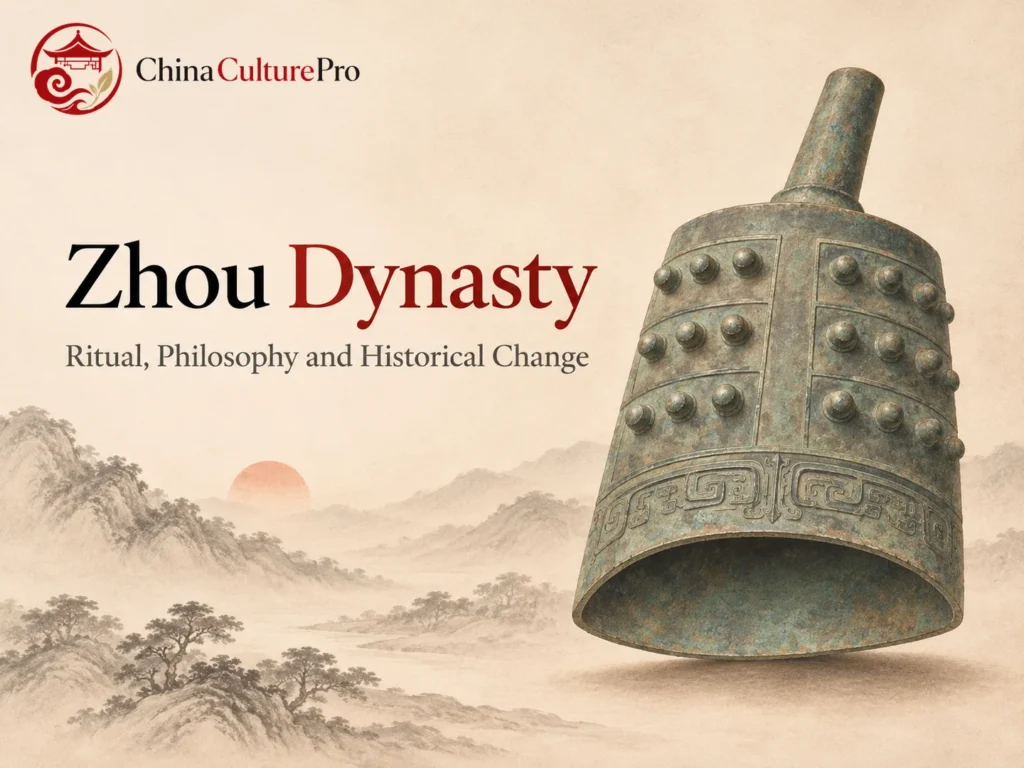
An inscribed bronze bell records a hereditary appointment under the Zhou. Centuries later, political thinkers debated how much a ruler could accomplish through inherited customs, moral example or enforceable standards.[5][8][11]
Western Zhou Rule and the Mandate of Heaven
King Wu of Zhou (周武王, Zhōu Wǔwáng) defeated the Shang dynasty around 1046 BCE. The new royal house justified its right to rule through the Mandate of Heaven (天命, tiānmìng). In this argument, Heaven’s approval could pass to a different ruling house. The Shang had once held it, and the Zhou claimed that it had passed to them. The claim explained how a former subject of the Shang could become a legitimate ruler.[1][3][4]
The poem honoring King Wen in the Classic of Odes (诗经, Shījīng) shows the argument in use. It celebrates the Zhou’s rise and presents the Shang loss of power as a warning to the new rulers. The poem is evidence for the way Zhou authority was explained and remembered. A fuller account of the Mandate of Heaven traces that idea beyond this particular change of rulers.[4]
An early Western Zhou bronze vessel called the He Zun (何尊, Hé Zūn) preserves a royal speech that recalls the transfer of Heaven’s mandate. The same inscription records a gift of cowries to the vessel’s maker. The two details show how the court invoked its founding story while addressing the duties and rewards of a particular person.[16]
The royal house granted regional positions and territories to relatives and allies. Historians often use the term fengjian (封建, fēngjiàn) for these arrangements. Hereditary authority was tied to service, kinship and ritual obligations. The arrangement gave the court a way to exercise influence across a wide area and gave regional families a base from which to build their own power. The familiar English comparison with feudalism captures aspects of hereditary regional rule, while ancestral lineage was particularly important to Zhou political relationships.[1][3]
Ritual, Music and Bronze Inscriptions
Early Zhou elites retained Shang practices such as offering food and drink to ancestors in bronze vessels. Inscriptions could connect those ceremonies to matters of government. A vessel commissioned after a royal appointment could preserve a record of the honor and carry it into ceremonies held by the recipient’s family. The link between ancestor worship and office thus appears on actual objects as well as in later accounts of Zhou society.[1][3][5]
The Lai Zhong (逨钟, Lái Zhōng), a bronze bell in the Cleveland Museum of Art, carries 118 characters. Its inscription recalls the service of Lai’s ancestors to the royal court and records a hereditary appointment granted to Lai. He commissioned a set of eight bells as an offering to his father. The casting was an investment in a set of instruments as well as a record of a grant. The lens-shaped cavity allowed the bell to sound two different pitches. The inscription joins two purposes in one object. The bell made music in ceremony and preserved the family’s account of its ties to the royal house.[5]
Bronze bells continued to be made in the Eastern Zhou. One Eastern Zhou example hangs from a ring cast at its top. Other types have longer handles. Those details help identify how a bell could be suspended within a set. Sets of bells accompanied rituals and other events. The guide to Chinese bronze vessels explains how form, inscription and ritual setting can help identify different objects from this tradition.[3][6]
The Move East and the Rise of Regional States
The Western Zhou court collapsed in 771 BCE. King Ping of Zhou (周平王, Zhōu Píngwáng) moved the royal seat east to Luoyang around 770 BCE. These dates describe the collapse and relocation respectively. The court survived the move, but its direct resources were smaller and the lords of regional states controlled much of the territory and military power.[1][2][7]
During the Spring and Autumn period (春秋时期, Chūnqiū Shíqī), regional rulers made alliances, fought and still drew on the prestige of Zhou rank and ceremony. In the subsequent Warring States period (战国时期, Zhànguó Shíqī), larger states absorbed smaller neighbors and expanded their ability to raise resources and armies. The two periods are often divided around 480 BCE. Historians use several boundaries because changes in military and political power accumulated over time.[1][7]
One consequence was that the royal and regional chronologies diverged. A state could negotiate with its neighbors or take up arms while a Zhou king still occupied the throne.[1][2][7]
Political Ideas in the Eastern Zhou
Confucius (孔子, Kǒngzǐ) lived from 551 to 479 BCE. In the received Analects (论语, Lúnyǔ), passage 2.3 contrasts governing through penalties with governing through moral example and ritual propriety (礼, lǐ). The first can make people look for ways to avoid punishment. The second can foster a sense of shame and a willingness to correct their conduct. This argument extends the role of ritual beyond ceremonies at a royal shrine.[8][9]
Mozi (墨子, Mòzǐ) and the movement known as Mohism (墨家, Mòjiā) evaluated practices by how they benefited people. Mohist texts ask whether expensive funerals, prolonged mourning or elaborate court music use labor and resources that could meet other needs. The disagreement with ritual-centered thinkers concerned how public resources should serve society, as well as how much inherited authority a custom deserved.[9][10]
Texts grouped under Legalism (法家, Fǎjiā) offer a different way to make a state effective. The Book of Lord Shang (商君书, Shāngjūn Shū) emphasizes agriculture and warfare and uses rewards and penalties to direct effort toward them. The label groups several thinkers and texts. The shared concern was how to make officials and subjects respond predictably to the state’s standards.[11]
Early Daoist thought (道家, Dàojiā) offered another response to ambitious government. The Daodejing (道德经, Dàodéjīng) questions aggressive warfare and heavy taxation and explores how rulers might accomplish more by intervening less. The Hundred Schools of Thought (诸子百家, Zhūzǐ Bǎijiā) is a broad name for the diversity of arguments from this era.[14][15]
The End of the Zhou Court and Qin Unification
The final Zhou king, King Nan of Zhou (周赧王, Zhōu Nǎnwáng), died in 256 BCE as Qin brought the royal domain under its control. The Warring States continued because the end of the royal house left powerful independent states in the field. Qin defeated its last major rival in 221 BCE, the date used to begin the Qin dynasty as a unified empire.[1][2][7][12][13]
The two endpoints answer different questions. For a list of reigning royal houses, 256 BCE marks the end of the Zhou. For a history of competition among the states, 221 BCE closes the Warring States. This is why a museum timeline of Zhou-era culture can include artifacts later than the last Zhou king.[2][3][7]
FAQs About the Zhou Dynasty
What is the difference between Western Zhou and Eastern Zhou?
Western Zhou refers to the phase when the royal court was based near present-day Xi’an. Eastern Zhou begins with the court’s move to Luoyang after the western capital fell. In the eastern phase, regional rulers held much of the military and territorial power.[1][2][7]
Why do some timelines end the Zhou in 221 BCE?
Some timelines group the entire Warring States era with the Zhou period for the purposes of dating art or historical developments. In royal chronology the Zhou ended in 256 BCE. Qin completed its conquest of the other major states in 221 BCE.[1][3][7][12]
Did Confucius live during the Zhou dynasty?
Yes. Confucius lived in the Eastern Zhou, near the end of the Spring and Autumn period. His teaching on government and ritual took shape in a world of competing regional courts.[7][8][9]
出典
[1] Columbia University Asia for Educators. Annotated Timeline of Chinese History
[2] Princeton University Art Museum. China Timeline
[3] National Museum of Asian Art. Zhou Dynasty Overview
[4] Columbia University Asia for Educators. Classic of Odes: King Wen, Ode 235
[5] Cleveland Museum of Art. Bell (Lai Zhong)
[6] The Metropolitan Museum of Art. Bell (Niuzhong)
[7] OpenStax. Ancient China
[8] Columbia University Asia for Educators. Selections from the Confucian Analects: On Government
[9] Stanford Encyclopedia of Philosophy. Confucius
[10] Stanford Encyclopedia of Philosophy. Mohism
[11] Stanford Encyclopedia of Philosophy. Legalism in Chinese Philosophy
[12] Routledge. Routledge Handbook of Imperial Chinese History: Chronology
[13] University System of Georgia. World History: Qin and the End of the Zhou Royal Line
[14] Stanford Encyclopedia of Philosophy. Laozi
[15] Columbia University Asia for Educators. Key Points in Early Chinese History: Eastern Zhou and the Hundred Schools
[16] National Museum of China. He Zun and Western Zhou Bronze Inscriptions from Baoji