


Quick Answer: Who Was Zhen Ji?
The Records of the Three Kingdoms (三国志, Sānguó Zhì) identifies Zhen Ji (甄姬, Zhēn Jī), or Lady Zhen, as Cao Pi’s (曹丕, Cáo Pī) wife and Cao Rui’s mother. A later tradition connected her with the river goddess in a work by Cao Pi’s brother, Cao Zhi (曹植, Cáo Zhí).[1][3]
- Lady Zhen received the title Empress Wenzhao after her death.[1]
- Cao Zhi’s preface calls the goddess Mi Fei (宓妃, Fú Fēi).[2]
- The identification with Lady Zhen appears in a later commentary tradition.[3]
The court record, the poem and the commentary answer different questions about the same famous association.
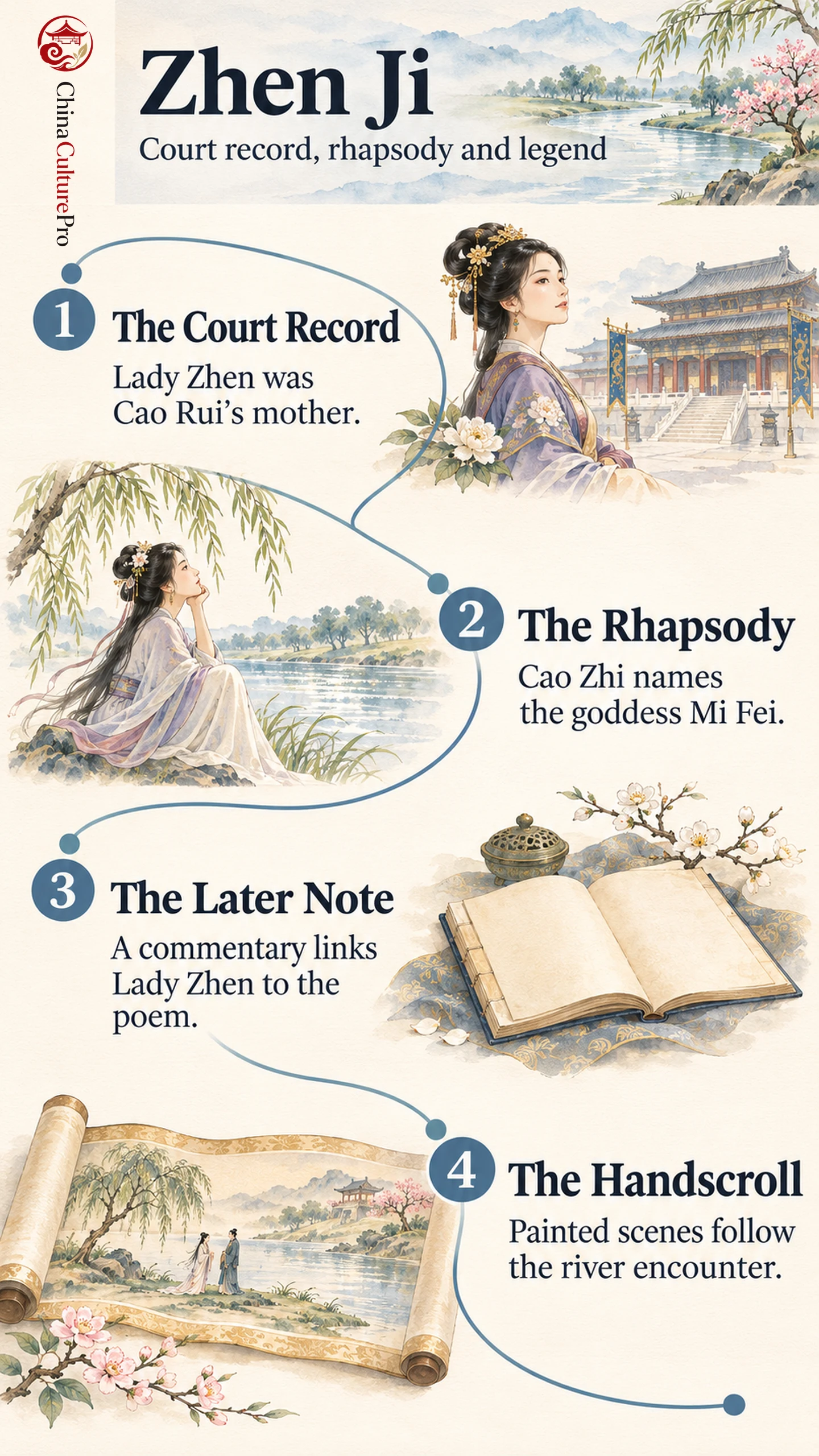
The riverbank encounter and the Wei court belong to different sources. That distinction helps when a modern retelling uses the name Zhen Ji for a historical woman and gives her the setting of a river goddess.
Lady Zhen in the Court Biography
Lady Zhen first married Yuan Xi, a son of Yuan Shao. She entered Cao Pi’s household at Ye after the defeat of the Yuan family there and had two children, Cao Rui and the Princess of Dongxiang. The biography records that Cao Pi ordered her death in 221. Cao Rui later honored her with the title Empress Wenzhao.[1]
Her place among the families of Wei connects her biography with the history of the Three Kingdoms. Reading the record alongside Lady Sun’s story shows how marriages in rival households became the subject of later narratives.
Who Is the Woman in Cao Zhi’s Rhapsody?
In the preface to the Rhapsody on the Luo Goddess (洛神赋, Luòshén Fù), Cao Zhi dates his crossing of the Luo River to 222. He identifies the river’s goddess as Mi Fei and names an earlier literary encounter with a goddess as his inspiration. The rhapsody follows the meeting and separation of its traveler and the river deity.[2]
How Lady Zhen Became Linked With the Goddess
A commentary preserved in one edition of the literary anthology Wen Xuan tells a story about Cao Zhi’s feelings for Lady Zhen. It gives the rhapsody an earlier title that refers to her. Other editions lack the note, and details in its story conflict with her recorded marriage history. The note explains the later association with Lady Zhen.[1][3]
How the Story Moves Across a Handscroll
A Northern Song handscroll in the Palace Museum collection follows the meeting and parting as successive scenes. As a viewer unrolls it, recurring figures move the story forward through images alone in the painted scenes. The scroll is an example of how Chinese painting could turn the movement of a poem into the movement of a viewer’s eye.[4]
FAQs About Zhen Ji
Was Lady Zhen an empress in her lifetime?
The title Empress Wenzhao was conferred after her death, during the reign of her son Cao Rui.[1]
Does Cao Zhi name Lady Zhen in the rhapsody’s preface?
The preface identifies the deity as Mi Fei and explains the literary inspiration for the work.[2]
Is the Luo Goddess handscroll a portrait of Lady Zhen?
The Northern Song handscroll illustrates episodes from the rhapsody. Its figure represents the river goddess in that work.[2][4]
出典
[1] Records of the Three Kingdoms. Volume 5, biography of Empress Wenzhao
[2] Cao Zhi. Rhapsody on the Luo Goddess
[3] The Palace Museum. Rhapsody on the Luo Goddess
[4] Hong Kong Palace Museum. The Making of Masterpieces: Chinese Painting and Calligraphy from the Palace Museum