


Quick Answer: What Does Tian Ren He Yi Mean?
Tian ren he yi (天人合一, tiān rén hé yī) is often translated as the unity of Heaven and humanity. The phrase raises a question about how human life belongs within a wider order. In the work of Zhang Zai (张载, Zhāng Zǎi), the Western Inscription (西铭, Xīmíng) gives this relationship ethical force through an image of shared kinship.[1][2][3]
- Cosmological: Human beings are formed within the same world as other things.
- Ethical: A sense of belonging can give people reasons to care for others.
- Interpretive: Translating the phrase as “harmony with nature” highlights one possible concern and can narrow the range of the older expression.[1][2][4]
A reading depends on what a particular author means by Heaven and what kind of unity is at issue.
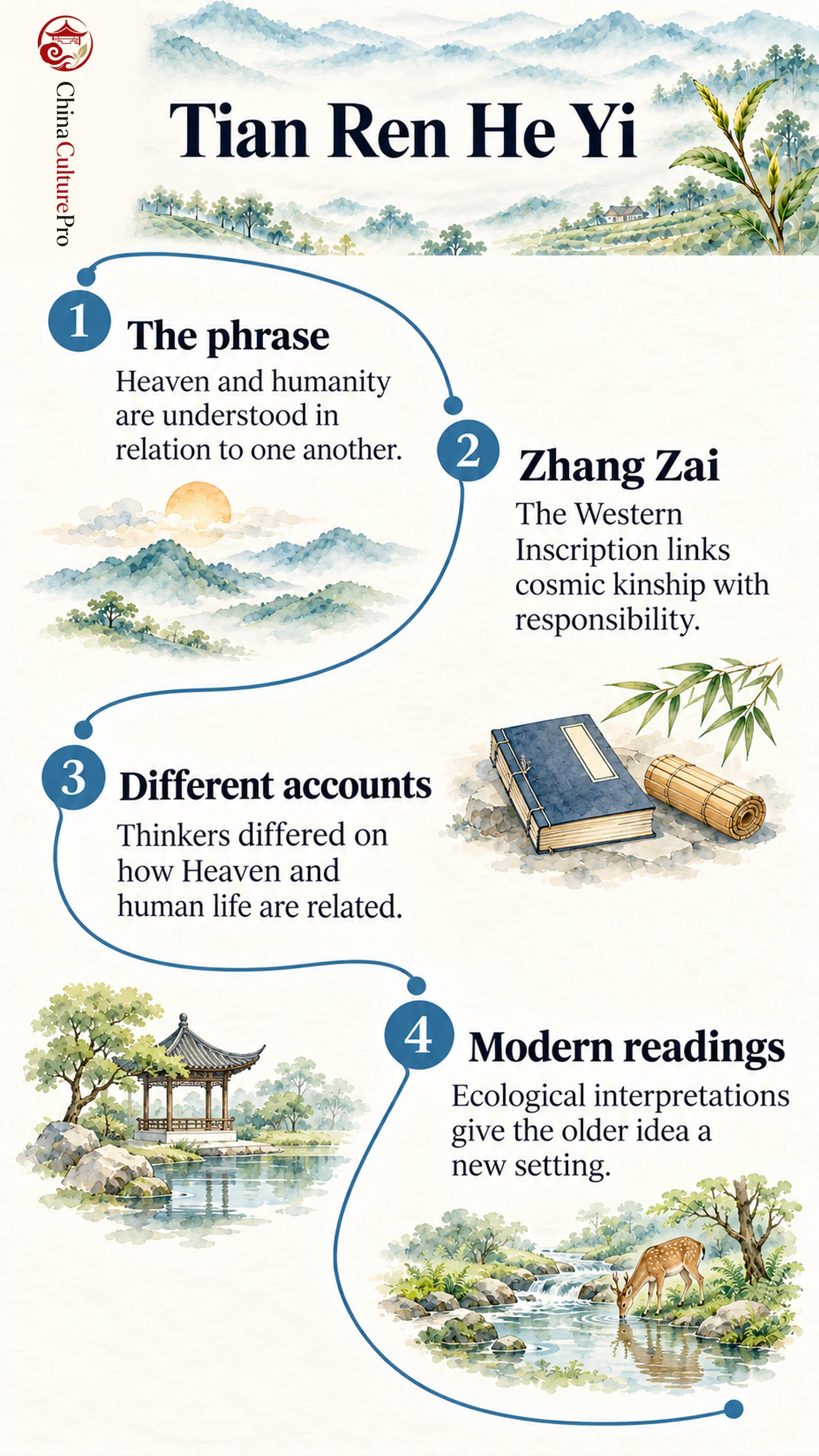
The phrase can appear in discussions of morality, cultivation and environmental responsibility. Those discussions ask different questions. A single text can help make the differences visible because it has to say how a claim about the world bears on what a person does.
What Unity Means in Zhang Zai’s Western Inscription
The Western Inscription describes Heaven and Earth in terms of a parental relationship. It presents other people as siblings and other things as companions. Within Zhang Zai’s wider cosmology, qi (气, qì) helps explain why beings can share a world without all having the same form or role. The text gives that connection a familiar language through kinship.[1][2]
It then asks what follows for conduct. It names people in difficulty, including those who are ill or lack anyone to appeal to. Care for them becomes part of the response owed within the larger relationship. The move from cosmology to responsibility is concrete. The family comparison asks the reader to extend to someone without support a kind of attention they already recognize within a household. It also gives the idea a connection to humaneness.[1][2]
Why Early Accounts of Heaven and Humanity Differ
The term tian can bear on natural processes, political authority or moral responsibility. The emphasis changes with the problem a text is addressing. In Xunzi’s Discourse on Heaven, the constancy of its course makes human choices about how to organize life especially important. The course of the seasons supplies conditions, and people still have to decide how to respond to them.[2][5]
Zhang Zai’s account asks how people belong within the wider processes that form them. Xunzi’s account of the respective roles of Heaven and people helps explain why a common subject can give rise to different arguments. The phrase unity of Heaven and humanity is more precise when a writer identifies the text and the feature of the relationship at issue.[2][3][5]
How Modern Ecological Readings Use the Phrase
Modern environmental interpreters sometimes draw on the phrase to question a view of people as independent of the world that supports them. There are disagreements about how much weight these readings give human flourishing and how much they give other beings or processes in their own right. Those questions are part of current uses of the idea.[4]
The difference matters when a reader returns to the Western Inscription. Its image of a larger community offers a way to think about the reach of responsibility. It also gives particular attention to vulnerable people, family obligations and cultivation. An environmental interpretation brings a new set of questions to that older combination of concerns.[1][2][4]
FAQs About Tian Ren He Yi
Does tian simply mean nature?
Nature can be a helpful translation when the focus is on natural processes. “Heaven” can preserve the wider senses of moral order and authority that matter in some texts.[2][5]
Is the exact phrase in the Western Inscription?
The Inscription is a well-known expression of the underlying idea through kinship imagery. Zhang Zai uses the explicit formulation in the Zhengmeng in a discussion that connects clarity and sincerity.[1][3]
Does unity make human choices irrelevant?
Zhang Zai’s argument gives shared belonging practical consequences. Its account of responsibility depends on how people respond to those around them.[1][2]
出典
[1] Bryan W. Van Norden, Vassar College. Translation of Zhang Zai’s Western Inscription
[2] Stanford Encyclopedia of Philosophy. Metaphysics in Chinese Philosophy
[3] Beijing Language and Culture University. Unity of Heaven and Humanity in Ancient Chinese Thought
[4] Xinzhong Yao, Frontiers of Philosophy in China. An Eco-Ethical Interpretation of Confucian Tianren Heyi
[5] UPL Open. Xunzi: Discourse on Nature, Translation and Commentary