


Quick Answer: What Is Sichuan Crispy Pork?
Sichuan crispy pork, or xiaosurou (小酥肉, xiǎo sū ròu), is battered, fried pork strips flavoured with Sichuan peppercorns (花椒, huājiāo).[2][4]
- It can be eaten as a crisp snack with an optional dry chili dip.[2]
- In soup or hot pot (火锅, huǒguō), the coating absorbs broth and becomes softer.[3][4]
- Recipes differ in pork cuts, starches, spices and added water; choose one complete batter formula.[3][4]
The recipe below follows a sweet-potato-starch-and-egg version, with no added water in its batter.
Prepare two trays: one for the cooked first batch and one for finished crisp pork. Keep raw-pork equipment separate from serving utensils and allow room to work safely around the oil.
Pepper, Pork Cuts and Batter Differences
The pepper-forward seasoning gives this version its connection to Sichuan cuisine (川菜, chuāncài). Sichuan peppercorns contribute a fragrant, numbing character; a chili dip supplies a separate kind of heat.[2]
Shoulder gives a rich bite; belly is fattier, while some home recipes allow loin. Cut choice changes the result.[2][4]
Some versions include five-spice powder (五香粉, wǔxiāngfěn), corn or tapioca starch, or a little ginger-scallion water. Other starch batters adjust with water. Those are different formulas, not additions to pour into this one.[3][4]
Ingredients for One Sweet-Potato-Starch Version
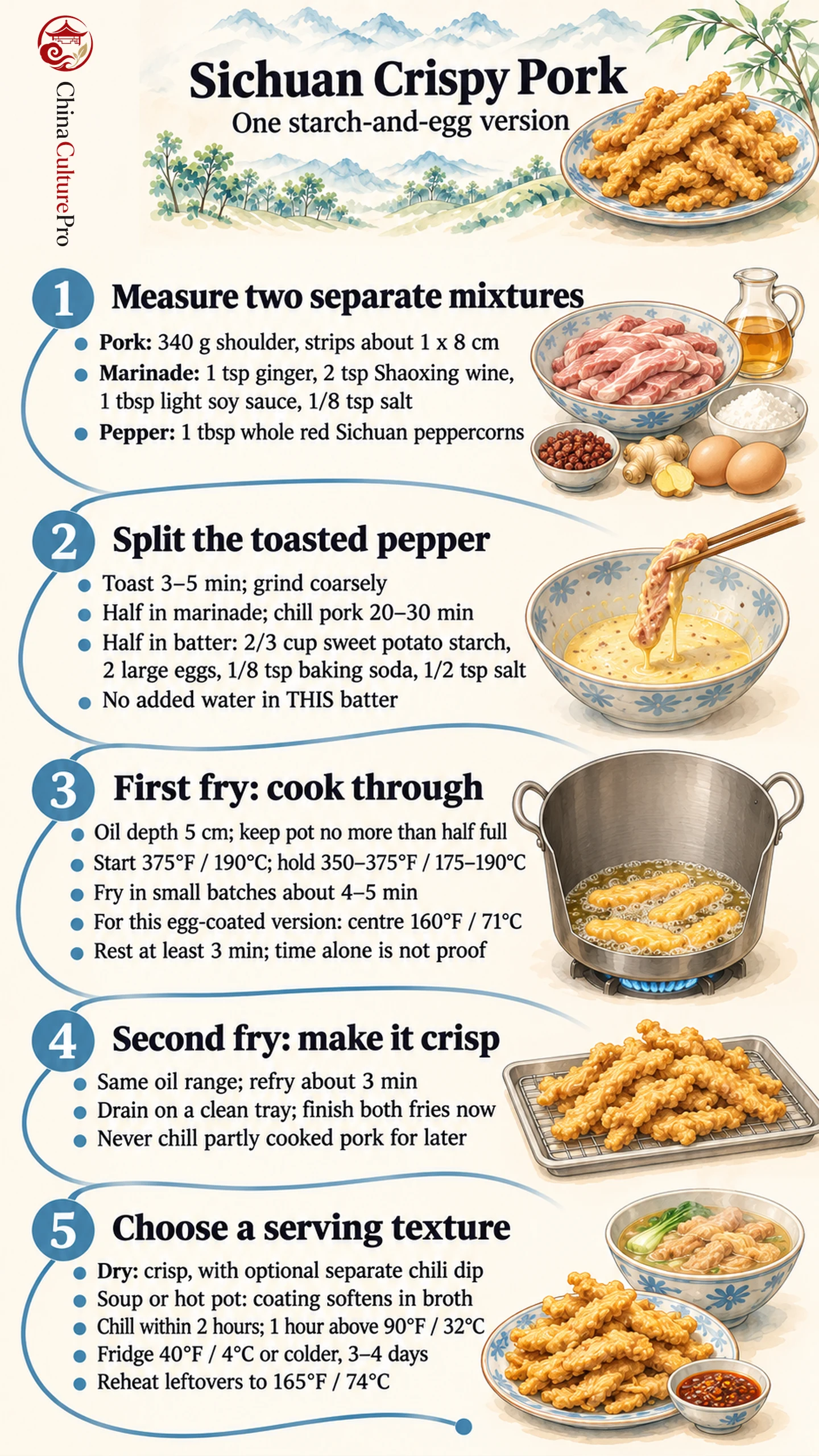
- Meat and marinade: 12 oz/340 g boneless, skinless pork shoulder, in roughly 1 × 8 cm strips; 1 tbsp whole red Sichuan peppercorns; 1 tsp grated ginger; 2 tsp Shaoxing wine (绍兴酒, Shàoxīng jiǔ); 1 tbsp light soy sauce (生抽, shēngchōu); ⅛ tsp salt.[1]
- Batter: ⅔ cup sweet potato starch (红薯淀粉, hóngshǔ diànfěn); 2 large eggs; ⅛ tsp baking soda; ½ tsp salt.[1]
- Frying: Canola oil for a 5 cm depth in a suitable deep pot.[1]
The peppercorn amount is measured whole, before grinding. The marinade’s ⅛ tsp salt and batter’s ½ tsp salt are separate portions.[1]
Use a stable, heavy pot with enough headroom that the oil fills no more than half its capacity. Keep utensils dry, use long tongs and a frying thermometer, and cool bulk oil before transferring it.[7]
How to Marinate, Batter and Double-Fry
- Toast peppercorns. Dry-toast over medium-low heat 3–5 minutes until fragrant; grind coarsely.[1]
- Marinate cold. Mix pork, ginger, wine, light soy, marinade salt and half the ground pepper. Refrigerate 20–30 minutes.[1]
- Make the batter. Stir starch, eggs, baking soda, batter salt and remaining pepper until lump-free. Coat pork evenly.[1]
- First-fry and rest. Heat oil to 375°F/190°C; maintain 350–375°F/175–190°C while frying uncrowded strips about 4–5 minutes. For this egg-coated version, cook centres to a conservative 160°F/71°C, then rest at least 3 minutes.[1][5][6]
- Crisp again. Refry in batches within the same oil-temperature range about 3 minutes, until deeply golden and crisp. Drain on a clean tray and serve promptly.[1]
Floating or browning alone cannot establish doneness. Probe a thick strip rather than judging only its shell, and complete both frying stages in the same cooking session.[5][9]
Three Ways to Serve Xiaosurou
Choose the texture you want:
- Dry and crisp: Serve freshly fried, plain or with gan die (干碟, gāndié), a seasoned dry chili dip offered separately.[2]
- In soup or stew: Cooked fried pork absorbs liquid; the softened coating becomes part of the appeal rather than staying crunchy.[3]
- With hot pot: Serve as a snack alongside the pot, or heat cooked strips in broth. The hot pot guide および ingredient guide help distinguish raw ingredients from ready-cooked additions.[2][4]
Keep ready-to-eat fried pork away from raw hot-pot meats and their utensils. If using refrigerated leftovers, heat them thoroughly to 165°F/74°C rather than merely warming the outside.[8]
FAQs About Sichuan Crispy Pork
Can I use another starch?
Other recipes use corn, tapioca or potato starch, sometimes with flour and different egg or water quantities. Follow a complete alternative formula rather than assuming a cup-for-cup swap will give the same coating.[2][3][4]
Why does the batter fall off or clump?
The batter must coat the strips evenly. Lower pieces into the oil individually with space between them; dropping a sticky handful together creates a clump that is difficult to separate cleanly.[2]
Can I save the second fry for another day?
Complete this recipe’s cooking before chilling. Do not refrigerate partly cooked pork to finish later. Store fully cooked portions instead, then reheat them safely.[9]
How should I store and reheat leftovers?
Refrigerate shallow portions within 2 hours, or 1 hour above 90°F/32°C. Keep at 40°F/4°C or colder for 3–4 days; reheat to 165°F/74°C. Soup or hot pot can give softened leftovers a useful serving role.[8]
出典
[1] Judy Leung. Little Crispy Pork: Xiaosurou
[2] Taylor Holliday. Sichuan Pepper-Studded Little Crispy Pork
[3] Elaine. Sichuan Crispy Fried Pork
[4] Xueci Cheng. Crispy Fried Sichuan Pepper Pork
[5] U.S. Department of Agriculture. Safe Internal Temperatures for Meat and Poultry
[6] U.S. Food and Drug Administration. What You Need to Know About Egg Safety
[7] Iowa State University. Deep Fat Frying
[8] U.S. Department of Agriculture. How Do I Handle Leftovers Safely?
[9] U.S. Department of Agriculture. Is It Safe to Partly Cook Pork?