


Quick Answer: Who Was Shi Nai’an?
Shi Nai’an (施耐庵, Shī Nài’ān) is the author traditionally associated with Water Margin (水浒传, Shuǐhǔ Zhuàn), the Chinese novel of outlaw brotherhood, official injustice and violent revenge. Reliable evidence for his role in its composition is limited.[1][2]
- Main work: A many-character novel whose episodes bring outlaws together.
- Biographical caution: Traditional attribution does not establish every detail of the attributed author’s life.
- Reading decision: Check the chapter version and translator before choosing a copy.
The name on an edition is a starting point for understanding the book’s transmission, rather than a complete account of how it was made.
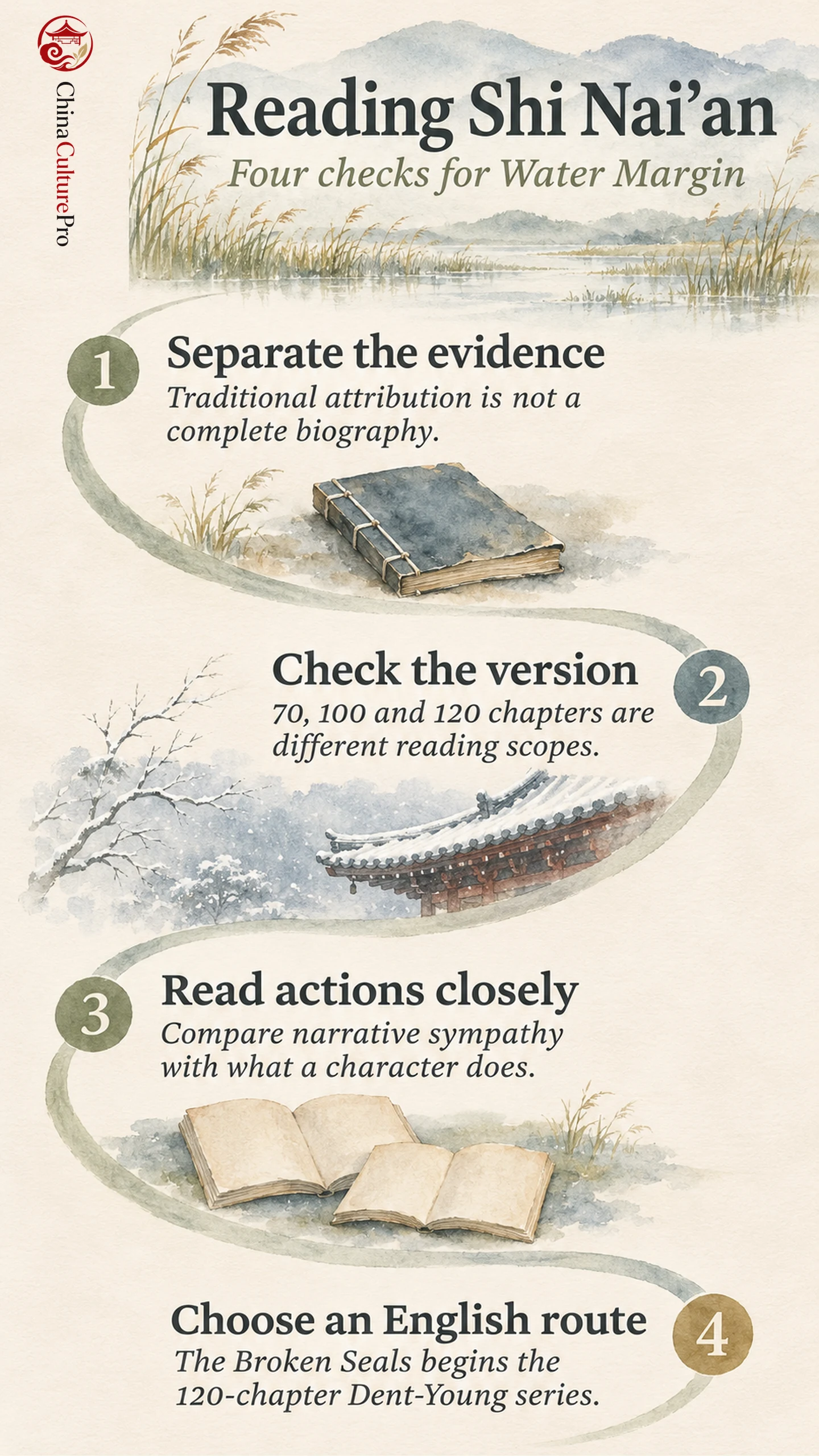
For the story and its principal characters, see our Water Margin guide. Here the focus is what the author’s name means and how that affects a first reading.
Traditional Attribution and the Limits of Biography
William C. Hedberg’s study describes the scarcity of reliable evidence about Shi’s role. It also examines how Japanese writers in the Meiji period and Chinese writers in the late Qing helped shape a recognizable author figure. Stories about the writer can therefore have a history of their own.[1]
The Dent-Young edition credits both Shi and Luo Guanzhong (罗贯中, Luó Guànzhōng). That records a publishing attribution, not a proven collaboration.[2]
Our Luo Guanzhong reading guide introduces the other name readers encounter.
Why the Chapter Count Matters
A familiar title can conceal substantially different reading experiences. These are versions of the same novel tradition, rather than three independent books written by Shi.
| Version evidence | What the reader should check |
|---|---|
| USC records an illustrated 70-chapter edition from 1657 with commentary by Jin Shengtan (金圣叹, Jīn Shèngtàn).[4] | Commentary and editorial shaping belong to the book’s transmission. |
| The Chinese text used for the episode below is labelled a 100-chapter version.[5] | Confirm the version before comparing chapter references or endings. |
| The Dent-Young series translates a 120-chapter version; its fifth volume covers chapters 91–120.[2][3] | Later campaigns and the ending require more than the opening volume. |
Do not read a claim of completeness without asking which version it means. A complete shorter version and an abridgment of a longer one are different editorial choices.
Reading Lin Chong Beyond the Hero Label
In chapter 10, Lin Chong (林冲, Lín Chōng) survives because snow collapses his shelter, sending him to a temple. There he overhears the men responsible for an arson plot against him; he kills the three conspirators. The narrator presents his survival as heaven protecting a worthy man.[5]
Yet the chapter continues: after receiving shelter elsewhere, Lin attacks his hosts when they refuse to share their wine. Read those actions beside the narrator’s sympathetic framing. A victim of official abuse can also inflict harm on people outside the original conspiracy.[5]
Track three things as you read: who suffers injustice, whose violence receives narrative justification, and whose suffering gets less attention. These questions make brotherhood and revenge more interesting than a simple catalogue of admirable heroes.
Starting Water Margin in English
- The Broken Seals: John Dent-Young and Alex Dent-Young’s 1994 translation is Part One of The Marshes of Mount Liang. It contains the first 22 chapters of the 120-chapter version, including much verse. Start here for the sequence’s opening; it is not the whole novel.[2]
- The Water Margin: Outlaws of the Marsh: Tuttle’s 2024 edition credits J. H. Jackson as translator and Edwin Lowe for the introduction. Check the contents of the particular copy before assuming its scope matches the Dent-Young sequence.[6]
FAQs About Shi Nai’an
Are Water Margin and Outlaws of the Marsh different novels?
They are English titles associated with the same Chinese novel. Translation titles alone do not identify the underlying chapter version.[2][6]
Is the novel a direct record of Song history?
Read it as fiction with historical settings and later textual transmission. Use the distinction between history and legend when moving from its scenes to claims about real events.
Does the story treat every outlaw as admirable?
No. Chapter 10 alone lets a reader see both persecution and troubling conduct in the same character. Sympathy for an outlaw need not settle every moral question about his actions.[5]
出典
[1] William C. Hedberg, Arizona State University. William C. Hedberg, 2019, authored study abstract on the construction of Shi Nai’an’s author image
[2] Columbia University Press. Columbia University Press, The Broken Seals, CUHK Press edition details
[3] The Chinese University of Hong Kong Press. CUHK Press, The Scattered Flock
[4] University of Southern California Libraries. USC Chinese Rare Books, indexed Water Margin edition record
[5] Water Margin, Wikisource. Water Margin, 100-chapter Chinese text, chapter 10
[6] Tuttle Publishing. Tuttle Publishing, The Water Margin: Outlaws of the Marsh, 2024 edition