
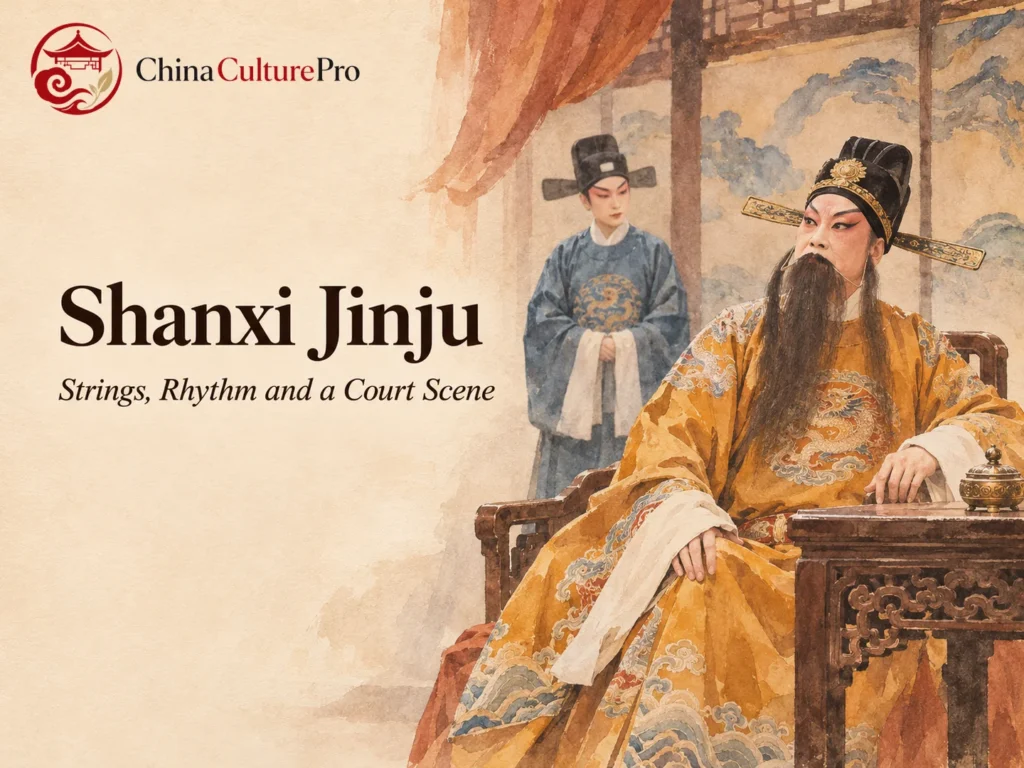

Quick Answer: What Is Shanxi Jinju?
Jinju (晋剧, Jìnjù), also called Central Route Bangzi (中路梆子, Zhōnglù Bāngzi), is an opera tradition from central 山西省. Strings carry the melody, and percussion can mark an entrance or a change of pace.[1][2]
- Region: The form developed in central Shanxi and spread into neighboring regions.[1][2][3]
- Sound: Listen for sustained strings against the short attacks of the clapper and gong.[1]
- First viewing: A film of a court dispute preserves a prominent performer in the role of the Tang emperor.[5][6]
In the film, compare the emperor’s spoken response with the way Ding sustains a sung phrase.

A dispute within the emperor’s family becomes a matter for the court. Ding plays a ruler whose composure is part of his response.
Why It Is Called Central Route Bangzi
The route in the name refers to the central part of Shanxi. The heritage register traces the form to the arrival of Puzhou Bangzi in the Jinzhong area in the Qing, where its music met local songs and dance tunes. The heritage account also credits Shanxi merchants and local writers with helping the new form develop.[1][2]
Puzhou Bangzi remained a regional form in its own right. The Jinzhong tradition developed a repertoire and performance practice of its own and reached central and northern Shanxi and parts of neighboring provinces.[1][2]
Listen to the Strings and Percussion
The traditional ensemble divides melodic playing and percussion into two sections. The huhu (呼胡, hūhú) fiddle and other strings carry the melody around the singer. Clappers, cymbals and gongs are part of the percussion section. The guide to Chinese musical instruments introduces the larger families.[1]
Listen for the difference between a phrase that follows a close pulse and one that opens out more freely. The national listing identifies several patterns in the main vocal repertory. The movement between them lets performers give a scene momentum or hold the audience’s attention on a word.[1]
How Ding Guoxian Played the Emperor
Ding Guoxian (丁果仙, Dīng Guǒxiān) was among the early women to become prominent in Jinju. Her work in mature male roles combined resonant singing, clearly articulated speech and economical movement. In the 1955 film of Striking the Princess (打金枝, Dǎ Jīnzhī), she plays the Tang emperor.[1][4][5][6]
The emperor has to respond to a quarrel between the princess and her husband. Watch how Ding uses a pause or a settled posture when the argument moves to her character. The broadcast excerpt also credits Niu Guiying as Empress Shen.[5][6]
FAQs About Shanxi Jinju
Are Jinju and Jingju different forms?
Yes. Jinju is the central Shanxi form. Jingju (京剧, Jīngjù) is the Chinese name for Peking opera and refers to a separate tradition. The Chinese characters distinguish the names on a program.[1]
Is Jinju performed outside Shanxi?
Yes. Jinju reached Hohhot by the late Qing and early Republican period. The Hohhot heritage entry describes a stage speech that draws on Shanxi, Beijing and local forms.[3]
出典
[1] China Intangible Cultural Heritage Network. Jinju in Shanxi
[2] China Intangible Cultural Heritage Network. Jinju in Jinzhong
[3] China Intangible Cultural Heritage Network. Jinju in Hohhot
[4] 中国無形文化遺産ネットワーク. Jinju on the Loess Plateau
[5] CCTV. Striking the Princess Across Opera Genres
[6] CCTV. Striking the Princess Film Excerpt