


Quick Answer: What Is Shanghai Cifangao?
Cifangao (粢饭糕, cí fàn gāo) is a savory Shanghai breakfast cake made by pressing cooked rice into a slab, chilling it, then frying cut pieces until golden.[2]
- Its centre retains the texture of compressed rice rather than smooth dough.
- A modest addition of glutinous rice can help a household batch hold together.[1]
- Refrigeration sets the slab; leaving cooked rice on the counter overnight is unsafe.[4][5]
This guide uses one shallow-fried home version; rice ratios and seasonings differ between recipes.
The appeal is the contrast: a thin, crisp exterior gives way to a tender rice centre. Within Shanghai cuisine, it belongs to the breakfast-snack side of the table rather than the sweet dessert course.[2]
Rice, Ratios and the Texture You Want
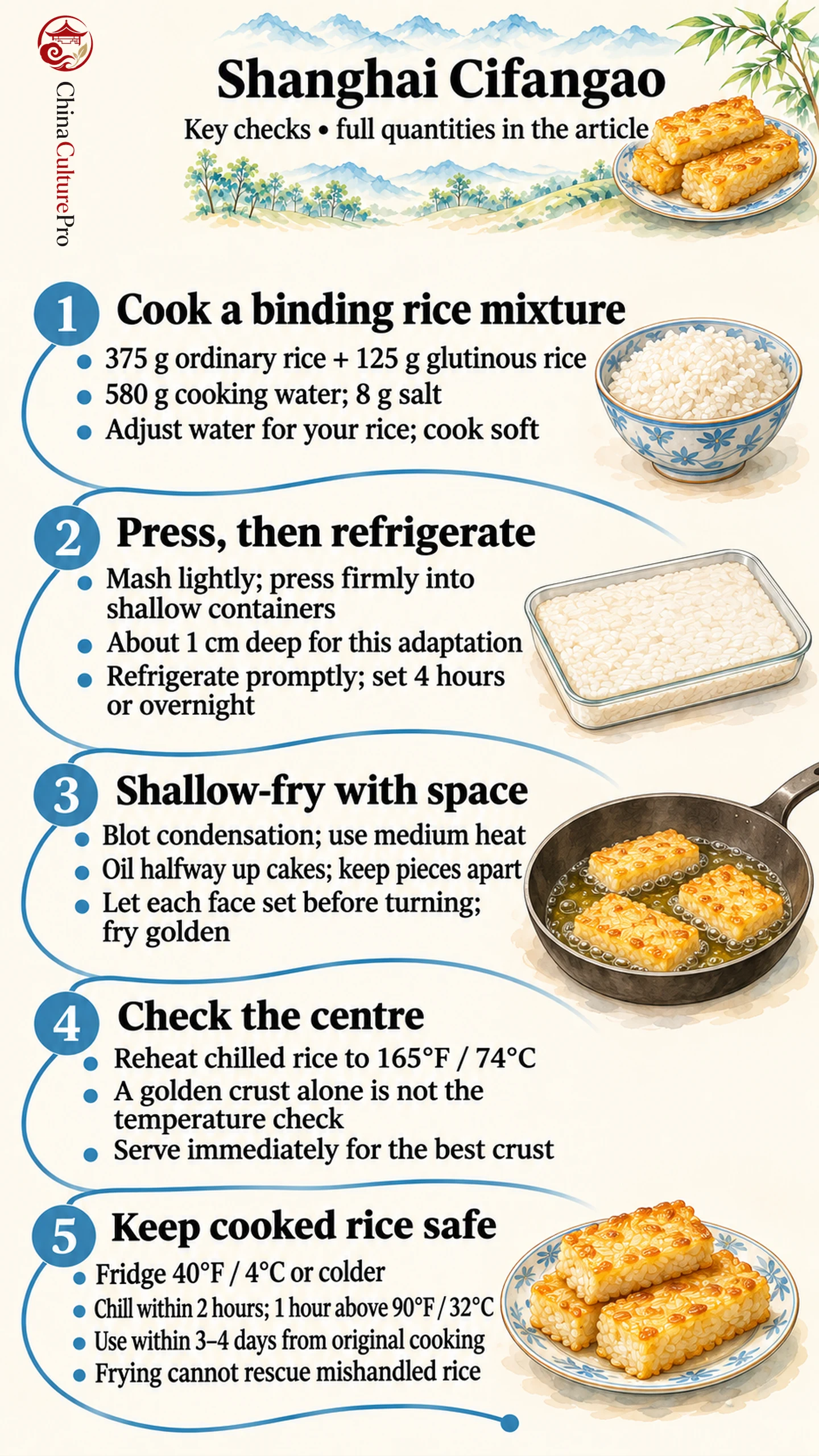
Use 375 g ordinary rice, 125 g glutinous rice, 580 g cooking water and 8 g salt. Adjust water for your rice; aim for soft, mashable grains.[1]
Glutinous describes the sticky rice variety. It does not mean that this dish is made from wheat gluten. Keep the identity separate from niangao (年糕, nián gāo), the broader rice-cake family often made into a smooth dough, and cifantuan (粢饭团, cí fàn tuán), a filled Shanghai breakfast rice roll. For the wider distinctions, see Chinese rice-cake varieties.
A Measured Shallow-Fried Version
Have a rice cooker, an oiled shallow heat-safe container, a knife, a heavy pan and neutral cooking oil ready.
- Rinse the rice. Add the measured cooking water and salt, then cook until soft.
- Mash the hot rice lightly until sticky. Press firmly into oiled shallow containers. For this adaptation, spread the rice about 1 cm deep, using more than one container if needed.[1][4]
- Refrigerate promptly. Let the slab set for at least four hours or overnight inside the refrigerator.[1]
- Unmould and slice into manageable bars. Lightly oil the knife if it sticks; blot surface condensation before frying.
- Heat oil over medium heat, using enough to reach halfway up the cakes when added. Space pieces apart. Let the first face set, roughly two to three minutes, then turn. Once both faces set, keep turning until golden.[1]
- Check that the centre reaches 165°F/74°C when reheating the chilled rice. Drain and serve immediately; a crisp surface alone does not establish the centre temperature.[6]
A serving of Chinese soy milk makes a useful breakfast pairing.
Plain and Seasoned Shanghai Styles
Two documented approaches show how seasoning changes without changing the basic pressed-rice identity:
- Plain salted: rice, salt and cooking oil produce the straightforward savory version.[2]
- Seaweed and scallion oil: another Shanghai recipe mixes seaweed powder, salt and scallion oil into the rice before shaping.[3]
These are recipe variations, not a fixed division between neighborhoods or an exhaustive map of Chinese regional food.
Cooling, Storage and Troubleshooting
Refrigerate promptly in shallow containers at 40°F/4°C or colder. Never leave the cooked rice out for more than two hours, or one hour above 90°F/32°C. Use refrigerated leftovers within three to four days, counting from the original cooking.[4]
Rice can carry spores that survive cooking and produce heat-stable toxins during prolonged warm storage. Frying cannot reliably rescue rice that has been mishandled.[5]
Crumbling suggests poor binding, loose pressing or incomplete chilling. To prevent sticking, separate pieces and let the crust set before moving them. Avoid an overly hard crust.[1]
FAQs About Shanghai Cifangao
Is glutinous rice essential?
No. A plain-rice recipe also works; the mixed-rice batch here is one household option.[2]
Can cifangao be made with leftover rice?
Only consider rice that was cooled and refrigerated safely. A loose, dry leftover batch may need a different shaping approach; do not assume this dry-rice formula can be applied to an arbitrary weight of cooked rice.[4][5]
Is it the same as stir-fried rice cake?
No. This recipe fries pieces of pressed cooked rice. Shanghai stir-fried rice cakes are a separate dish using sliced cakes tossed with other ingredients.
出典
[1] hey_its-me. 粢饭糕
[2] Touch Shanghai. Lockdown delicacies from government gift packs
[3] Shanghai government recipe via The Paper. 油墩子、葱油饼、排骨年糕……这些上海传统小吃在家也能做
[4] USDA FSIS. How do I handle leftovers safely?
[5] Centre for Food Safety. Bacillus cereus in Fried Rice
[6] FoodSafety.gov. Leftovers: The Gift that Keeps on Giving