

Quick Answer: Who Is Samantabhadra Puxian?
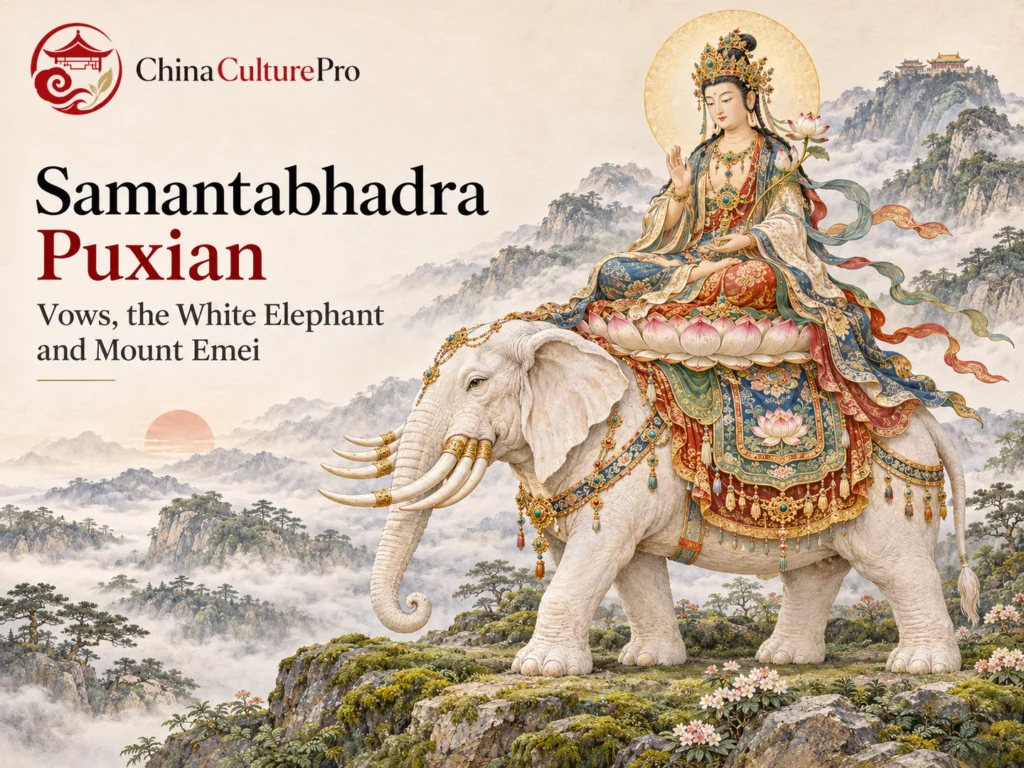
Samantabhadra (普贤, Pǔxián) is a bodhisattva associated with vows and their practice in Chinese Buddhism. Artists often show him seated on a white elephant. Mount Emei (峨眉山, Éméi Shān) in Sichuan is a major center of devotion to him.[1][3][5]
- Vows: A Flower Garland text records commitments that include honoring the buddhas and dedicating merit.[3][4]
- Image: The Lotus Sutra describes a white elephant with six tusks.[2]
- Place: Temples on Mount Emei preserve the mountain’s association with Puxian.[5]
The vows, mount and mountain connect the same figure with different religious practices.

Samantabhadra (普贤, Pǔxián) can be recognized by a white elephant in many Chinese works. His role becomes clearer when the image is read beside texts that describe what a bodhisattva promises and does.
What Samantabhadra’s Vows Describe
The closing section of one Chinese version of the Flower Garland Sutra, translated by Prajña, presents ten great vows. They include honoring the buddhas, making offerings and dedicating the merit of practice. The list gives the reader examples of how an aspiration can guide action for the benefit of others.[3][4]
How to Read the White Elephant
In the final chapter of the Lotus Sutra, Samantabhadra promises to appear riding a white elephant with six tusks to protect and encourage people who preserve and recite the scripture. The elephant carries him into a scene of care for the scripture and its readers.[2]
A Chinese poplar sculpture in the Asian Art Museum, dated about 1300–1400, shows the figure seated on an elephant. In a late Tang scroll in Cleveland, the elephant distinguishes Samantabhadra from Manjushri on a lion. The mounts can help read the relationship among figures in a larger assembly.[1][6]
Why Mount Emei Matters
Mount Emei (峨眉山, Éméi Shān) in Sichuan is one of China’s sacred Buddhist mountains. Tradition connects it with Samantabhadra’s teaching, and temples there display images of him. In Chinese Buddhist pilgrimage, the mountain gives devotion to the bodhisattva a place in the physical landscape.[5]
FAQs About Samantabhadra Puxian
Are Puxian and Samantabhadra the same figure?
Puxian is the Chinese name for the bodhisattva Samantabhadra discussed here.
Why does the elephant have six tusks?
The six-tusked white elephant appears in the Lotus Sutra’s account of how Samantabhadra promises to support people who uphold it.
Where do the ten great vows appear?
They appear in the concluding portion of Prajña’s Chinese translation of a Flower Garland text. Other traditions preserve related versions of the aspirations.
出典
[1] Asian Art Museum. The Bodhisattva Samantabhadra on an Elephant
[2] Bukkyō Dendō Kyōkai. The Lotus Sutra, Chapter XXVIII
[3] Institute of Buddhist Studies, Pacific World. Studies on Chinese Buddhist practice and the vows of Samantabhadra
[4] Tsadra Foundation, Bodhicitta. Chapter Ten: Dedication
[5] Chinese Academy of Sciences. Emei Mountain and Giant Buddha of Leshan
[6] Cleveland Museum of Art. Shakyamuni Triad: Buddha Attended by Manjushri and Samantabhadra