


Quick Answer: What Is the Qingming Poem About?
Qingming (清明, Qīngmíng), traditionally attributed to Du Mu (杜牧, Dù Mù), presents a rainy festival-season journey and a search for a wine shop. It is a seven-character quatrain (七言絕句, qīyán juéjù), with four lines and 28 characters.[1][3]
- The opening: Persistent rain frames the traveler’s overwhelming low spirits.
- The exchange: A polite question about a wine shop receives an answer through a child’s pointing gesture.
- The destination: Apricot Blossom Village (杏花村, Xìnghuā Cūn) offers a direction and the prospect of refuge, rather than a narrated arrival.
The traditional author attribution is debated, and the poem alone cannot establish an exact village, composition date or autobiographical itinerary.[3][4]
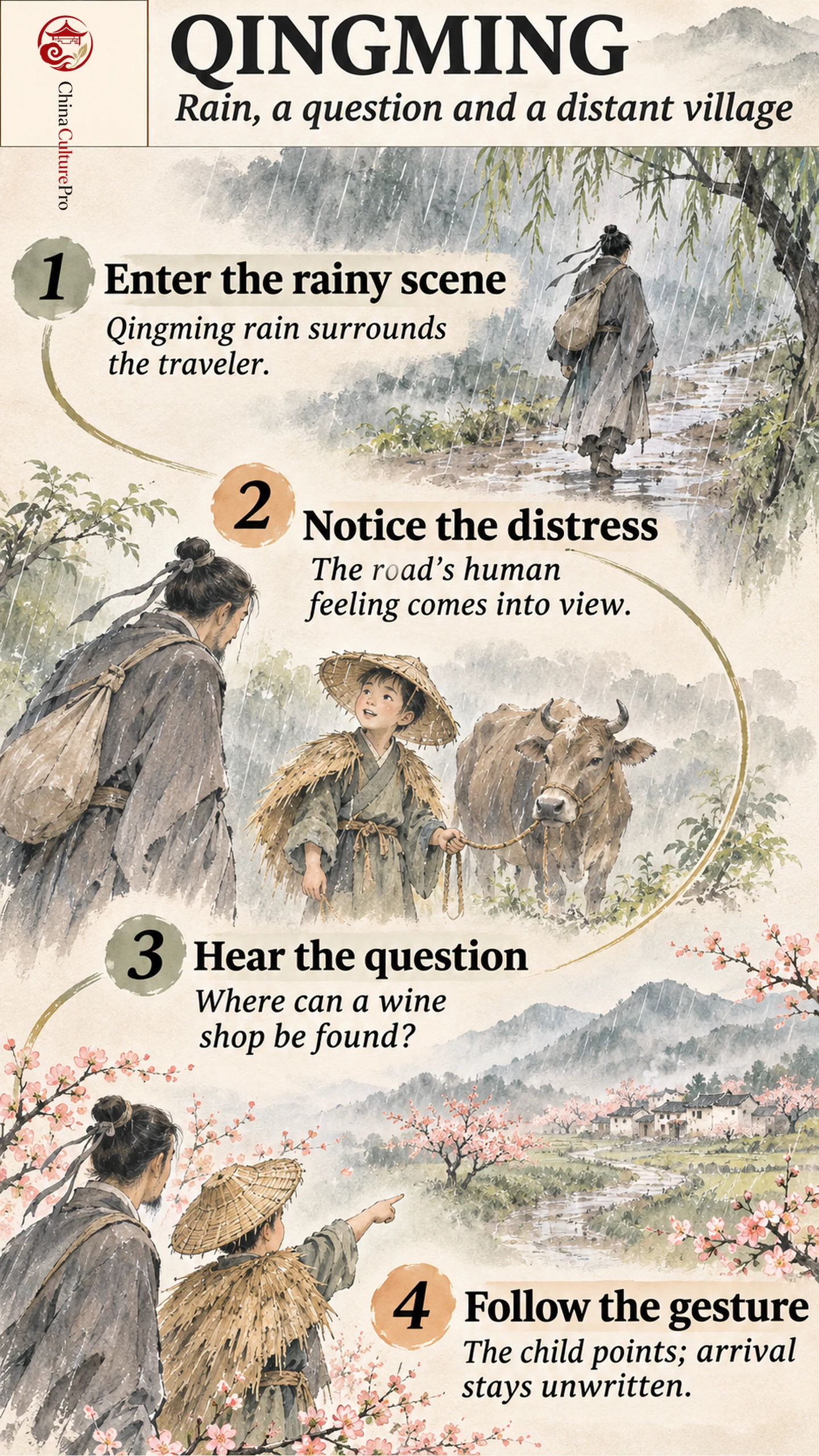
Rain and distress occupy the opening; a question and a pointing gesture occupy the close. This familiar four-line poem moves toward the possibility of comfort without taking the traveler all the way there. Its final village remains distant enough for the reader’s imagination to enter.
The Complete Poem and an English Sense Translation
The following original English rendering follows the complete received Chinese text. “Wine shop” can also be rendered “tavern” in this setting.[1][2]
| Chinese line | English sense translation |
|---|---|
| 清明時節雨紛紛, | Around Qingming, rain falls thick and steadily; |
| 路上行人欲斷魂。 | the traveler on the road is nearly overcome with sorrow. |
| 借問酒家何處有? | “Could you tell me where to find a wine shop?” |
| 牧童遙指杏花村。 | A herding child (牧童, mùtóng) points far away toward Apricot Blossom Village. |
The last line gives a physical gesture in place of a quoted spoken answer. Translating it as a lengthy reply would add words and explanations absent from the poem.
The Festival Setting and Traditional Attribution
清明節 falls in early April, around the opening of the same-named period among the 24 solar terms. Its traditions include remembrance at family graves as well as spring outings. Those associations help readers understand the emotional atmosphere.[2]
But festival context and narrated action are different things. The poem shows someone on a road; it does not describe a grave, an offering or a specific deceased relative. Qingming traditions provide a cultural background without supplying missing events.
The poem is transmitted in the Thousand Masters’ Poems (千家詩, Qiānjiā Shī) anthology tradition. University and education commentaries note its absence from major collections of Du’s work and from the Complete Tang Poems, which has prompted doubts about the familiar attribution.[3][4] “Traditionally attributed” preserves that distinction without claiming that a different author has been conclusively identified.
From Falling Rain to the Traveler’s Distress
The first line establishes a surrounding condition: rain continues across the scene. The second brings that atmosphere into relation with a person. The image of a soul nearly breaking (欲斷魂, yù duànhún) expresses intense distress, rather than reporting a literal death.[1][2]
The cause of the feeling remains open. Seasonal remembrance, traveling away from home and the discomfort of rain can all shape a reading, but the verse does not provide a detailed personal explanation.
The rain also remains this poem’s weather. Turning the line into a rule that Qingming always brings rain would confuse a literary scene with a forecast.
A Question Answered by a Distant Gesture
“May I ask” (借問, jièwèn) changes the poem from description into an encounter. The question seeks somewhere practical to go. The child’s response is economical: an arm points outward, and the reader’s attention follows it.[1][2]
The word “far” matters. It creates space beyond the immediate rainy road, rather than placing the traveler inside a tavern. The village name adds the visual possibility of apricot blossoms, softening the mood without requiring the rain to stop.
Teaching notes allow several readings of the name: a village called Apricot Blossom Village, a settlement among apricot blossoms, or an establishment bearing that name.[2] None of those possibilities authenticates a modern site. The final line’s function is to suggest a reachable direction and leave the next action unwritten.
How to Read the Open Ending
- Separate setting from event: Let the festival supply context without inventing a completed grave visit.
- Follow the change in focus: Move from rain to the distressed traveler, then to the question.
- Watch the answer: Read the child’s pointing as a response, even though no reply is quoted.
- Stop where the poem stops: Imagine the distant village without adding a drinking scene or a guaranteed emotional recovery.
FAQs About Qingming by Du Mu
Is Apricot Blossom Village a proven location?
The poem gives no province, coordinates or verifiable route. Its village can be read as a name or a descriptive expression, so a modern place’s association with the poem does not settle its original location.
Has the traveler just visited a grave?
The festival makes that association understandable, but no grave visit is explicitly narrated. The traveler’s precise circumstances are left unstated.
Does the poem end with drinking at the tavern?
It ends with the child pointing toward the village. Drinking, shelter and relief may be imagined afterward; they are not completed actions in the text.
出典
[1] Chinese Wikisource. Qingming, received text in the Thousand Masters’ Poems tradition
[2] National History Education Centre (Hong Kong), supported by SCOLAR. Qingming teaching plan: text and vocabulary notes
[3] University of Geneva. Du Mu, Qingming: textual notes and transmission
[4] Huang Kun-yao, Education Bureau seminar materials. Appreciating Classical Chinese Works III, Qingming section