

Quick Answer: What Is Qianliang Tea?
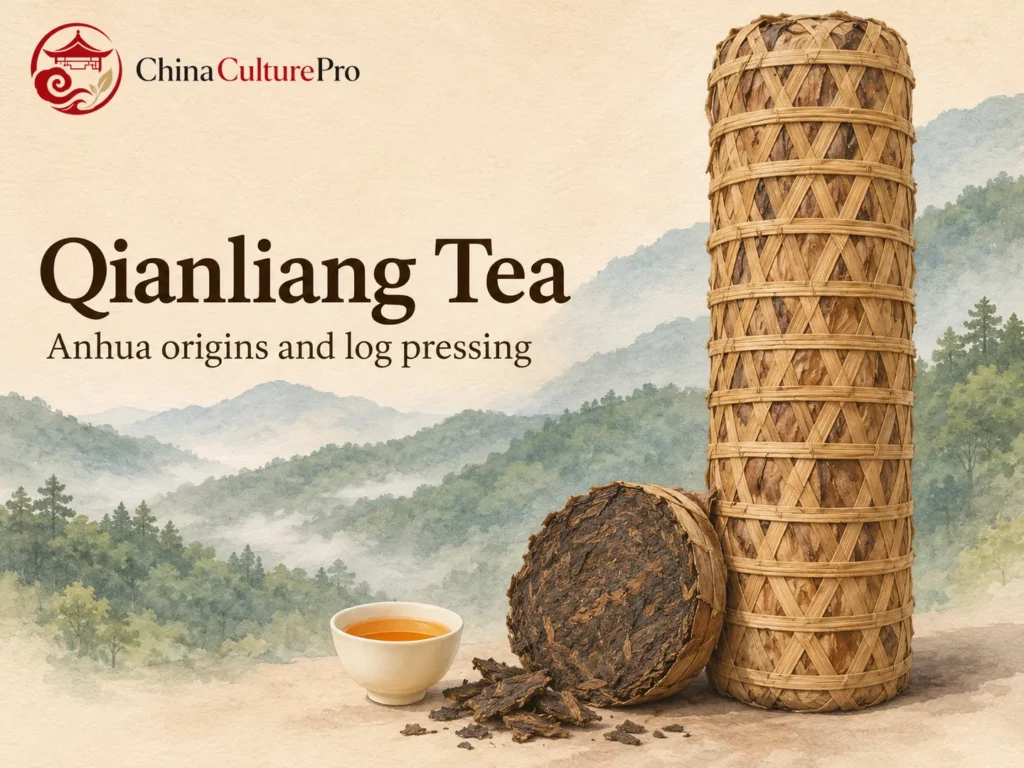
Qianliang tea(千两茶,qiānliǎng chá)is an Anhua dark tea traditionally compressed into a large, bamboo-bound cylindrical log.[1]
- 産地: Anhua County, Hunan.
- Name: “Thousand liang” refers to an older weight convention; a traditional full-size modern product is 36.25 kg.
- Making: Dark-tea manufacture comes before steaming, binding, compression and drying.
- Buying: Slices and smaller portions make the tea accessible without purchasing a whole log.[1][4][5]
The log shape identifies a production format, not a fixed age or guaranteed flavor.

Its woven casing is part of the making process, rather than a decorative wrapper added afterward.
Anhua Origins and the Thousand-Liang Name
Qianliang belongs to huajuan tea(花卷茶,huājuǎn chá), the flower-roll family associated with a patterned bamboo casing. A full-size modern product lists 36.25 kg, preserving the older weight convention.[2][4]
The national heritage account describes nineteenth-century development from smaller, hundred-liang cylinders to thousand-liang logs for transport. It lists the Anhua tea-making craft as a national intangible cultural heritage project from 2008.[1]
How Dark Tea Becomes a Bound Log
There are two distinct production stages. First comes the dark-tea base: heat fixation, rolling, pile fermentation(渥堆,wòduī), a second rolling and baking. The resulting material is then sorted and blended for the larger forming process.[1]
A technical patent from the Anhua Tea Association describes a three-layer casing. Closest to the tea are woven liao leaves(蓼叶,liǎoyè); outside them are fibrous palm sheaths, then the bamboo basket. Steamed, softened tea is loaded into this casing, which is tightened as the tea is compressed into a cylinder. The casing is therefore a forming tool.[2]
The bound log is cooled and dried. Traditional accounts describe outdoor sun-and-night exposure, while the patent also records a drying-room option. The documented outdoor method includes turning the logs for even drying and covering them against rain.[1][2]
Flavor and the Effect of Storage
Named products show why a single flavor description is insufficient:
| 例 | Published cup description |
|---|---|
| 2020 Furongshan, Anhua log | Clear orange-gold liquor; sweet, smooth and mellow |
| 2017 Gao Ma Er Xi slice | Reddish amber liquor; woody and mineral notes, a little tobacco and a camphor-like finish |
These descriptions come from the named products’ suppliers.[4][5]
A 2026 aroma study found a shift from greener, fresher notes in earlier-storage samples toward woody, aged and herbal characteristics later. Those observations concern the studied samples, without establishing a universal best drinking age.[3]
Choosing and Brewing a Qianliang Portion
Ask whether the stated year means leaf harvest or final compression. For example, a Qujiang, Anhua batch labeled 2021 was pressed from spring 2020 tea after a year in dry storage. The two dates describe separate stages.[6]
Check those details alongside the growing place using Chinese tea origin labels. For home preparation, a pre-cut slice is easier to portion than a full log. A round cross-section remains a slice of the original column; compare compressed tea shapes separately from tea type.
One published method for the 2017 Gao Ma Er Xi tea uses smaller, loosened pieces:[5]
- Measure 6–8 g for 100 ml of water at 100°C.
- Rinse and pour that water off before the first drinking infusion.
- Steep for 25 seconds, then about 10 seconds for each of the next three infusions.
- Extend later infusions as the leaves open and the liquor becomes lighter.[5]
Use the directions for your actual portion; a compact chunk opens differently from loosened leaf. The guide to tea rinsing explains that preparation step.
FAQs About Qianliang Tea
Is a Round Qianliang Slice a Pu-erh Cake?
No. A round slice can come from a Qianliang column made from Anhua dark tea. Its outline alone does not make it Pu-erh.[1][5]
Must You Buy the Whole Log?
No. Sellers offer cross-cut slices and smaller quantities. Check the portion weight rather than assuming every retail package contains the traditional full log.[5]
Does Older Qianliang Always Taste Better?
No. Storage changes aroma, but the research does not establish a best age for every product or drinker.[3]
出典
[1] China Intangible Cultural Heritage Network. Dark-tea making techniques: Qianliang tea-making techniques
[2] Anhua Tea Association. Qianliang tea production method, patent CN101084771A
[3] Xia, M., et al. Aroma evolution of Anhua Qianliang tea across different storage years
[4] Xiangfeng Tea Group. Qianliang tea: Furongshan product
[5] Xin An Chu. 2017 Gao-Ma Qian Liang Cha
[6] MyTeaPal. 2021 Qian Liang Cha, 2020 Spring