


Quick Answer: Who Was Ni Zan?
Ni Zan (倪瓒, Ní Zàn) was a Chinese scholar-painter from Wuxi, known for sparse landscapes and restrained ink handling.[1]
- Composition: Near and far banks frame an open stretch of water.[5]
- Brushwork: Dry, delicate strokes give forms a quiet presence.[3]
- Works: Six Gentlemen dates to 1345; Rongxi Studio to 1372.[1][2]
Look at the space between forms as carefully as the trees and rocks themselves.
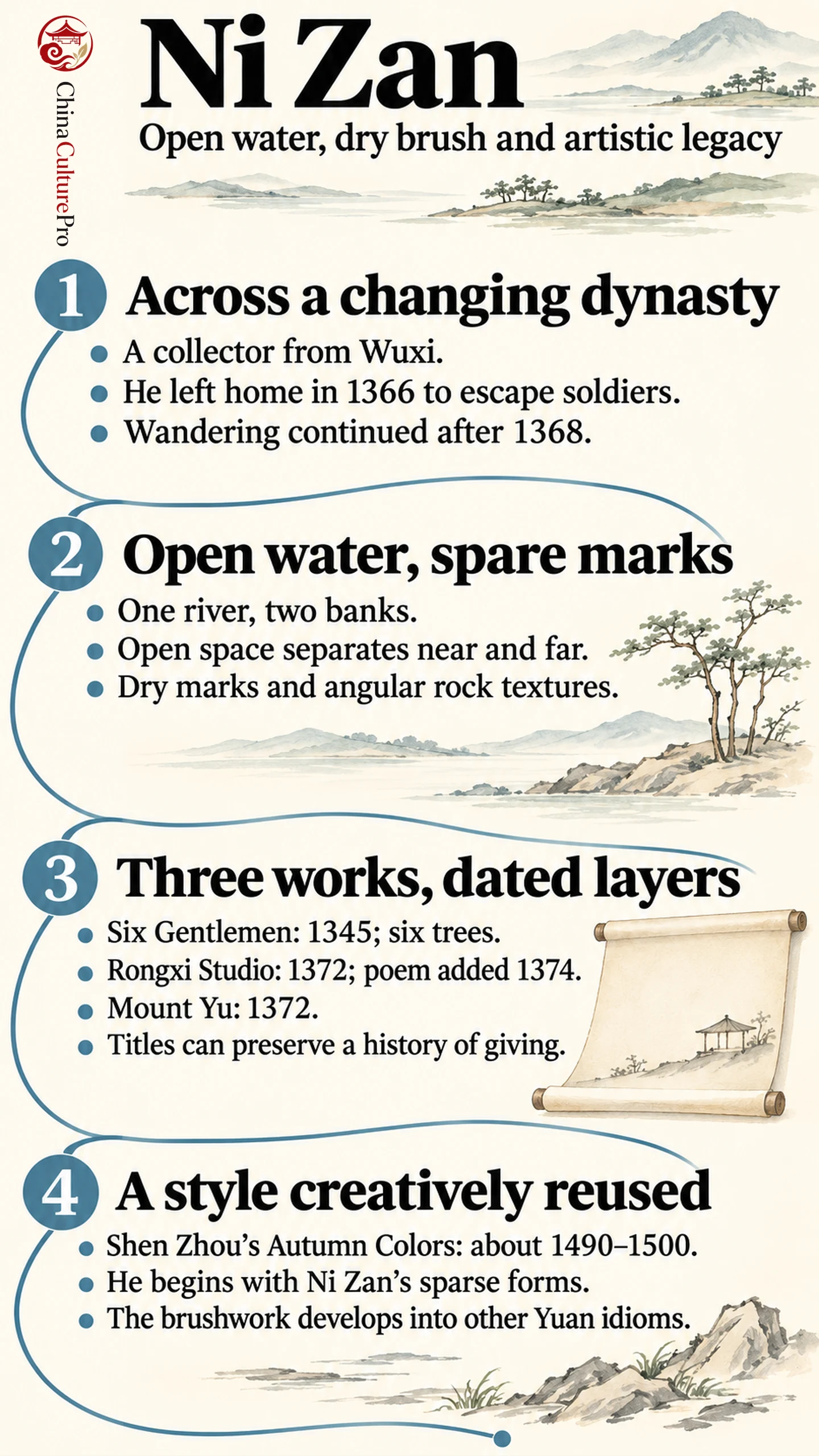
A few trees can anchor a landscape when they stand beside a wide expanse of untouched paper. Ni Zan’s economy makes small differences in ink tone, spacing and brush direction unusually noticeable.
A Scholar-Painter Across the Yuan–Ming Transition
Ni Zan came from a wealthy Wuxi family, collected books and art, avoided official commitments and later wandered the Lake Tai region.[2]
The Four Yuan Masters (元四家, Yuán sì jiā) group him with Huang Gongwang, Wu Zhen および Wang Meng.[4] They became major models within literati painting (文人画, wénrén huà), the scholarly tradition of expressive painting.
His life crossed the end of the Yuan dynasty. In 1366 he left home to escape soldiers and continued wandering after the Ming dynasty began in 1368.[3] His later landscapes belong to this changing world as well as a longer scholarly tradition.
Reading the Open Water and Dry Brushwork
“One river, two banks” (一河两岸, yī hé liǎng àn) describes the arrangement in Rongxi Studio: near land and distant shores surround an open middle space.[5]
Folded-belt texture strokes (折带皴, zhédài cūn) give the rocks angular turns and a restrained surface pattern.[2] Dry brushwork is also central to Woods and Valleys of Mount Yu.[3]
In this kind of landscape painting, follow the near bank, cross the pale water and return to the distant hills. Then compare a broken rock stroke with a darker tree mark. These brush techniques make economy an active visual choice: each mark changes the balance of the surrounding space.
Three Paintings and the Stories in Their Inscriptions
All three works below are hanging scrolls in ink on paper.[1][2][3] Their dates allow comparison across nearly three decades.
| Work | 日付 | Collection and dimensions |
|---|---|---|
| Six Gentlemen | 1345 | Shanghai Museum; 61.9 × 33.3 cm.[1] |
| Rongxi Studio | 1372 | National Palace Museum, Taipei; main image 74.7 × 35.5 cm.[2] |
| Woods and Valleys of Mount Yu | 1372 | Metropolitan Museum of Art; image 94.6 × 35.9 cm.[3] |
Six Gentlemen has six trees on the near bank and dry-brushed mountains beyond. Its title comes from Huang Gongwang’s inscription, which likens the trees to gentlemen facing one another.[1] The title invites a figurative reading of a landscape, rather than a search for six human portraits.
Rongxi Studio was painted in 1372 and received Ni Zan’s further inscription in 1374 for the physician Pan Renzhong.[2] The name refers to Pan’s residence and came from that later text.[5] A painting’s title can therefore preserve a history of friendship and giving as well as a depicted place.
Read the inscriptions and collecting marks alongside the image. Keep the date of the painting separate from later additions, and consider how a gift’s recipient changes its meaning.
Shen Zhou and the Continuing Life of Ni Zan’s Style
In Autumn Colors among Streams and Mountains, made around 1490–1500, Shen Zhou begins with sparse trees, rocks and an empty pavilion associated with Ni Zan. He lengthens the angular rock strokes before moving through the idioms of other Yuan masters.[4]
This is creative reuse of an earlier painter’s vocabulary. Compare how the brushwork changes along the handscroll: the later work can acknowledge Ni Zan while developing a broader range of moods.
FAQs About Ni Zan
Why do Ni Zan’s landscapes leave so much paper open?
In Rongxi Studio, the open area establishes water and distance between two banks.[5]
Does Six Gentlemen depict six people?
No. The “gentlemen” refer to a group of trees through an inscribed comparison.[1]
Was Rongxi Studio painted under the Yuan dynasty?
No. It was painted in 1372, during the early Ming, with a further inscription dated 1374.[2]
出典
[1] Shanghai Museum. Six Gentlemen
[2] National Palace Museum. Rongxi Studio: Object Record and Inscriptions
[3] Metropolitan Museum of Art. Woods and Valleys of Mount Yu
[4] Metropolitan Museum of Art. Shen Zhou’s Autumn Colors among Streams and Mountains
[5] National Palace Museum. The Rongxi Studio: How a Painting Acquired Its Title