


Quick Answer: What Is Mongolian Beef?
Mongolian beef (蒙古牛肉, Ménggǔ niúròu) is a Chinese-American restaurant-style dish of sliced beef, scallions and a sweet, savoury soy glaze.[2]
- A restaurant menu lists sweet soy glaze, garlic and green onion as its defining flavours.[4]
- Crisp versions coat the beef in starch before shallow-frying, then finish it briefly in sauce.[3]
- Chili and tenderising marinades vary between recipes.[2]
Below is one complete small-batch version.
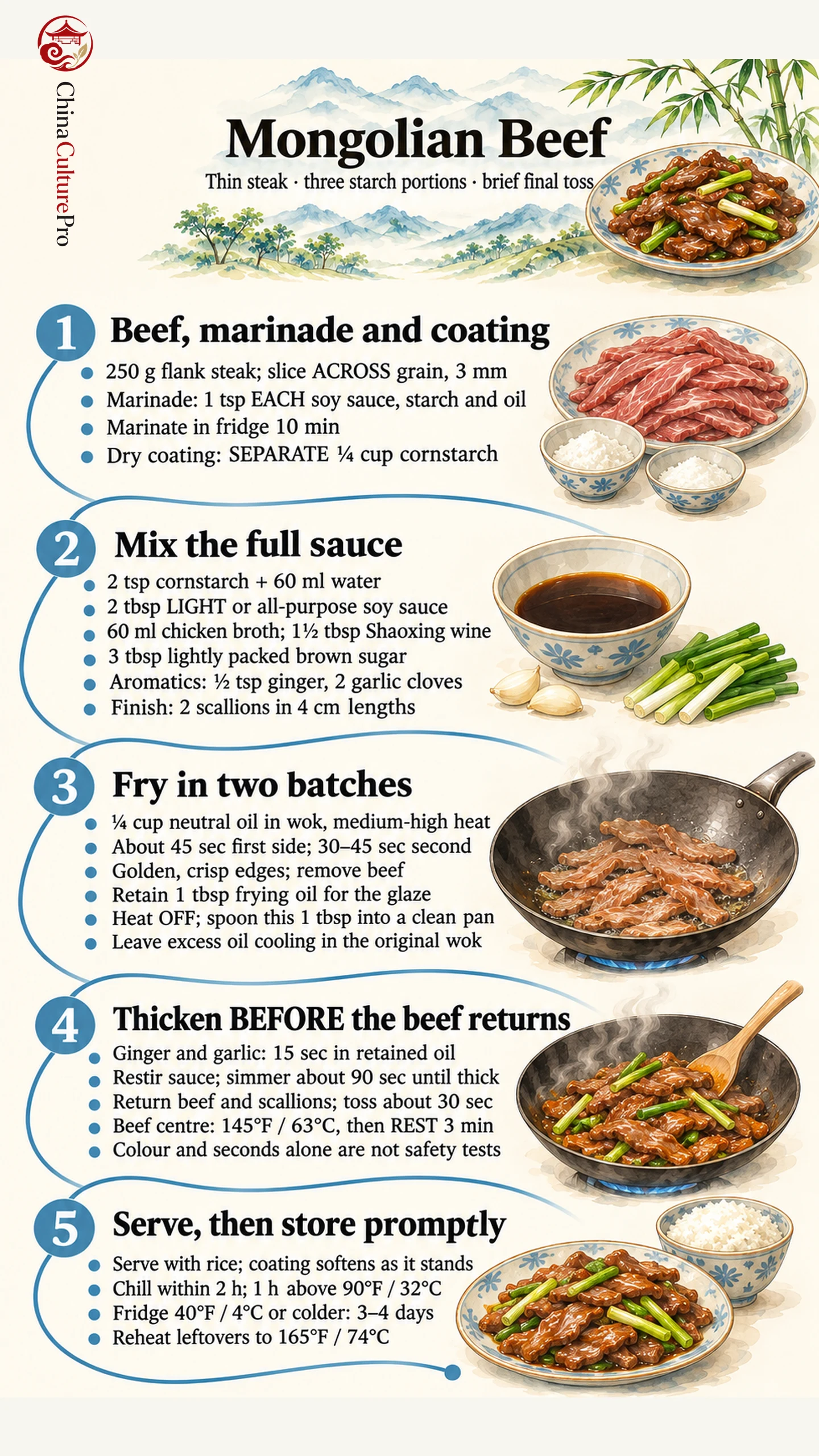
Prepare the rice, sauce and aromatics before heating the oil: the final cooking stages move quickly.
Restaurant Context and Recipe Styles
The dish belongs to the Chinese-American restaurant repertoire. The dish’s name does not establish a traditional Mongolian formula. Recipes differ in the marinade, amount of sugar and final coating.[2]
Two home-cooking approaches illustrate the variation:
- Short-marinated, crisp-coated: Soy, starch and oil precede a separate starch coating; no baking soda is required.[1]
- Longer tenderising marinade: Baking soda joins the wet marinade before coating and frying. The meat preparation guide explains related marinade and coating techniques.[2]
These are preparation choices, not two fixed provincial schools.
Slicing Beef and Protecting the Coating
Look for the long muscle fibres in the steak and cut across them, not parallel to them. A 20–30-minute freezer chill can firm the meat for more controlled slicing; do not freeze it solid. Thin, evenly sized pieces cook more consistently than a mixture of thick chunks and thin scraps.[3]
Work in batches and let each side form a crust before moving it repeatedly. Crowding lowers the effectiveness of the sear; separating pieces also prevents the coating from joining into one mass. See the wok cooking guide for heat and batch control.[3]
Ingredients for a Small Wok Batch
Serves two to three.[1]
- Beef and marinade: 250 g flank steak; 1 tsp each soy sauce (酱油, jiàngyóu), cornstarch and neutral oil.[1]
- Sauce: 2 tsp cornstarch; 60 ml water; 2 tbsp light or all-purpose soy sauce; 60 ml chicken broth; 1½ tbsp Shaoxing wine (绍兴酒, Shàoxīng jiǔ); 3 tbsp lightly packed brown sugar.[1]
- Coating and pan: ¼ cup cornstarch; ¼ cup neutral oil; ½ tsp minced ginger; 2 crushed garlic cloves; 2 scallions in 4 cm lengths.[1]
The marinade starch, dry coating and sauce starch have separate quantities and jobs; do not combine them in one bowl.
How to Fry and Glaze Mongolian Beef
- Slice and marinate. Cut steak across the grain, 3 mm thick. Coat with marinade; refrigerate 10 minutes. Mix sauce starch with some water, then add remaining sauce ingredients.[1]
- Coat and shallow-fry. Coat beef with dry starch. Heat frying oil in a wok over medium-high heat. Fry two uncrowded batches: about 45 seconds on the first side, then 30–45 seconds on the second, until golden and crisp. Remove.[1]
- Cook the glaze. Retain 1 tbsp frying oil. Sauté ginger and garlic 15 seconds; restir sauce, add and simmer about 90 seconds until glossy and thickened.[1]
- Finish briefly. Return beef with scallions; toss about 30 seconds to coat. Serve promptly.[1]
For safer oil handling, switch off the frying heat and use a long-handled metal spoon to transfer the retained tablespoon to a clean second pan for the glaze. Leave the excess oil cooling in the original wok instead of tipping it out during cooking.
Treat frying times and colour as cooking guides, not safety tests. Beef must reach 145°F/63°C in the centre, followed by a three-minute rest; complete this after the final cook before eating.[5]
FAQs About Mongolian Beef
Can I replace light soy sauce with dark soy?
Dark soy (老抽, lǎochōu) is used differently: some versions add a little for colour. Use the specified light or all-purpose soy as the main seasoning rather than replacing its full volume with dark soy.[3]
Is Mongolian beef spicy?
It can be mild. Some recipes include optional dried chilies, while others omit them. For a chili-centred alternative, see Hunan beef for a different flavour profile.[2][7]
Why does the coating turn soggy?
An overcrowded pan, insufficient browning or prolonged time in sauce weakens the crisp contrast. Brown in batches, thicken the sauce first and keep the final toss brief; the coating will soften as it stands.[3]
How should I store leftovers?
Refrigerate shallow portions within 2 hours, or 1 hour above 90°F/32°C. Keep at 40°F/4°C or colder for 3–4 days. Reheat to 165°F/74°C.[6]
出典
[1] Nagi Maehashi. Crispy Sticky Mongolian Beef
[2] Bill Leung. Mongolian Beef
[3] Jennifer Segal. Mongolian Beef
[4] P.F. Chang’s. Chef’s Feast Menu
[5] U.S. Department of Agriculture. Safe Internal Temperatures for Meat and Poultry
[6] U.S. Department of Agriculture. How Do I Handle Leftovers Safely?
[7] Maggie Zhu. Hunan Beef