
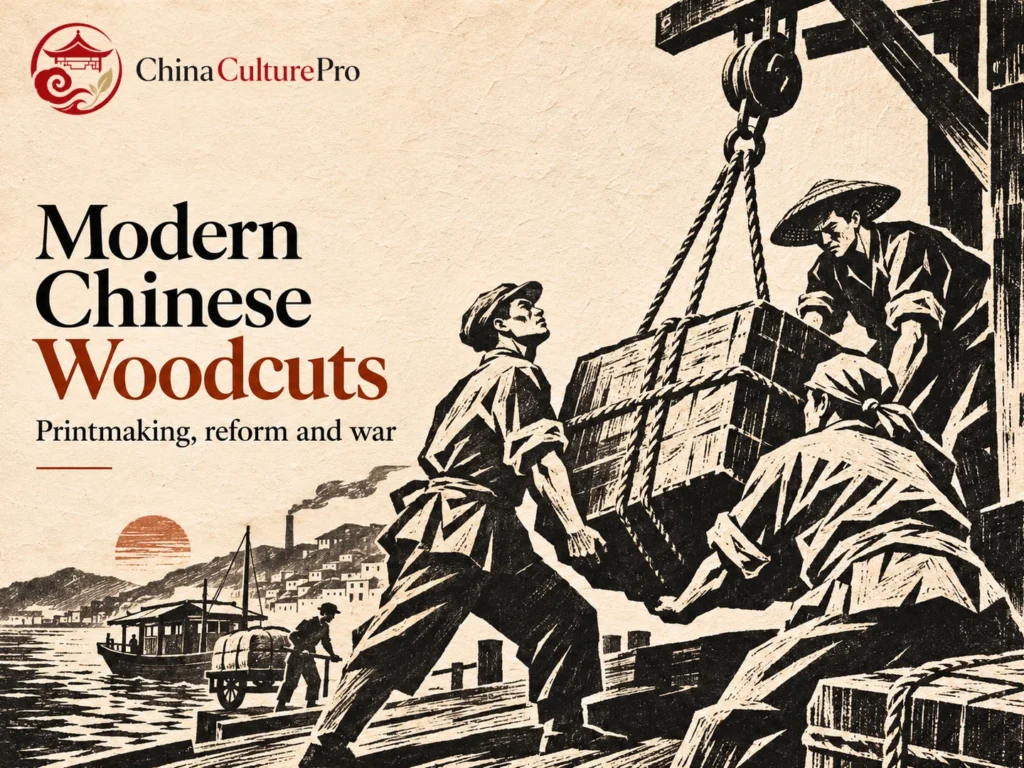

Quick Answer: What Are Modern Chinese Woodcuts?
Modern Chinese woodcuts are relief prints made from carved wooden blocks. The Modern Woodcut Movement (新兴木刻运动, Xīnxīng Mùkè Yùndòng) used this longstanding medium to reach new audiences with images of protest, reform, war and daily life. The writer Lu Xun (鲁迅, Lǔ Xùn) promoted prints and organized a workshop in Shanghai in 1931. [1][2][3][6]
- Method: Ink transfers from raised wood to paper. The carved recesses leave gaps in the printed image. [2]
- Movement: Artists gave strong contrasts and compact compositions a new role in public and political communication. [1][4][5][6]
- Circulation: A block could make multiple impressions, and an image could circulate farther as a reproduction in print. [2][5]
Woodcut had long served publishing, decoration and worship. The movement changed what artists did with the medium and who they expected to see it. [1][8]

Look closely at a dark figure against a white streak. The streak may be where the artist removed wood, leaving the paper unprinted. That simple reversal helps explain the force of many twentieth-century prints, as well as the appeal of the process to artists working in different periods of Chinese art.
What the Carved Block Does
In a black-ink woodcut, an untouched area of the block can make a broad dark shape. Thin cuts can leave pale contours or build a field of sharp marks. Printing reverses the design on the block, something to keep in mind when a work incorporates text. If the artist prints from the same block again, the next sheet is another impression. A picture reproduced in a book can carry the same image without being an impression pulled from that block. [2]
Woodblock printing had many uses before the twentieth-century movement. New Year prints (年画, niánhuà) include images made for seasonal display, such as brightly colored pictures of door gods. Those prints and modern artists’ relief works share a process. Their occasions, imagery and audiences explain why they occupy different places in histories of Chinese folk painting and modern art. [1][8]
Lu Xun and the 1931 Workshop
Lu Xun introduced young artists to woodcuts through exhibitions, printed examples and instruction. At the August 1931 workshop, Japanese teacher Kakichi Uchiyama provided technical guidance. European prints circulated alongside Japanese sources. Hu Yichuan (胡一川, Hú Yīchuān) studied the work of Belgian printmaker Frans Masereel and exhibited his own woodcuts in Shanghai in June 1931, before the August workshop. His career helps put the workshop in context as one event in an active print culture. [1][3][4]
From Protest to Wartime Printmaking
In Roar, China, Li Hua (李桦, Lǐ Huà) used a tightly framed body, bound and blindfolded, to give a political argument a visible form. The work was designed in 1935 and circulated in newspapers. One collection record gives 1938 in its object date field while dating the creation of the image to 1935 in its description. The record leaves the relationship between those dates open. When a design appeared in newspapers as well as on individual sheets, it is worth checking which version a date refers to. [5]
During the War of Resistance against Japan (1937–45), woodcuts appeared in both Communist and Nationalist settings. In Yan’an, artists drew on folk imagery for work made in the Communist base. In Chongqing, prints used stark contrasts in calls for resistance. In Production in the Eighth Road Army, Gu Yuan (古元, Gǔ Yuán) represents work supporting the army. For viewers following a war, images of labor could make production part of the story alongside combat. [1][6]
After 1949: Color, Academies and Experiment
Print departments at art academies gave printmaking a formal teaching setting after 1949. A revival of multicolored woodcuts printed with water-based ink drew on earlier practice. Reprints of decorated seventeenth-century stationery in 1952 are one example of that renewed attention. This history is easy to miss if your first examples are the sharp black-and-white prints of the 1930s. [1]
In Mountain Place (1987), Xu Bing (徐冰, Xú Bīng) explored the process itself. He printed a block at different stages while gradually carving more of it away. Each cut changed what the block could print next. The early dark states survive in the impressions even though the block could no longer print those states after it was cut farther. The changing block became part of the work’s subject, an example of how print processes continued to develop in Chinese contemporary art. [7]
Four Works to Compare
| Work | Artist and date | 見分けるポイント |
|---|---|---|
| To the Front | Hu Yichuan, 1932 | Compare the figure scale with the force of the surrounding dark shapes. [4] |
| Roar, China | Li Hua, design dated 1935 | Look at how binding and blindfold make a single figure carry the argument. [5] |
| Production in the Eighth Road Army | Gu Yuan, cataloged to the 1930s and 1940s | At about 16 by 26 centimeters, the image packs a scene of work into a sheet small enough to handle. [6] |
| Mountain Place | Xu Bing, 1987 | Compare successive states to see how a lighter image follows more carving. [7] |
FAQs About Modern Chinese Woodcuts
Did Lu Xun Invent Chinese Woodblock Printing?
Woodblock printing existed in China for centuries before his workshop. Lu Xun championed artist-made woodcuts for twentieth-century readers and helped younger artists learn the process. [1][3]
Are Modern Chinese Woodcuts Always Black and White?
Many prominent prints from the 1930s use black ink on light paper. Color also has a long history, and artists revived multicolored water-based printing in the decades after 1949. [1][5]
Is Every Printed Copy a Woodcut Impression?
A woodcut impression is made by transferring ink from a carved block. A newspaper, catalog or digital reproduction can show the same image through a different process. [2][5]
出典
[1] The Metropolitan Museum of Art. The Printed Image in China, 8th–21st Century
[2] The Metropolitan Museum of Art. Woodcut
[3] Berkeley Undergraduate Journal. The Knife, the Pen, and the Scalpel
[4] National Art Museum of China. Hu Yichuan: To the Front
[5] CAFA Art Museum. Li Hua: Roar, China
[6] The Metropolitan Museum of Art. Gu Yuan: Production in the Eighth Road Army
[7] Cleveland Museum of Art. Xu Bing: Mountain Place (from series of Repetitions)
[8] The Metropolitan Museum of Art. Woodblock Prints Including New Year’s Pictures