

Quick Answer: What Is Military Philosophy in Early China?
Early Chinese military philosophy includes writings on war and government, along with debates over the conditions under which rulers could claim a right to use force. The Seven Military Classics (武经七书, Wǔjīng Qīshū) became an influential collection in the Song. Mohist (墨家, Mòjiā) arguments and dialogues in the Mencius (孟子, Mèngzǐ) preserve ethical disputes that extend beyond that collection.[1][2][3][4]
- Texts: Later editors brought military works with different histories and concerns into one collection.
- Justification: Some arguments ask whether a ruler has a defensible reason for using force.
- Consequences: Others ask how a ruler’s actions affect the people whose welfare is invoked.[1][3][4][5]
Those questions emerged in particular political settings. They can also help explain why victory and legitimacy receive different treatment in the sources.
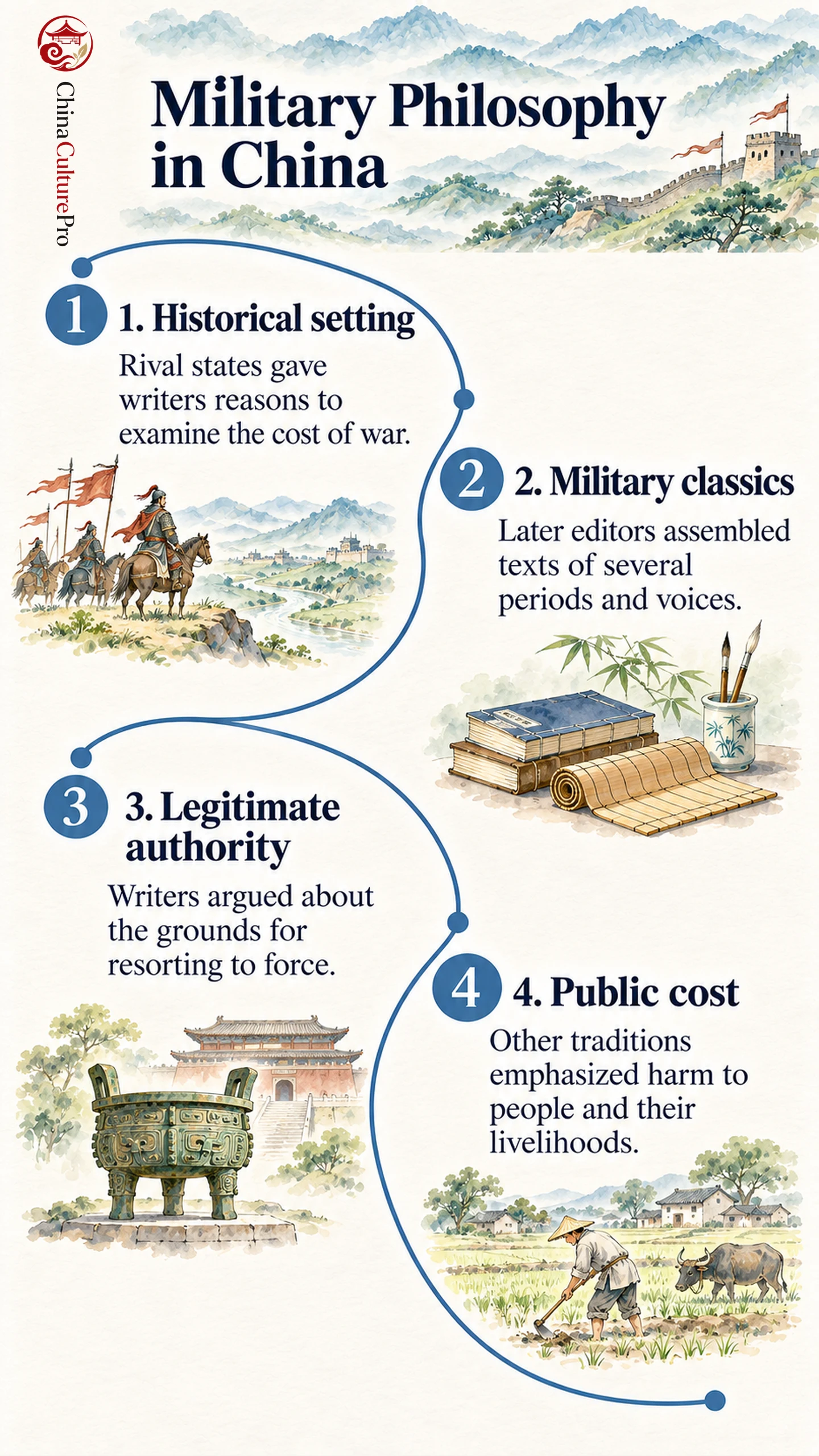
During the Warring States period, competing states placed severe demands on their populations. Writers turned those conditions into arguments about responsibility. Their claims can be read alongside other debates in Chinese political philosophy about who benefits from a ruler’s decisions.[3][5]
What the Seven Military Classics Bring Together
The collection established under the Northern Song includes The Art of War (孙子兵法, Sūnzǐ Bīngfǎ) and other works such as the Wuzi and the Methods of the Sima. The later decision to put them together gave military education a common body of reading. The date of the collection describes that editorial and institutional decision. The individual works came from different periods and have their own histories of attribution and transmission.[1]
The collection is a useful entry into how the responsibilities of rulers and commanders were discussed. Its works address such questions with different emphases. Other sources matter as well. A court dialogue may explore the moral conditions for a ruler’s claim, while an argumentative essay may ask whether war deserves the praise that rulers commonly attach to it. Neither kind of passage needs to belong to the military collection to inform the history of ideas about war.[1][3][5]
Why the Mohists Challenged Aggressive War
In Condemnation of Offensive War (非攻, Fēigōng), an argument begins with actions that readers readily recognize as wrong, such as taking fruit from another person’s garden. It moves toward harms on a greater scale and asks why attacks on other states are then praised. The escalation puts pressure on a moral distinction drawn by status. The authors demand consistency. If harming another for one’s advantage warrants condemnation in a small case, they ask what justifies praising rulers who do it on a larger scale.[2][3]
The wider Mohist writings also consider loss of life and damage to people’s livelihoods. For readers interested in Mozi’s account of universal care, the question is whose losses enter the reckoning. The corpus allows for defense, and scholars discuss passages treating exceptional punitive action as possible. Its opposition to aggression is a strong position with a more complicated boundary than a rejection of every use of force.[2][3]
How Mencius Weighed a Ruler’s Claim to Legitimacy
In Mencius 1B.10, the ruler of Qi has defeated Yan and asks whether he should take it. Mencius makes the response of the people of Yan matter. His answer contrasts the relief people might seek with conditions they might find even worse under a new ruler. The dialogue asks readers to consider the difference between claiming to relieve suffering and actually relieving it.[4][5]
The passage does not set out a modern system for consulting a population. It belongs to an account of rule that includes inherited stories about exemplary kings and concern for the consequences of government. Alongside the Mohist critique, it shows how a claim about the welfare of the people could challenge a ruler’s preferred description of an act.[3][4][5]
FAQs About Military Philosophy in China
Does the Art of War represent all early Chinese military thought?
It is one influential work. The other military classics have their own histories, and the Mohist and Mencian arguments address questions of authority and harm from different perspectives.[1][3][4]
Was Mohism opposed to all force?
Mohist writers condemn aggressive war and make room for defense. Some passages also raise the possibility of punitive action under unusual circumstances, a distinction historians of Mohist thought continue to examine.[2][3]
Why study the later history of the military classics?
The formation of the collection helps explain why those seven works were read together and how they reached later students. Their inclusion in a curriculum is a separate historical fact from when or how any particular text took shape.[1]
出典
[1] University of California San Diego. David K. Jordan, The Military Canon
[2] Chinese Text Project. Mozi: Condemnation of Offensive War I
[3] Chris Fraser, Journal of Chinese Military History. The Mohist Ethics of War
[4] Mencius. Passage 1B.10, with Chinese Text and Translation
[5] Asian Journal of International Law. Ancient China and the Responsibility to Protect