
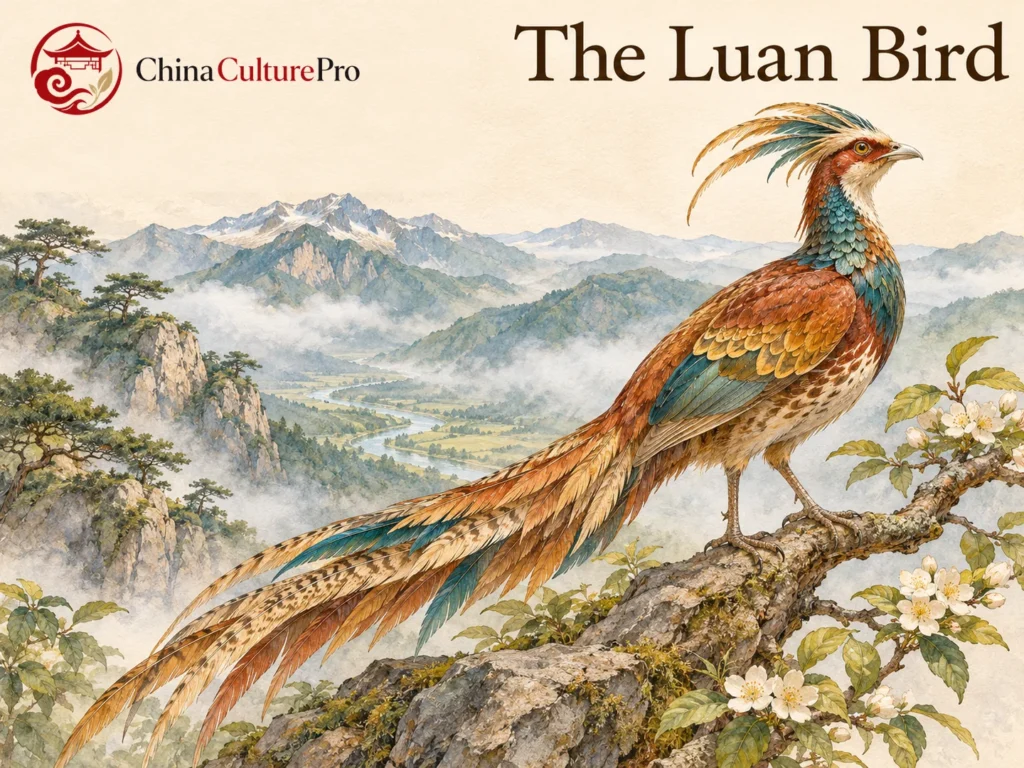

Quick Answer: What Is the Luan Bird?
The luan bird (鸞鳥, luánniǎo) is an auspicious bird in Chinese mythology. The Classic of Mountains and Seas describes a pheasantlike bird at Mount Nüchuang whose appearance signals peace. Other passages associate the luan with song and with the fenghuang (鳳凰, fènghuáng), often called the Chinese phoenix.[1][2][5]
- 外観: The mountain account gives the luan patterned plumage in five colors.
- Omen: Seeing it is associated with peace in the realm.
- Mirror: A poem’s preface tells of a captive luan crying at its reflection.
The bird’s role changes from omen to musical companion to lonely captive across the sources.[1][2][3]

A bird that sings in open country also appears in a story about a silent cage. Those settings explain why the luan can carry several meanings in Chinese writing.
The Luan at Mount Nüchuang
The Western Mountains chapter places the luan at Mount Nüchuang. It compares the bird to a pheasant and describes a pattern in five colors. Its appearance promises tranquility under heaven in the terms of the text. The entry attaches the meaning to the bird being seen, without describing an action that brings about peace.[1]
Mount Nüchuang supplies a specific setting for that omen. A colored bird by itself is a broad visual clue. The mountain name and the promise of peace identify the passage more precisely than feather color alone.[1]
Song, Dance and the Fenghuang
The Classified Collection of Literary Writings preserves a passage about the luan singing in the wilds associated with Xuanyuan. Other selections in the collection connect the bird with music or describe it as the fenghuang’s companion. One account says that it dances in rhythm when it hears music.[2]
The Southern Mountains chapter names and describes a fenghuang separately at Mount Danxue. Both birds can be associated with peaceful rule, but their named mountain entries give them different details. The nine-headed Jiufeng is another distinct bird in the same book. Its human faces belong to its own entry.[1][5]
The Captive Luan and Its Reflection
Fan Tai’s preface to a poem tells of a ruler who captures a luan and tries for three years to hear it sing. Rich food and a decorated cage leave it silent. The ruler’s wife suggests hanging a mirror because birds may call when they see their own kind. The luan sees its reflection and cries out before dying.[3]
The mirror works by offering the appearance of company to a solitary bird. The story uses the call to express grief, quite differently from the music in the auspicious accounts. That is why the phrase “luan and mirror” can evoke solitude even though the bird is associated with peace elsewhere.[2][3]
The Luan on a Bronze Mirror
A Tang bronze mirror in the National Palace Museum has a Chinese title that names luan, beasts and grapevines. The museum describes birds with wings spread and birds at rest around the outer zone, with vines and insects between them. These shapes decorate the back of the mirror.[4]
Fan Tai’s tale depends on the reflection in the polished side. The Tang object preserves imagery on the other side. A museum title can identify a bird motif on an object. It takes further evidence to connect a particular mirror to the literary story of the captive luan.[3][4]
FAQs About the Luan Bird
Is the luan a Chinese phoenix?
The luan is often compared with the fenghuang, and some texts give it a role alongside that bird. The Classic gives the two different names, places and descriptions.[1][2][5]
What does the luan symbolize?
The Western Mountains account associates its appearance with peace. Other texts use its song, dance or reflection to evoke different situations.[1][2][3]
Why is the luan associated with mirrors?
In Fan Tai’s preface, a ruler hangs a mirror for a captive luan. It cries at the sight of what appears to be another bird of its kind.[3]
出典
[1] Chinese Wikisource. Classic of Mountains and Seas, Western Mountains
[2] Chinese Wikisource. Classified Collection of Literary Writings, volume 99
[3] Chinese Text Project. Classified Collection of Literary Writings, Luan
[4] National Palace Museum. Bronze Mirror with Mythical Animals and Grapevines
[5] Chinese Wikisource. Classic of Mountains and Seas, Southern Mountains