


Quick Answer
Li Tieguai (李鐵拐, Lǐ Tiěguǎi), or Iron-Crutch Li, is one of the Eight Immortals (八仙, Bāxiān). A legend explains how he came to inhabit the body of a man who used a crutch. In art, the crutch and a bottle gourd often help identify him.[1][2][3]
- Name: The iron crutch gives Li his familiar title.
- Legend: His spirit returns from a journey to find that his body has been cremated.
- Images: Artists use the gourd to suggest medicine, immortality, or a hidden realm.
The stories and objects give the gourd more than one meaning.[1][3][4]
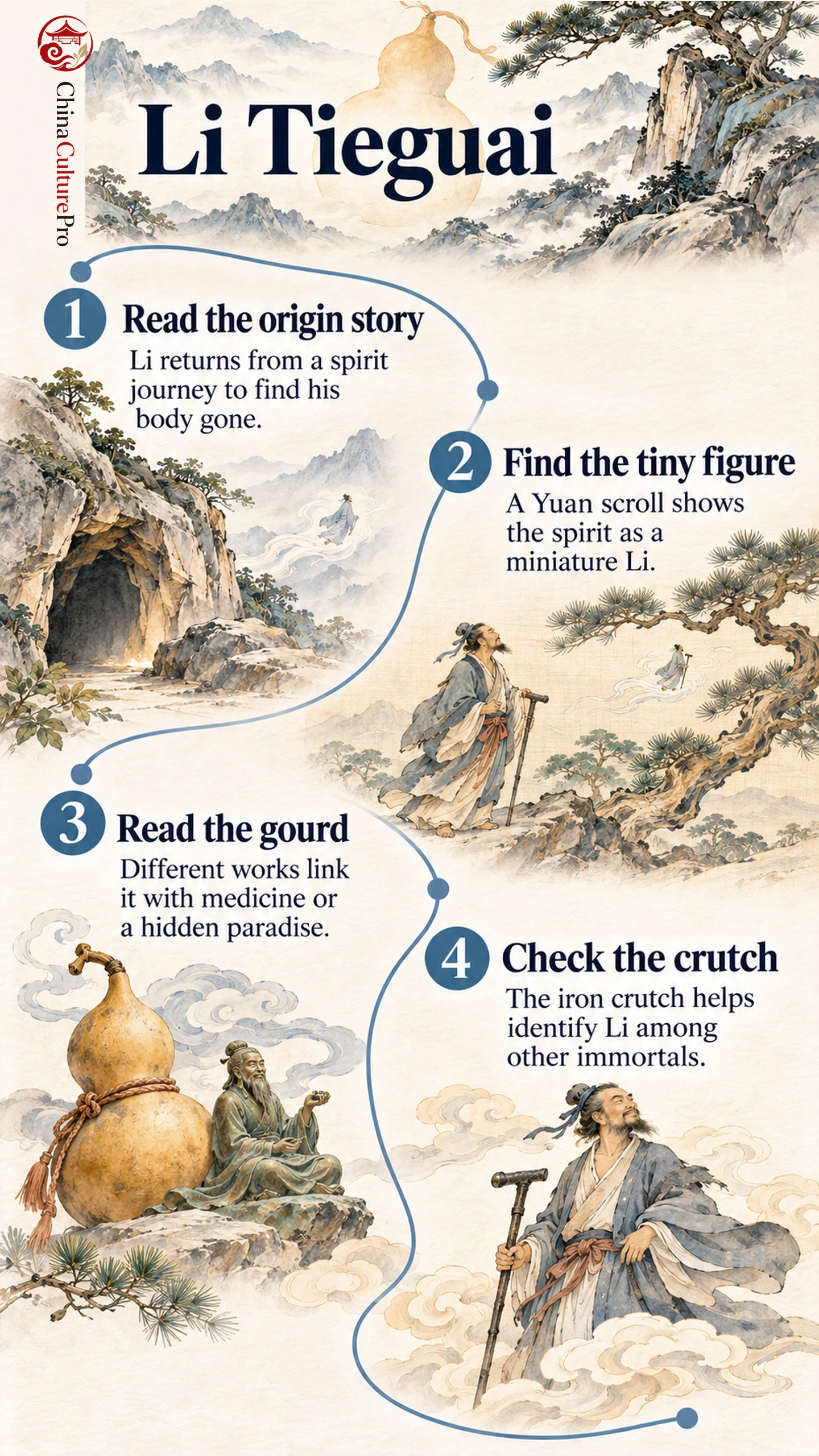
In a fourteenth-century painting, a small figure floats above Li Tieguai while the larger figure leans on a crutch. The painter gives the travelling spirit a miniature body while the larger figure stays grounded.[2]
How Li Acquired the Iron Crutch
In one version, Li leaves his body behind while his spirit journeys. An assistant finds the body motionless, believes the master has died, and cremates it. Li returns to find that he needs another body. The man whose body he takes used an iron crutch, giving Li the name by which he is remembered.[1]
In the story used to explain the fourteenth-century scroll, Li’s spirit visits the deified Laozi (老子, Lǎozǐ). The scroll shows Li after he has taken another body. He blows a tiny likeness into the air, a visual clue to the ability that sets the legend in motion.[2]
What the Gourd Means in Different Works
A sixteenth-century bronze by Su Wennan presents Li with a crutch in his right hand and a ball of medicine in his left. A small gourd hangs at his waist. The museum associates the medicine with the tradition of Li as a patron of physicians, in which he dispenses remedies from a gourd.[3]
In Su Renshan’s ink painting from the late 1840s, a gourd rests on the ground in front of the sleeping immortal. The work’s catalogue connects it with the image of a paradise concealed within. The context changes the emphasis: the bronze puts medicine in Li’s hand, while the ink painting places the gourd beside his sleeping form.[3][4]
How to Recognize Li in a Group
The crutch is the clearest starting point. A pair of Yuan-era scrolls gives Li a crutch and gives the companion figure Liu Haichan a three-legged creature. An attribute can distinguish neighboring figures even when both have a similar scale and are set in the same kind of landscape.[2][5]
In larger groups, read the objects together. A Qing cup, for example, distinguishes Han Xiangzi by his flute. In other works, a gourd may be more visible than a crutch, so compare the objects and group together. The Eight Immortals’ sea-crossing story gives the wider context for the group and the objects its figures carry.[2][6]
FAQs About Li Tieguai
What does Li Tieguai mean?
It means “Iron-Crutch Li.” The name comes from a legend about the body he assumed after losing his own.[1][2]
Why does Li Tieguai carry a gourd?
A gourd can refer to the remedies he gives in legend or to a hidden paradise. The meaning depends on the particular image and its surrounding clues.[3][4]
Why does one painting show two versions of Li?
The tiny figure in the fourteenth-century scroll represents Li’s capacity to send his spirit on a journey. The larger figure remains beside the crutch.[2]
出典
[1] Metropolitan Museum of Art. Daoist immortal Li Tieguai receiving a visitor
[2] Cleveland Museum of Art. Li Tieguai, 1982.29.1
[3] Cleveland Museum of Art. Su Wennan, The Immortal Li Tieguai, 1973.158
[4] Metropolitan Museum of Art. Su Renshan, The Immortal Li Tieguai
[5] Cleveland Museum of Art. Li Tieguai and Liu Haichan, pair of hanging scrolls
[6] Metropolitan Museum of Art. Cup with Eight Daoist Immortals