

Quick Answer: Why Does Chinese Buddhism Call Nāgas Dragons?
A nāga is a serpent-associated supernatural being in South Asian traditions. Chinese Buddhist translations often use dragon (龙, lóng) for nāga and Dragon King (龙王, lóngwáng) for nāgarāja. The translation draws on a word already familiar in China. In the opening of the Lotus Sutra, the Chinese list of eight Dragon Kings corresponds to a list of eight nāga kings in English translations. [1][2][6]
- In scripture: Nanda and Sāgara are named kings in the Lotus Sutra’s assembly.
- In Chinese art: A nāga can appear as a serpent or as a human-shaped king wearing robes.
- In local worship: Dragon Kings also appear in practices concerned with rain and waterways. Those traditions have more than one source. [3][4][6][7]
Read the object’s scene or a figure’s name before deciding which kind of dragon a text or picture represents. [1][2][3][4]
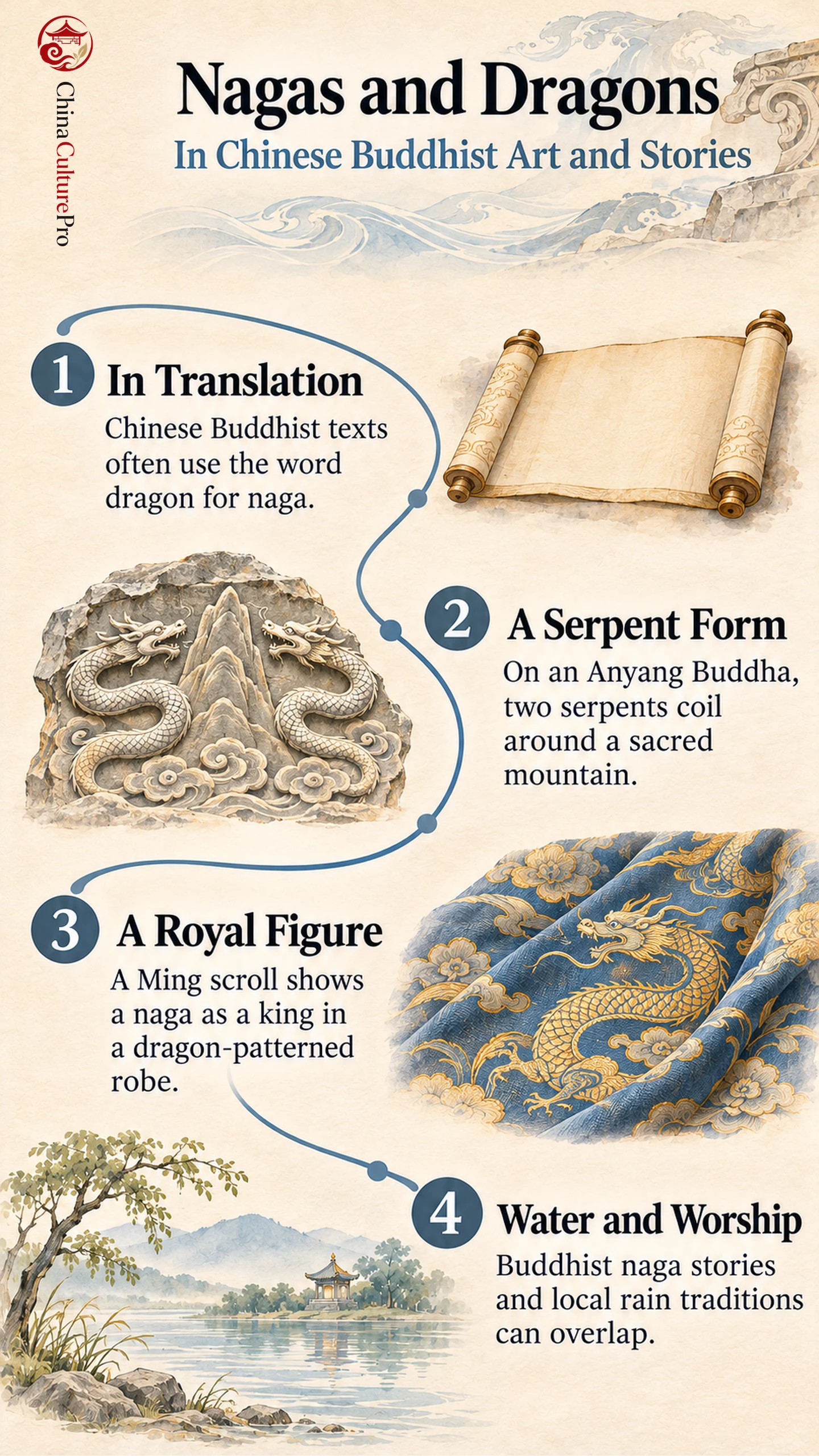
On a Northern Qi sculpture, two serpents frame a Buddhist mountain. On a Ming hanging scroll, a king wears a blue robe patterned with gold dragons. Museum records identify nāgas in both works. The sculpture places them in a Buddhist cosmos. The scroll depicts a participant in a ritual assembly. [3][4]
From Nāgarāja to Dragon King in the Lotus Sutra
The opening assembly in Kumārajīva’s Chinese Lotus Sutra (妙法莲华经, miàofǎ liánhuá jīng) includes eight named Dragon Kings. 難陀龍王 is Nanda, and 娑伽羅龍王 is Sāgara. The BDK English edition by Tsugunari Kubo and Akira Yuyama of the same Chinese text calls the group eight nāga kings. Nanda and Sāgara give you two names to match when you compare editions. [1][2]
The characters are participants in a Buddhist assembly. The shared names identify the same figures across translations. Their shape in an illustration depends on the scene and the artist. For the wider use of texts and images in this setting, see Chinese Buddhism. [1][2][3][4]
Two Chinese Artworks, Two Ways to Picture a Nāga
In the Smithsonian’s limestone Buddha from Anyang, Henan, dated 550–577, the figures to look for are on the front of the robe. The museum identifies two nāgas entwined around Mount Sumeru on the chest. Scenes from the Buddha’s life and other cosmic imagery continue across the front and back of the robe. You can locate the sculpture by accession number F1923.15. [3]
On Cleveland’s silk hanging scroll The Eight Hosts of Deva, Naga, and Yakshi, dated 1454, look toward the lower right for the nāga. The museum identifies him as a king whose blue robe bears golden dragons. The scroll belonged to a set for the Water-Land ritual (水陆法会, shuǐlù fǎhuì), a Buddhist rite for the dead. Here the body reads as human and the markings on the robe cue the royal figure’s association with dragons. The accession number is 1973.70.2. [4]
| Artwork | Where to look | How the nāga appears |
|---|---|---|
| Anyang limestone Buddha, 550–577 | Chest of the monk’s robe | Two serpents around Mount Sumeru. |
| Ming ritual scroll, 1454 | Lower right | A king in a blue robe with gold dragons. |
Protection in Stories and Water in Local Worship
In the Mucalinda story preserved in the Pāli Udāna, a nāga king coils around the seated Buddha and spreads his hood above him during a storm. A serpent body makes sense in that scene because of the action described. [5]
Chinese readers could draw on ideas about dragons and water that were already part of local religion. Tomoyasu Iiyama’s study of a Tangut family in Puyang, Henan, documents a community association formed around a Dragon King temple in northern China. Iiyama discusses earlier research that traces Dragon King worship to a meeting of local dragon traditions and Buddhist ideas about nāgas. The Dragon King in Chinese mythology および 中国の龍がもつ象徴 guides follow those wider traditions. [6][7]
How to Read a Dragon in a Buddhist Image
Start with the location within the work. A pair around a sacred mountain has a different setting from a crowned figure inside a ritual assembly. Then check the catalogue or inscription for a name, narrative, patron or ritual use. If all you have is a dragon motif on clothing, that detail may help you look but cannot identify a particular nāga king by itself. [3][4][6]
FAQs About Nagas and Dragons in Chinese Buddhism
Is every dragon in Chinese Buddhist art a nāga?
The identification depends on the scene and its record. A museum catalogue, name or story can identify a nāga figure. A dragon design alone may carry a different meaning. [3][4][6]
Why does one Chinese nāga look like a human king?
In the Ming scroll, the museum identifies the nāga by his place in a religious assembly and his royal role. His blue robes have gold dragons even though the central figure has a human form. [4]
出典
[1] Kumārajīva, Chinese Text Project. Lotus Sutra, Opening Chapter in Chinese
[2] Tsugunari Kubo and Akira Yuyama. The Lotus Sutra, BDK English Tripiṭaka
[3] Smithsonian National Museum of Asian Art. Buddha Draped in Robes Portraying the Realms of Desire
[4] Cleveland Museum of Art. The Eight Hosts of Deva, Naga, and Yakshi
[5] Bhikkhu Ānandajoti, SuttaCentral. Mucalindasutta, Udāna 2.1
[6] Gerrit Lange. Cobra Deities and Divine Cobras: The Ambiguous Animality of Nāgas
[7] Tomoyasu Iiyama. A Tangut Family’s Community Compact and Rituals