

Quick Answer: Who Is Leizu?
Leizu (嫘祖, Léizǔ) is the legendary wife of the Yellow Emperor and a patron of silkworm raising in China. An early genealogy names her as a woman of Xiling and the mother of two sons. Later accounts credit her with teaching people to raise silkworms and use their cocoons for cloth.[1][2]
- Genealogy: The Records of the Grand Historian names Leizu in the Yellow Emperor’s family.
- Ritual: Later sources honor her as the First Silkworm (先蠶, xiāncán).
- Evidence: Early silk remains and proteins tell a separate archaeological story.
The sources preserve a tradition about who introduced the craft, alongside physical evidence that people worked with silk long ago.[2][4][5]
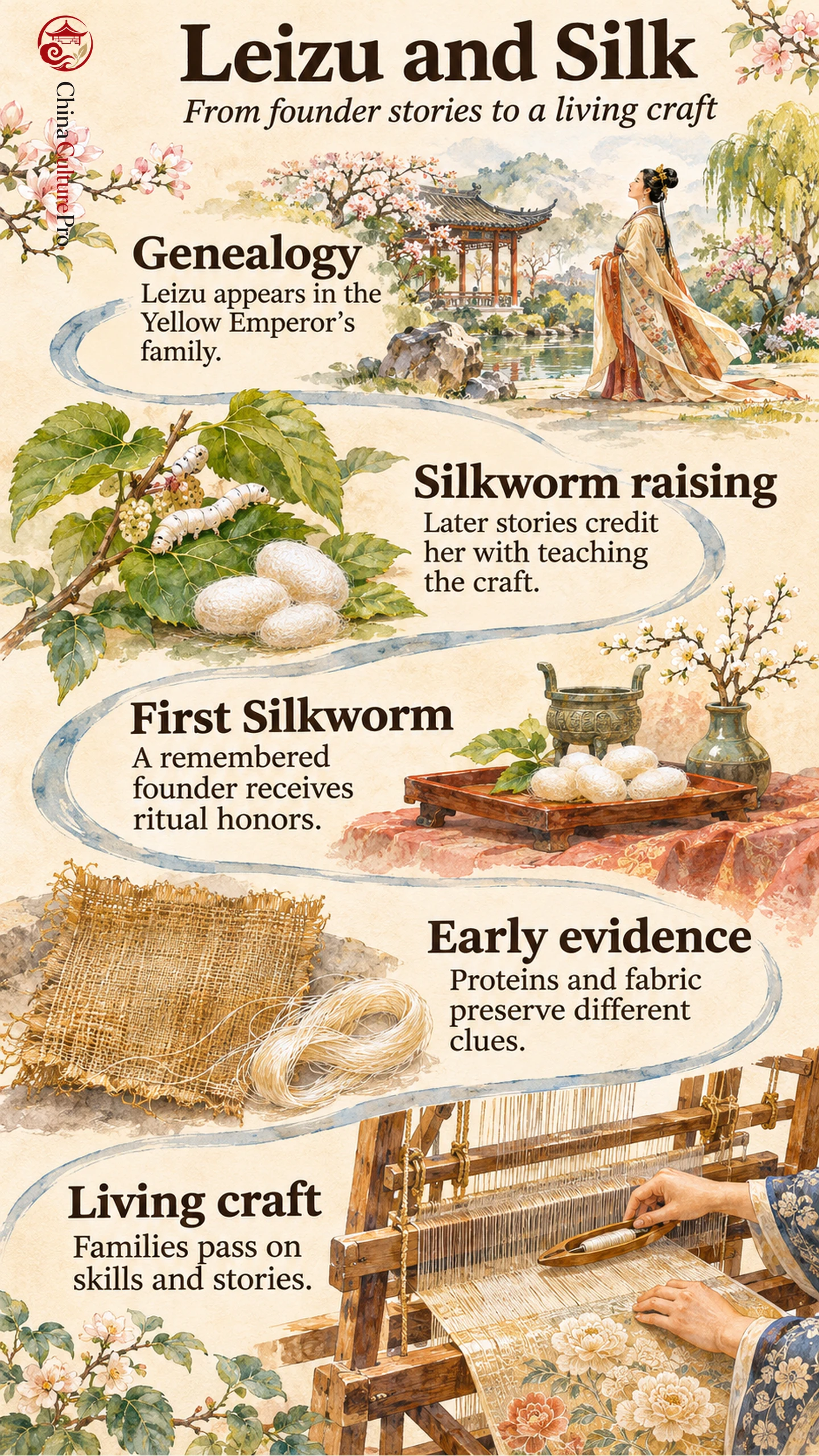
A cocoon, a ritual offering and a woven fragment all belong to the history of silk. Each tells us something different about the story attached to Leizu.
Leizu in Early Genealogy and Later Silk Stories
Sima Qian’s Records of the Grand Historian names Leizu in its account of the Five Emperors. She comes from Xiling, becomes the Yellow Emperor’s principal wife and bears two sons. The passage uses the marriage to explain lines of descent. It leaves silk out of the account of her marriage and children.[1]
Later texts put the craft at the center. A Song account cited by the Hubei Provincial Ethnic and Religious Affairs Commission tells of Leizu teaching people to raise silkworms and process cocoons to provide clothing. Another links the Yellow Emperor’s household to raising silkworms and providing cloth for ritual use. These accounts give Leizu a role in the social life of silk.[2]
The First Silkworm and Ritual
Wang Zhen’s agricultural treatise explains the First Silkworm rite by comparing it with rites honoring the beginnings of other useful crafts. It identifies the Yellow Emperor’s wife as the person who first encouraged silkworm raising. The honor recognizes a remembered founder and gives the seasonal work a ritual place.[3]
The name “First Silkworm” therefore refers to a patron honored for the origin of a practice. It can also appear in discussions of the rite itself. The Hubei account describes changes in who received silkworm offerings over time, so Leizu’s prominence belongs to the history of the cult as well as to the invention legend.[2][3]
What Archaeology Can Tell Us About Early Silk
At Jiahu in Henan, researchers reported identifying silk fibroin in soil from prehistoric tombs in a study of evidence dating back about 8,500 years. The evidence in that study is molecular. A recovered fabric can tell researchers different things, such as how threads were interlaced.[4]
The China National Silk Museum describes material from Qianshanyang in Zhejiang, including fragments of silk fabric, thread and a ribbon. Analysis identified a plain weave in one fragment. Neither the silk protein nor the weave carries the name of an inventor. They give archaeologists evidence of early materials and techniques, independent of the founder tradition.[4][5]
How Sericulture Is Practiced and Remembered
UNESCO inscribed sericulture and silk craftsmanship of China in 2009. Its account connects mulberry growing and silkworm rearing with drawing filaments from cocoons, making thread and weaving fabric. It also describes silkworm farmers inviting performers into homes to tell the story of the Silkworm Goddess near the start of the lunar year.[6]
That performance brings a story into the season when the craft matters to farming families. The inscription documents a living tradition with skills and customs. The ancient records and archaeology answer separate questions about how silk was remembered and when it was used.[2][4][6]
FAQs About Leizu
Did Leizu invent silk?
Tradition credits her with teaching people to raise silkworms and work with their cocoons. Archaeological silk evidence can date materials or identify techniques, while the inventor’s name belongs to the story.[2][4][5]
Was Leizu the wife of the Yellow Emperor?
Yes, in the early genealogy. The Records of the Grand Historian calls her a woman of Xiling and the Yellow Emperor’s principal wife.[1]
What is the difference between sericulture and silk weaving?
Sericulture is raising silkworms for silk. Weaving turns prepared threads into fabric. Reeling filament from cocoons is one of the steps that connects the two.[6]
出典
[1] Chinese Text Project. Leizu entry with the Records of the Grand Historian
[2] Hubei Provincial Ethnic and Religious Affairs Commission. The Evolution of the Leizu Legend and Chinese Silk Culture
[3] Chinese Wikisource. Wang Zhen’s Agricultural Treatise, volume twenty
[4] PLOS ONE. Biomolecular Evidence of Silk from 8,500 Years Ago
[5] China National Silk Museum. Silk remains from Qianshanyang
[6] UNESCO. Sericulture and Silk Craftsmanship of China