


Quick Answer: What Is Kou Shui Ji?
Kou Shui Ji, or mouthwatering chicken (口水鸡, kǒushuǐ jī), is a Sichuan cold dish of cooked chicken with a complex red-oil dressing.[1][2]
- Chicken: Cooked before cooling, cutting and dressing.
- Sauce: Chili oil combines with savory, sour and aromatic seasonings.
- Texture: Tender meat contrasts with optional crunchy garnishes.
- Versions: Cuts, accompaniments and sauce ingredients differ.
Cold serving does not mean raw chicken, and the red sauce is not the cooking liquid that cooks the meat.[3]
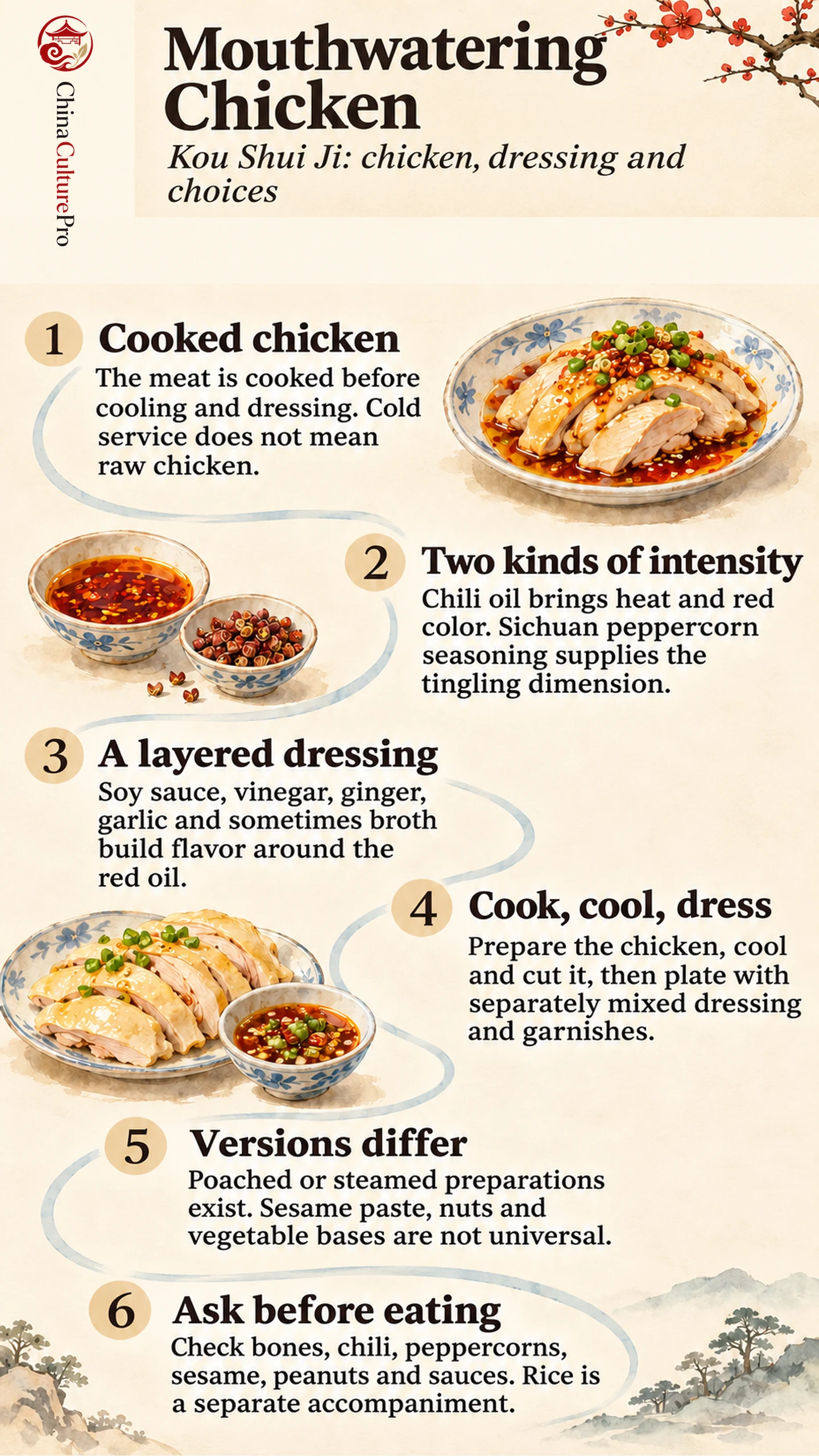
A glossy red plate can look intensely hot. This Chinese dish becomes easier to understand when chicken texture and dressing flavor are considered separately.
The Chicken and the Dressing Have Different Jobs
The chicken supplies a relatively mild, tender base. A professional preparation uses chopped cooked chicken arranged over onion and scallion, while other published versions use thighs or breast portions. The cut and whether bones remain affect eating more than the English name does.[1][3][4]
The dressing carries several flavor layers. Sichuan peppercorns (花椒, huājiāo) supply the characteristic tingling dimension; chili oil contributes chili heat and red color. These are separate ingredients, even when they are combined in one sauce.[1][3]
| 構成要素 | Role in the plate | Variation to check |
|---|---|---|
| Cooked chicken | Tender meat beneath the dressing | Whole-bird portions, thighs or breast; bone-in or deboned |
| Chili oil and peppercorn seasoning | Red chili flavor and tingling aroma | Oil, ground pepper and their intensity differ. |
| Soy sauce, vinegar and aromatics | Savory depth, acidity and ginger-garlic fragrance | The dressing may also contain broth or sugar. |
| Paste, seeds and nuts | Body, toasted aroma or crunch | Sesame paste, sesame seeds and peanuts are distinct additions. |
A professional red-oil preparation combines chicken broth, soy sauce, vinegar, ginger and garlic before adding peanut and sesame garnishes. This illustrates why the sauce is more than Chinese chili oil alone.[1]
From Cooking the Chicken to the Final Dressing
Three operations need to remain separate: cooking the meat, cooling and portioning it, and assembling the dressed plate. Cold-dish teaching materials explicitly separate chicken cooking and chilling from compound red-oil seasoning and garnish.[2]
- Cook the chicken with the aromatics used in the chosen preparation.
- Cool the cooked chicken before its final cutting and plating.
- Mix the dressing separately, combining chili oil with the other seasonings.
- Arrange the chicken and any vegetable base, spoon over the dressing and finish with garnishes.
One poached-thigh preparation follows this pattern, placing the chicken over cucumber and bamboo shoots. These vegetables are accompaniments, not essential parts of every serving. The sauce is added after the meat has been cooked and cooled; it does not replace the cooking stage.[3]
The finished meat should be understood as moist cooked chicken, often with smooth skin where retained. Crisp fried coating is not the defining texture. A cold dish can still carry a strongly flavored dressing without being served steaming hot.[5]
Sichuan Roots and Documented Adaptations
Mouthwatering chicken belongs to the Sichuan cold-dish repertoire. Its identity centers on cooked chicken and layered seasoning, rather than one universally agreed presentation. A red-oil plate should not be read as proof of a specific city, inventor or historical date.[2][3]
Published adaptations make the range concrete. One cook steams the chicken instead of poaching it and adds the collected juices to the dressing. Another debones poached thighs and uses a sauce with sesame seeds and peanuts but no sesame paste. These are documented choices, not evidence that one version replaces all others.[4][5]
A garlic-focused variation includes oyster sauce, soy sauce, sesame oil and peppercorn oil. Such differences matter when ordering: a sauce can contain ingredients that are not apparent from its color. Even the sour component varies; black vinegar appears in some preparations, while others simply specify vinegar.[5][6]
Ordering and Eating Mouthwatering Chicken
Ask first whether the chicken is bone-in or boneless and how the portion is cut. Separate any bones before eating. For a shared meal, take chicken with some of its dressing, and ask for plain rice separately if you want an accompaniment. The red-oil sauce is a dressing, not a soup to assume should be drunk.
Next confirm chili heat and peppercorn intensity independently. A restaurant may use a premixed sauce and be unable to change one component. Asking for sauce on the side may help only when the kitchen can actually serve it separately.
Check sesame paste, sesame oil, seeds, peanuts and soy sauce individually when relevant. A garlic-focused recipe also includes oyster sauce and cooking wine. Removing visible nuts does not establish that the dressing is free of nut ingredients or shared-preparation contact.[3][5][6]
In the context of Chinese food culture, the dish can occupy the cold-plate part of a shared table. Confirm portion and accompaniments directly rather than expecting a complete rice meal from the name alone.[2]
FAQs About Mouthwatering Chicken
Why Is It Called Mouthwatering Chicken?
The Chinese name literally evokes saliva or a watering mouth. “Mouthwatering” is a natural menu translation describing anticipation of its strongly flavored dressing; it does not name an ingredient.
Is Mouthwatering Chicken Served Hot or Cold?
It is a cooked cold dish. Published preparations serve the chicken chilled or at room temperature after cooking and cooling.[3][5]
Does It Always Contain Sesame Paste?
No. Some recipes use paste; others include sesame oil or seeds without paste. Those differences are especially relevant when checking sauce ingredients.[3][5]
Is Kou Shui Ji Gluten-Free?
Do not infer that from the chicken alone. Check the soy sauce, other compound seasonings and preparation arrangements before treating the entire dressed dish as gluten-free.
出典
[1] Zhang Daqian / China Cuisine Association. 口水鸡
[2] Zhengzhou Tourism College. Cold-Dish Craft Curriculum Standard
[3] School of Wok. Mouthwatering Chicken
[4] Taylor Holliday / The Mala Market. Mouthwatering Sichuan Cold Chicken
[5] Karen / daigasikfaan. Sichuan Mouthwatering Chicken
[6] Xiaomi Kay / Lee Kum Kee. 蒜香口水鸡