

Quick Answer: What Did Wen Zhengming Write About Yue Fei?
Inscription for Gaozong’s Imperial Order to Yue Fei (题宋高宗赐岳飞手敕词, Tí Sòng Gāozōng Cì Yuè Fēi Shǒuchì Cí) is a calligraphy handscroll by Wen Zhengming, dated 1559. It presents his poetic response to a Song imperial order and the fate of Yue Fei. It is not Emperor Gaozong’s own handwritten order. The main written field measures 46.5 × 356.6 cm, and the work belongs to the National Palace Museum in Taipei.[1]
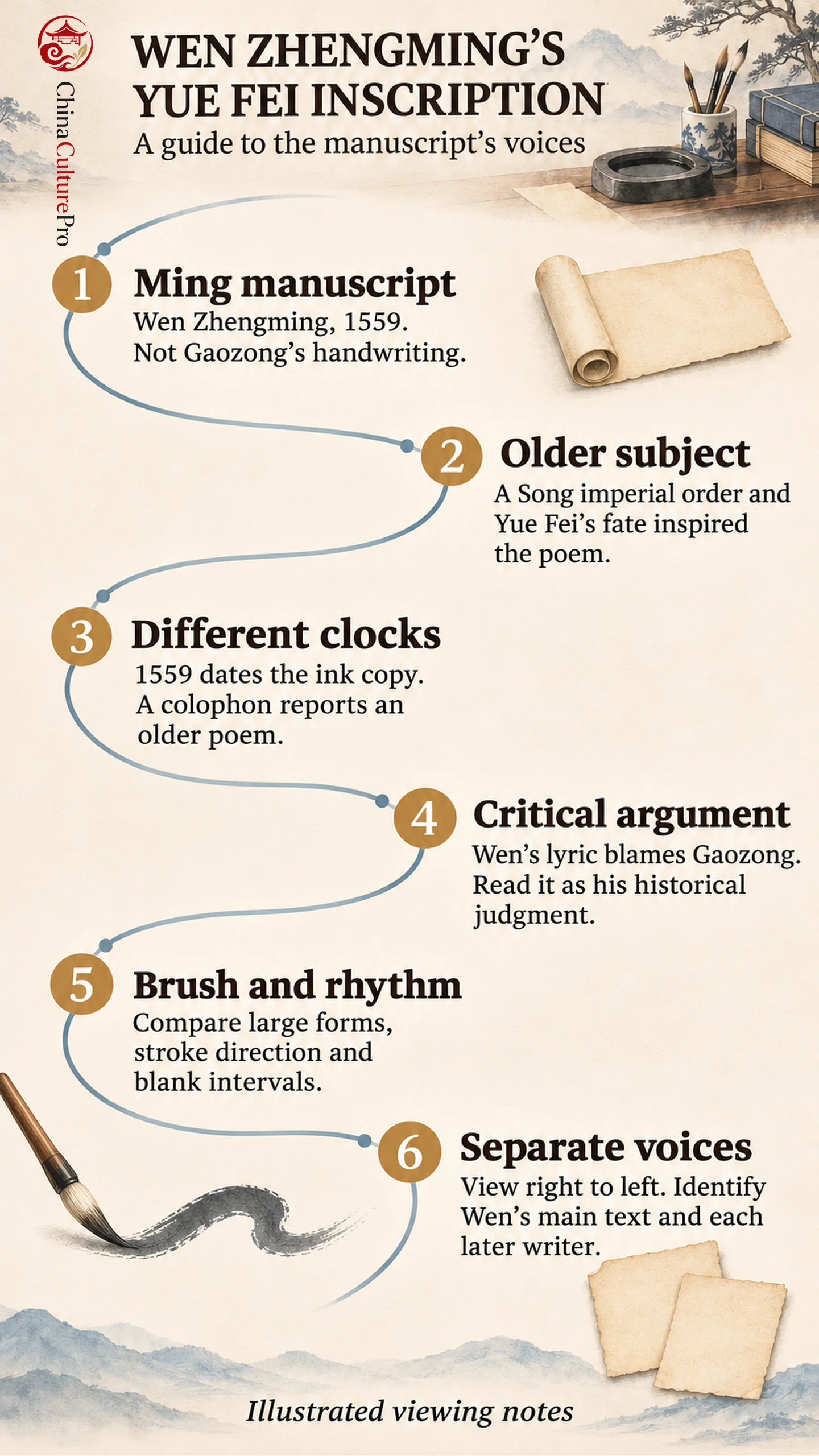
The long English title contains two different authorship roles: Gaozong issued an order, while Wen wrote a later response. Keeping them separate makes both the history and the Chinese calligraphy easier to understand. The scroll also contains later comments, so not every passage of writing belongs to the same moment.
One Scroll, Several Historical Layers
The object is ink writing on paper. Its significance depends on distinguishing the earlier subject from the surviving manuscript and the commentary attached to it.[1]
| 意味の層 | Time or status | 主な役割 |
|---|---|---|
| Gaozong and Yue Fei | Southern Song historical setting | The imperial order and the general’s fate supply the subject |
| Wen’s poetic text | Earlier composition reported in a later colophon | The argument existed before this particular writing |
| Wen’s surviving manuscript | Catalogued to 1559 | The large-character calligraphy examined here |
| Appended colophons | Written by other readers at different times | Accounts of the manuscript, its maker and its reception |
Peng Nian’s appended account describes the lyric as having been composed roughly fifty years earlier. That is evidence reported by a commentator, not a reason to assign an exact composition year by subtraction. The catalogue’s 1559 date identifies this manuscript.[1]
A separate museum object, Imperial Order Presented to Yue Fei, preserves an imperial letter associated with 1137. Its written field measures 36.7 × 61.5 cm.[2] It is a useful comparison for the difference between an order and a later response. Its existence alone does not establish that it was the exact exemplar behind the stone inscription mentioned in Wen’s scroll.
Why the Poem Blames Gaozong
Wen’s lyric is set to the tune Man Jiang Hong (满江红, Mǎn Jiāng Hóng). It turns from an old inscription to the contrast between reliance on Yue Fei and his subsequent treatment. Its criticism places responsibility with Gaozong rather than allowing the minister Qin Hui to carry all the blame.[1][3]
Read this as Wen’s historical judgment. The poem gives the emperor’s own interests a central place in explaining the general’s fate; it does not provide direct access to the private thoughts of the Song court. That distinction preserves the force of the writing without turning its accusation into an uncontested historical finding.
The reported discovery of a stone engraving helps explain why an old order could provoke a new response. A surviving trace of imperial trust becomes a starting point for asking what followed.[3] The difference between an ink manuscript, an engraved text and its printed impression matters here; Chinese stone rubbings explains those related forms.
For the ruler’s wider setting, the Song Gaozong guide provides historical context. The present page stays with the way Wen made that history into a lyric and a work of calligraphy.
Large Characters and a Running Rhythm
The catalogue classifies the work as running-regular script (行楷书, xíngkǎishū), while its explanatory description emphasizes large characters in running script (行书, xíngshū). These labels describe related aspects of the writing: recognizable character structures coexist with movement and freedom in their execution.[1][3]
Compare a character’s overall shape with the direction of an individual stroke. A form can remain legible while its parts lean, stretch or answer the movement of the neighboring character. The useful question is how much freedom the structure can carry without losing its identity. The guide to Chinese running script develops that relationship between connection and readability.
Then look at intervals. Blank space between strokes, characters and columns contributes to the rhythm as much as the dark marks do. Do not judge the writing only by whether every character occupies an identical box. Instead, compare a compact passage with a more open one and ask how your pace of looking changes.
The manuscript was written shortly before Wen Zhengming died.[3] That late date is important context, but it need not decide your visual judgment in advance. Examine the stroke direction, spacing and sustained movement before using the artist’s age as an explanation for what you see.
How to Read the Manuscript and Later Colophons
Handscrolls are traditionally encountered from right to left, section by section. Appended colophons can add later voices and records to the main work.[4] With a digital reproduction, use the catalogue to establish those boundaries before trying to read the scroll as one uninterrupted text.
- Locate Wen’s main written field. Match the reproduction to the catalogue’s object title and dimensions. Notice where the principal lyric ends and the artist’s own notation begins; a complete online image may include much more than this field.
- Separate meaning from visual movement. Read a reliable transcription or translation for the argument. Then return to the image to compare shapes, spacing and direction. A transcription makes words accessible but cannot replace the ink’s visible relationships.
- Identify one later commentator. Choose a catalogued colophon and check its writer and position. Ask whether it reports the circumstances of writing, praises the calligraphy, or responds to the poem’s argument. Those are different kinds of evidence.
- Reassemble the layers cautiously. Compare what the main text states with what a later reader says about it. Keep the date of the physical manuscript distinct from the older lyric and the still older Song subject.
The broader guide to reading Chinese calligraphy offers a framework for repeating this exercise. For this scroll, the most useful result is a clear account of who is speaking in each part, followed by a closer view of how Wen’s writing moves.
FAQs About Wen Zhengming’s Yue Fei Inscription
Is this the handwriting of Emperor Gaozong?
No. This is Wen Zhengming’s Ming-dynasty manuscript responding to a Song imperial order. The title names the earlier subject as well as the later inscription.[1]
Did Wen compose the poem in 1559?
The manuscript is catalogued to 1559, but Peng Nian’s colophon reports a much earlier composition. Treat the date of writing this copy and the date of creating the lyric as separate questions.[1]
Was Wen really ninety when he wrote it?
His own notation gives ninety, and the catalogue explains the late work in those terms. This is traditional Chinese age reckoning; it should not be converted automatically into ninety completed years by modern birthday counting.[1][3]
出典
[1] National Palace Museum Open Data. Inscription for Gaozong’s Imperial Order to Yue Fei
[2] National Palace Museum. Imperial Order Presented to Yue Fei
[3] National Palace Museum, catalogue explanation. 明文徵明題宋高宗賜岳飛手勅詞 卷
[4] Dawn Delbanco, The Metropolitan Museum of Art. Chinese Handscrolls