

Quick Answer: What Are Guizhou Silk Doll Wraps?
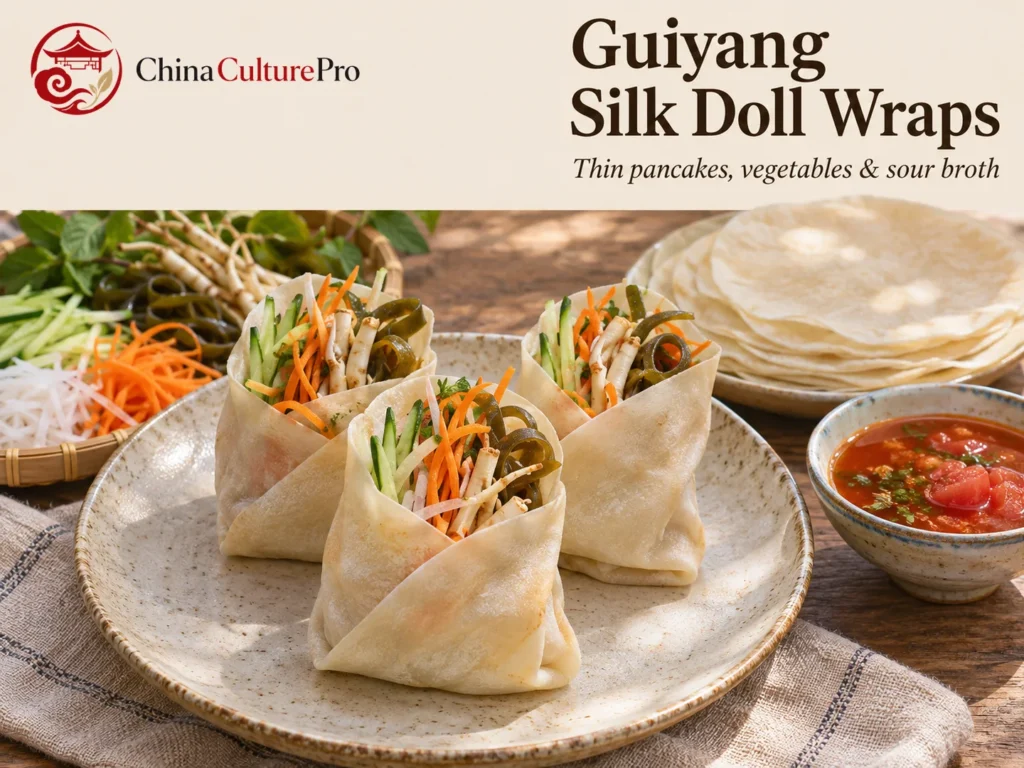
Guizhou silk doll wraps, or si wa wa (丝娃娃; sī wáwá), are thin pancakes wrapped around shredded fillings and served with sauce. Their folded shape resembles a swaddled baby, explaining the name.[1]
- Wrapper: Soft, thin and roughly palm-sized.[3]
- Filling: Choose from prepared shredded vegetables and other offered accompaniments.
- Finishing: Fold the base and sides, then add the selected sauce or broth.[6]
They are assembled at the table rather than deep-fried after filling. Check the actual wrapper and broth ingredients if you need a vegetarian or gluten-free meal.

The pleasure of silk doll wraps is choosing a few strands from a colorful platter and making each small parcel yourself. This guide explains the wrapper, the folding sequence and the different sauces documented in Guiyang. It places the snack within Guizhou cuisine without treating one restaurant’s set as the only version.
Wrappers and Shredded Fillings
The wrapper is already cooked before you fill it. A maker interview describes flour, water and salt worked into dough, briefly pressed onto a hot pan and lifted away as a thin round. It is a skilled wrapper-making process, not a reason to place raw dough straight on the table.[5]
Descriptions of the flour differ. Guiyang’s English guide calls it a rice-flour pancake, while a restaurant’s own product page specifies selected flour and its maker interview describes a flour dough. Ask what the actual wrapper contains rather than assuming every pale, thin pancake is gluten-free.[1][2][5]
Fish mint, or zhe er gen (折耳根; zhé ěr gēn), appears alongside radish, kelp and fried soybeans in a local program’s filling selection.[3]
Some selections also include cui shao (脆哨; cuì shào), crispy pork pieces. That optional topping changes a vegetable-centered wrap into a portion containing meat; it is not another kind of fried soybean.[3][7]
Build a small combination that fits the wrapper rather than trying every filling at once. Leave enough room to close the sides and keep the bottom folded.
How to Wrap and Add the Sauce
A Guiyang resident demonstrates folding the bottom and sides before adding soup in a 2026 report. Start with ready-to-eat wrappers and prepared fillings.[6]
- Take a wrapper: Lay one soft, ready to eat wrapper in your hand and handle it gently.
- Choose the filling: Place a small selection of prepared shredded vegetables in the middle, leaving room to fold.
- Fold and close: Fold the bottom upward and bring the sides around the filling to make a small upright parcel.
- Add the sauce: Spoon the selected dressing or broth into the opening and eat the wrap while holding the folded base.
The folded bottom helps contain the liquid; the opening at the top lets you add it. Start with a modest spoonful so you can see how much the wrapper holds. If it tears, reduce the filling in the next parcel instead of stretching the skin tighter.
Wrapper making, vegetable preparation and broth cooking are separate jobs from this table assembly method.
Traditional, Red Sour and Hot Broths
The sauce is often called zhan shui (蘸水; zhàn shuǐ). A Guiyang food program distinguishes three examples, with additional condiments chosen by the diner.[4]
| Sauce or broth | Documented flavor base | What to ask before choosing |
|---|---|---|
| Older sweet-sour dressing | Brown sugar and ginger with vinegar and soy sauce | How sweet, sour and spicy is this preparation?[4] |
| Red sour broth | Tomato with fermented red sour seasoning | Is it served mild or mixed with extra chili?[4] |
| Hot broth | A clear, meat-flavored broth described for cooler weather | What stock or meat ingredients does it contain?[4] |
The same program describes toasted chili, fried soybeans and scallions as additions. Adjust those at the table according to the sauce already in the bowl.[4]
The guide to Kaili sour soup bases explains the fermented ingredient family. A restaurant’s finished red broth may include further cooking and seasonings; it is not necessarily an undiluted ladle of fermented base.
Guiyang Table Service and Seasonal Variations
A 2026 report lists fish mint, carrot, cucumber, celtuce, kelp and lotus root on a restaurant platter. A street vendor in the same report offers spring ingredients including bamboo shoots and fish mint leaves. These are specific menus, not universal year-round lists.[6]
Ask whether your order includes wrappers, a vegetable platter and one broth, and whether different broths can be chosen separately. Portion sizes and refill arrangements belong to the actual restaurant; an older account of one shop’s pricing does not establish today’s terms everywhere.
For another way Guiyang uses a wet chili dressing, see love tofu. There it fills an opening in grilled tofu; here it moistens vegetables inside a thin pancake. The carrier changes how much liquid a portion can hold.
FAQs About Guizhou Silk Doll Wraps
Are silk doll wrappers always made from rice flour?
Do not assume so. Published descriptions differ, and a maker describes a flour-dough wrapper. Confirm the ingredients of the wrapper being served.[1][5]
Are silk doll wraps always vegetarian?
No. Some selections include crispy pork, and a documented hot broth has a meat flavor. Check both the toppings and the stock.[4][7]
Are the finished wraps deep fried?
The method here uses already-cooked soft wrappers: fill, fold and add the sauce. There is no deep-frying stage after assembly.[3]
出典
[1] Guiyang Municipal Government, English food guide. Silk Doll Roll
[2] Guiyang Silian Restaurant, original product description. 丝恋红酸汤丝娃娃
[3] Guizhou Television, original food program. 贵州盛宴|了不起的贵阳美食·【丝恋红酸汤丝娃娃】
[4] Qin Hong, Guizhou Television original culinary program. 《贵州盛宴》第二季 | 美食方志:贵阳,你可真够味儿!
[5] Chongqing Evening News, original interview via China News Service. 《舌尖2》推荐贵州丝娃娃:面皮和蘸水是关键
[6] Jiang Yuxi, Guizhou Daily original restaurant and street vendor report. 丝娃娃,把春生万物包进饼里
[7] Guizhou Radio and Television, culinary essay. 逛吃贵州丨西北的臊子和贵州哨子,无非是因方言音变的异形词罢了