
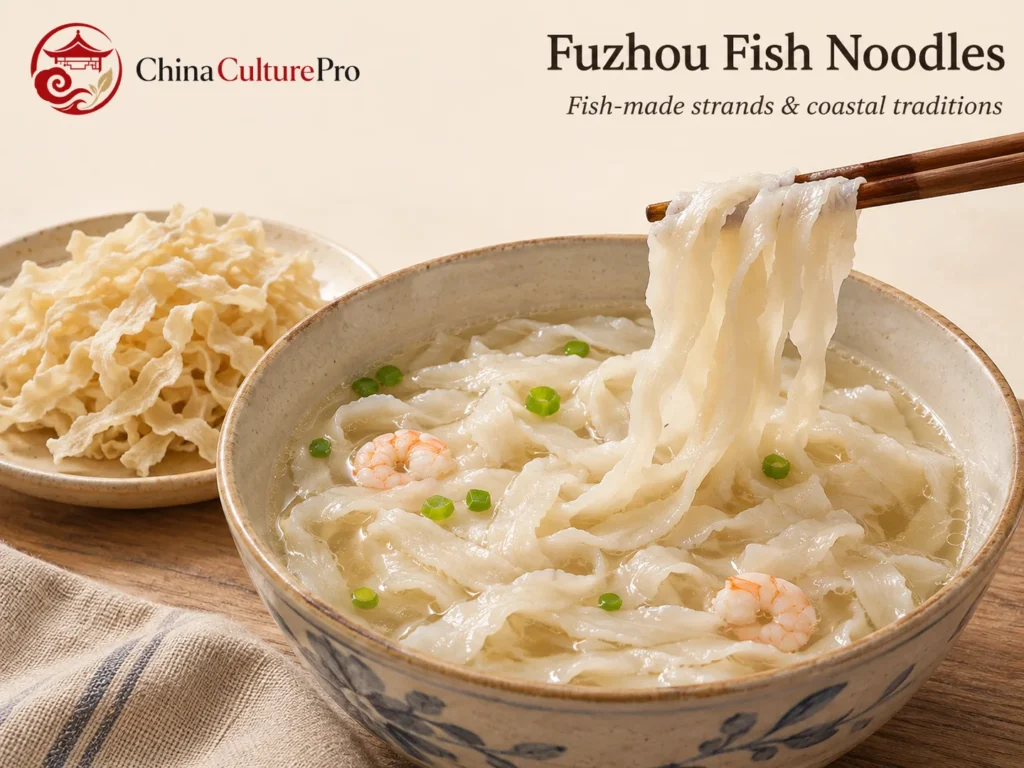

Quick Answer: What Are Fuzhou Fish Noodles?
Fuzhou fish noodles, or yu mian (鱼面; yú miàn), contain fish in the noodles themselves. Minced fish is combined with starch, worked into thin sheets and cut into strips.[3]
- Ingredients: Fish, starch and salt form the documented Zhanggang noodle mixture.[2]
- Texture: The finished strands are thin, translucent and resilient.[1]
- Serving: Soup is one option; the noodles can also be stir-fried or braised.[4]
Check which product you have before cooking. Fresh, dried and previously cooked fish noodles need instructions suited to their actual form.

In this coastal specialty, making the noodle is part of preparing the seafood. A bowl may look like a familiar noodle soup, but the strands bring their own fish flavor. This guide places them within Fujian cuisine, explains a documented production method and compares local versions without treating every packet as the same product.
What Goes into the Noodles
A local account describes fish flesh mixed with water and sweet potato starch, then pounded into sheets. This is different from xian mian (线面; xiàn miàn), the region’s fine wheat noodles.[3]
Fish choice varies. A 2026 Lianjiang product report identifies eel and Spanish mackerel, so yellow croaker should not be presented as the only fish used in contemporary production.[4]
Starch is part of the noodle structure, not merely something sprinkled over a finished fish dish. The ingredients become a workable mixture before the sheets are formed. A label may specify the starch and additional seasonings more precisely than an English menu name does.
For a buyer, the practical questions are simple: what fish is used, what starch is listed, and is the product raw, precooked, refrigerated, frozen or shelf-stable? Do not infer an allergen guarantee from the word “fish.” Read the complete ingredient and allergen information on the product you intend to use.
How Fish Becomes a Noodle
A reporter observed the following process at a Zhanggang maker in Changle. It explains the craft rather than supplying a complete home recipe: the report gives no fixed fish-to-starch ratio.[2]
- Prepare the fish: Remove skin and bones from eel or Spanish mackerel and mince the flesh to a paste.
- Make thin sheets: Knead with starch and salt, divide into portions and roll into broad, thin sheets.
- Steam the rolls: Roll the sheets up and steam. The documented workshop method gives 20–30 minutes; this is not a universal cooking time.
- Cut and dry: Unroll, cool and slice across into fine strips. The workshop then sun-dries the noodles.
Lianjiang production need not follow that exact steaming sequence. A report from the Huanghui workshop describes mixing, baking, cutting and outdoor drying. It also notes mechanical pounding and sheet pressing alongside handwork. These are documented workshop practices, not instructions to leave homemade seafood drying at room temperature.[1]
A steamed sheet and a baked sheet reach the cutting stage through different processes. Neither description supplies a validated drying or storage schedule for a home kitchen.
Lianjiang, Changle and Pingtan Styles
Lianjiang’s Huangqi Peninsula is associated with fish noodles alongside fish balls and fish dumplings. Local reporting describes the noodle craft as centuries old, but that account does not establish a precise invention date.[1]
A regional food essay describes yellow croaker in Lianjiang’s older noodle tradition. Its Pingtan example uses Spanish mackerel and sweet potato starch, with quail eggs, clams, wood ear mushrooms and shrimp in the finished bowl. These are concrete local examples, not a mandatory topping list for every fish noodle soup.[5]
Changle’s Zhanggang account uses eel or Spanish mackerel and describes steaming the rolled sheets before slicing and drying.[2]
When comparing bowls, ask about the noodles as well as the toppings. Our broader guide to Chinese noodles explains how fish-based strands sit beside wheat and rice varieties.
Cooking and Buying Prepared Fish Noodles
Start with the maker’s directions for soaking, thawing and cooking. A dried fish noodle may need a different treatment from a fresh one; the steaming time in a workshop description is not the simmering time for your purchased packet.
For a first bowl, a light broth makes it easier to notice the noodles’ own flavor. Boiling is described as an everyday preparation in Huangqi, although mixing, braising and stir-frying are also documented.[1]
Keep fresh seafood cold at 40°F (4°C) or below and thaw frozen seafood in the refrigerator. FDA guidance gives 145°F (63°C) for most seafood; follow a prepared product’s specific cooking directions too. Refrigerate perishable cooked food within two hours, or one hour above 90°F (32°C).[6]
Related foods can appear on the same menu without being interchangeable. Fujian fish balls have a different shape and construction. Rouyan (肉燕; ròuyàn) uses a pork-based wrapper; the guide to meat swallow dumplings explains that separate craft.[3]
FAQs About Fuzhou Fish Noodles
Are Fuzhou fish noodles ordinary noodles in fish soup?
No. Here the fish is worked into the noodle mixture itself, rather than appearing only as a topping or broth ingredient.[3]
Are fish noodles the same as fish balls or rouyan?
No. Fish noodles are cut into strands, while rouyan uses pork worked into thin sheets for wrappers. They are distinct foods.[3]
Can dried fish noodles go straight into the soup?
Use the packet’s directions. The name alone does not tell you whether soaking is required or how long that product needs to cook.
出典
[1] Hai Lianjiang, workshop report via Fuzhou News. 鲜!爽!滑!这道美食,在连江传承近400年
[2] Changle News, reporter Wang Xianzheng. 漳港鱼丸、鱼面风味独特
[3] Liu Zixian, personal local essay in Mindu Online. “面面”俱到
[4] Fuzhou Evening News, original local product report. “一碗福州·我来了”开渔专场直播举行
[5] Mindu Online, regional food essay. 福州到底多有面?
[6] US Food and Drug Administration. Selecting and Serving Fresh and Frozen Seafood Safely