


Quick Answer: What Is Fujian Lychee Pork?
Fujian lychee pork, or lizhi rou (荔枝肉; lìzhī ròu), is a pork dish named for its resemblance to lychees. A classic Fuzhou version uses scored pork that curls during frying and receives a sweet-and-sour glaze.[1]
- Main ingredients: Pork, water chestnuts and starch appear in a government-published Fuzhou recipe.[5]
- Signature technique: Crosshatch cuts help create the textured, curled appearance.[1]
- 地域差: A documented Putian version is served dry-fried with a vinegar-and-soy dip.[3]
The name does not require fresh lychees, but some restaurant versions explicitly include them. Check the actual preparation rather than assuming fruit is always absent.[4]
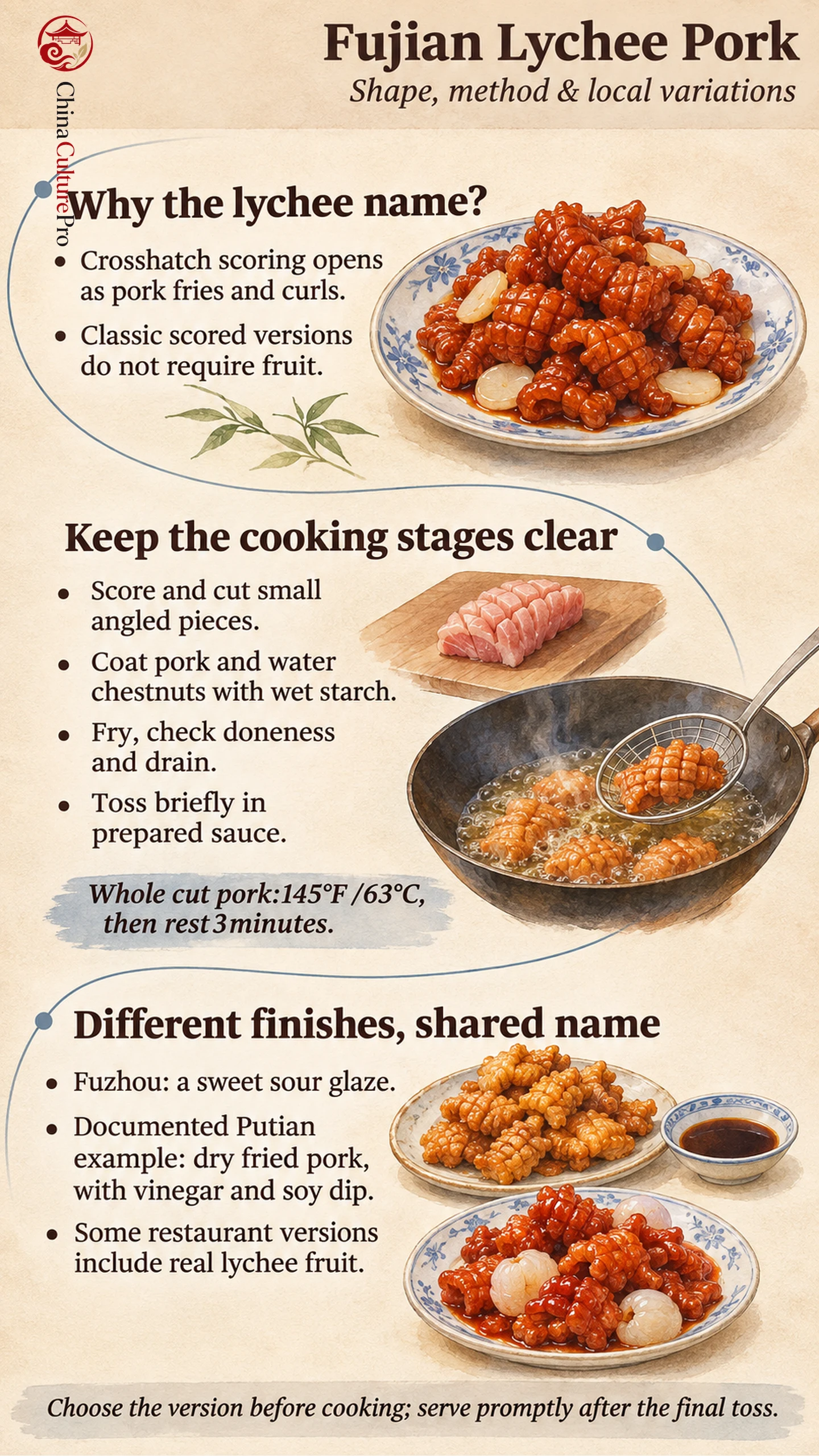
Lychee pork rewards a closer look at the cut of the meat and the way it is served. A glossy red plate and a golden dry-fried portion can share the name while offering different textures. This guide explains the scored Fuzhou method and places it alongside documented variations within Fujian cuisine.
Pork, Water Chestnuts and the Lychee Name
A Fuzhou account lists lean pork, water chestnuts, scallion, garlic, starch, soy sauce, vinegar, sugar, red yeast rice powder, bone broth and oils.[1]
The name therefore refers to a crafted resemblance, rather than simply pork cooked with a fruit sauce. The surface cuts and curl distinguish this presentation from an unscored cube of meat. Compare our broader sweet and sour pork guide for other dishes in that flavor family.
A contemporary Minhou chef’s account describes tomato-based seasoning in place of older red yeast rice coloring, and also mentions pork wrapped around water chestnut. These are different ways of developing the appearance; they should not be combined into a claim that every cook uses one identical technique.[2]
Scoring, Frying and Glazing the Meat
One concise government recipe starts with approximately 300 g lean pork and 100 g sliced water chestnuts. It also lists garlic, scallion and tomato juice. Because it leaves parts of the sauce unspecified, use a complete recipe for the final seasoning proportions rather than treating those few quantities as a finished formula.[5]
For the scored, glazed approach, the main stages are:
- Score and portion: Make a diagonal crosshatch on one side of the pork without cutting through, then divide it into small angled pieces.
- Coat the components: Coat the pork and sliced water chestnuts with wet starch, following the chosen recipe.
- Fry and drain: Fry until the scoring opens and the pork curls into lychee-like pieces, checking that the meat is safely cooked; lift out and drain.
- Glaze briefly: Fry garlic and scallion in a little retained oil, add the prepared stock-based sauce, then toss in the pork and water chestnuts to coat before serving.
Keep the scored side intact enough to hold together. Cutting straight through creates separate strips instead of the connected surface that can open during frying. Prepare the sauce and serving plate before the pork goes into the oil, so the final toss does not turn into a long simmer.
Frying color alone is not a safety check. For whole-cut pork, the FDA minimum is 145°F (63°C), followed by a three-minute rest. Follow the complete recipe’s handling sequence and check the thickest meat with a thermometer; a brief frying time cannot guarantee every size of piece is cooked.[6]
Fuzhou and Putian Variations
A useful distinction is how the fried meat meets its seasoning. Minhou reporting describes a contemporary tomato-based sweet-sour glaze.[2]
A Putian chef interviewed about a dry-fried version instead serves the crisp pork with vinegar and soy sauce for dipping. That makes the sauce a table accompaniment rather than a glaze covering the meat. It is a documented local preparation, not proof that all Putian cooks avoid a glaze.[3]
There are also versions with actual fruit: an original restaurant menu explicitly describes sweet-and-sour pork made with real lychees. This example shows why “lychee pork never contains lychee” is too absolute.[4]
Choose the version you want before cooking. A dry-fried portion designed for dipping and a glazed portion have different finishing jobs; adding a large sauce simply because the name is the same changes the intended texture.
Serving the Finished Pork
For the glazed style, serve promptly after the final toss so the scored surface remains distinct. For a dry-fried version, put the dip alongside and let diners season each bite. Rice and a simply prepared vegetable make useful companions without competing with the pork’s sweet-sour seasoning.
Our Chinese cooking methods guide explains the distinction between frying an ingredient and finishing it in sauce. Have the rice ready before glazing the meat.
Marinate pork in the refrigerator, and use a clean plate for cooked food. Refrigerate perishables within two hours, or one hour above 90°F (32°C). Reheat leftovers to 165°F (74°C).[6]
FAQs About Fujian Lychee Pork
Does lychee pork contain lychee fruit?
Not necessarily. The scored Fuzhou ingredient list contains no lychee, while a documented restaurant version explicitly adds real fruit.[1][4]
How does the pork get its lychee shape?
Crosshatch scoring opens as the pork fries and curls. Some contemporary preparations also wrap pork around water chestnut.[1][2]
Is Putian lychee pork always covered in sauce?
No. A documented Putian dry-fried version is served with vinegar and soy sauce for dipping. Check the kitchen’s own preparation.[3]
出典
[1] Fuzhou local history office, dish protection account. 福州市闽菜保护——热菜名录:荔枝肉
[2] Minhou County Government, original chef interview. 食在闽侯丨酸酸甜甜就是它,福州人都爱吃的开胃硬菜
[3] Southeast Net, original Putian chef reporting. 莆田特色小吃干炸荔枝肉 外酥里嫩块块香
[4] PUTIEN, original restaurant menu. A la carte menu: Sweet and Sour Pork with Lychee
[5] Fujian Taiwan Affairs Office, government recipe. 福州菜:荔枝肉
[6] US Food and Drug Administration. Safe Food Handling