


Quick Answer: What Is the Four Seasons Chinese Dish?
On many Chinese-American menus, Four Seasons combines shrimp, chicken, beef and roast pork with mixed vegetables. Brown sauce brings the components together.[2][4]
- Proteins: Expect a mixed-meat-and-seafood entree, not four separate courses.[2]
- Vegetables: Mushrooms, water chestnuts and bamboo shoots appear in one documented version.[1]
- Method: Prepare the components separately as needed, then combine them for the final sauce stage.
The name is a useful menu clue, not a guarantee that every kitchen uses identical vegetables, seasoning or proportions.
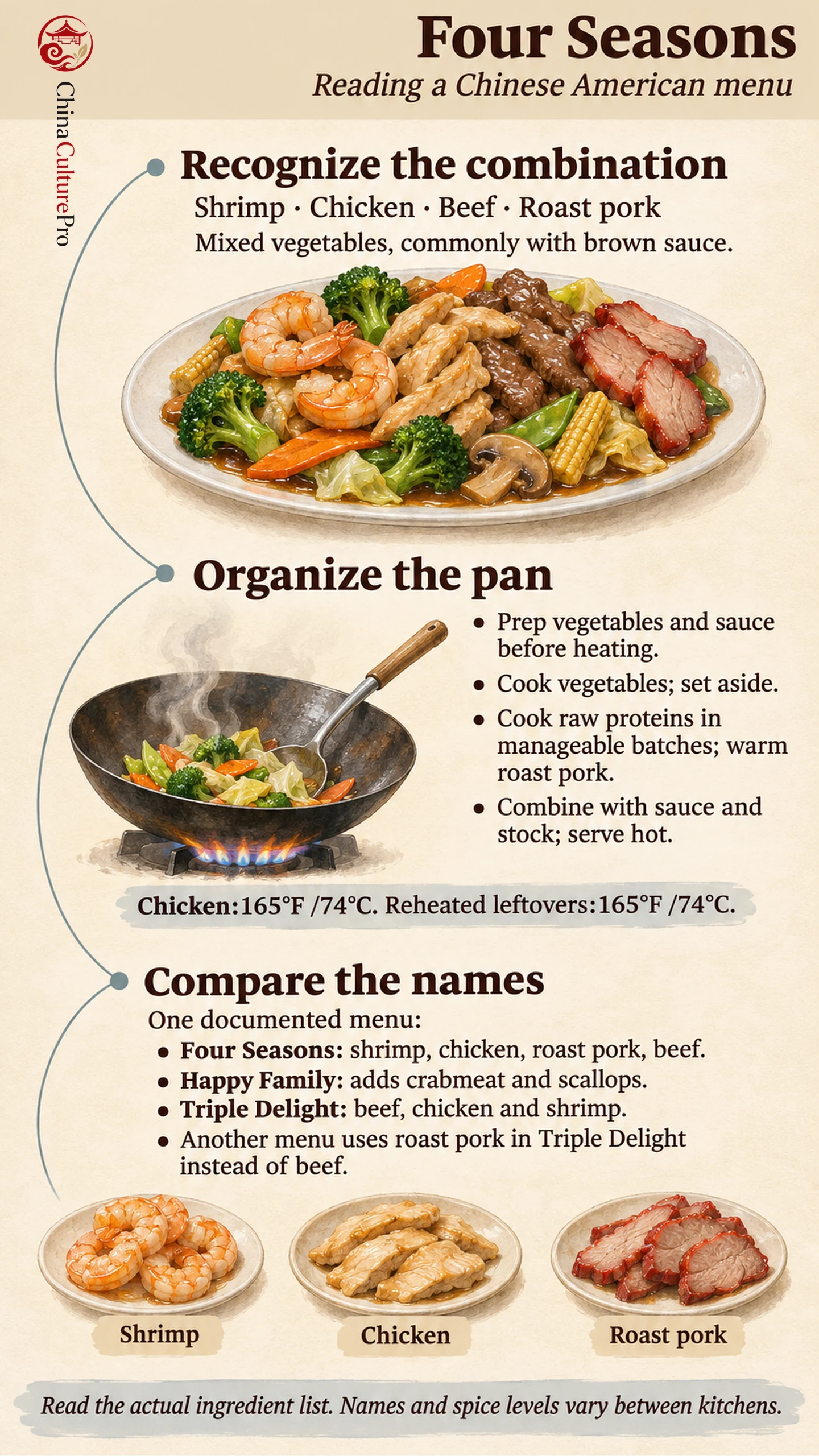
Four Seasons offers several textures in one dish: slices of meat, shrimp and a mixture of vegetables. Read the description to choose the combination; at home, prepare the components before the pan gets hot.
The Four Proteins and Their Vegetables
Three original restaurant menus agree on the core combination of shrimp, chicken, beef and roast pork. One specifies mushrooms, water chestnuts, bamboo shoots and vegetables in season; the others describe Chinese vegetables more generally.[1][2][4]
That distinction leaves room for a kitchen to change its vegetable selection. Do not assume that broccoli, baby corn or any other single vegetable must be present just because you remember it from a previous order. The protein list is a stronger clue in these examples than an exact vegetable count.
The pork is often listed as roast pork, which is different from adding raw pork slices to the pan. For background on Cantonese barbecue pork, see our roast pork guide. When following a home recipe, check which form it specifies before deciding the order of cooking.
Brown Sauce and a Home Cooking Sequence
Brown sauce is explicit in the two menu examples that name their sauce.[2][4]
A related mixed-meat-and-seafood home recipe uses soy sauces, oyster sauce, sesame oil, chicken broth and cooking wine. It provides a useful model for organizing this kind of stir-fry, rather than revealing a particular restaurant’s Four Seasons formula.[3]
Use the sequence below with a complete recipe whose quantities suit your pan and number of diners:
- Prepare before heating: Slice the meats and vegetables, drain canned vegetables, and mix the sauce before heating the pan.
- Cook the vegetables: Stir-fry onion, pepper and garlic, then broccoli and carrot; set the vegetables aside once they reach the texture you want.
- Cook the proteins: Cook the raw chicken, beef and shrimp in manageable batches, checking each for safe doneness; warm the sliced roast pork separately as needed.
- Combine and sauce: Return the vegetables and cooked proteins to the pan, add the prepared brown sauce and stock, and toss until everything is hot and evenly coated.
- Serve promptly: Taste and adjust the seasoning, then transfer to a serving dish with hot rice alongside.
The separate batches help you check each ingredient instead of treating the first browned piece as proof that the whole mixture is ready. Chicken must reach 165°F (74°C). The FDA gives 145°F (63°C) plus a three-minute rest for whole cuts of beef and pork, and describes cooked shrimp flesh as pearly and opaque. Reheated leftovers should reach 165°F (74°C).[5]
Our Chinese cooking methods guide explains stir-frying in the wider context of Chinese cooking. With the prep finished, you can concentrate on the proteins as they enter the pan.
Four Seasons, Happy Family and Triple Delight
The clearest comparison comes from reading related items on the same menu:
| Name on one menu | Listed proteins | 見分けるポイント |
|---|---|---|
| 四季 | Shrimp, chicken, roast pork and beef | The four-protein combination.[1] |
| Happy Family | Those four, plus crabmeat and scallops | A broader seafood-and-meat selection.[1] |
| Triple Delight | Beef, chicken and shrimp | A three-protein combination on this menu.[1] |
Another restaurant’s Spicy Triple Delight lists shrimp, roast pork and chicken instead. Even the three-protein name therefore does not identify the same ingredients everywhere.[4]
This is a comparison of actual menu usage, not a nationwide naming rule. Nor do these descriptions establish a fixed assignment of one meat to spring, summer, autumn or winter. The practical information is the ingredient list beneath the title.
Choosing and Serving Your Version
Before ordering, confirm the seafood, pork and sauce if any of them affect your choice. Ask about heat directly; “brown sauce” does not tell you whether a kitchen has added chili. If an allergy matters, discuss ingredients and cross-contact with the restaurant rather than relying on the short menu name.
Serve a home version with rice and bring it to the table promptly after the final toss. If you want a different chef’s-special combination, compare the dragon and phoenix dish, whose formats also vary between kitchens. Our guide to Chinese and Chinese-American food gives the broader context for these restaurant traditions.
FAQs About the Four Seasons Chinese Dish
Is Four Seasons the same as Happy Family?
They can overlap, but the menus examined here give Happy Family additional seafood such as scallops and crabmeat. Compare the actual descriptions.[1][2]
Is the Four Seasons dish spicy?
The cited menus describe a brown-sauce combination. Ask the restaurant whether its preparation contains chili or can be adjusted.[2][4]
Does Four Seasons contain only four vegetables?
No. In these menu examples, the recurring four are shrimp, chicken, beef and roast pork; the vegetables form a mixed selection.[2][4]
出典
[1] Panda Garden, original restaurant menu. Chef’s Specialties
[2] China Star, original menu PDF. Chef’s Special Suggestion
[3] Bee Yinn Low, original recipe. Happy Family
[4] Wen Wu Buffet, original restaurant ordering menu. Chef’s Specialties
[5] US Food and Drug Administration. Safe Food Handling