


Quick Answer: What Are the Former Liang Li Bo Manuscripts?
The Li Bo (李柏, Lǐ Bǎi) manuscripts are early paper documents associated with an official of Former Liang (前凉, Qián Liáng), preserved at Ryukoku University Library in Kyoto.
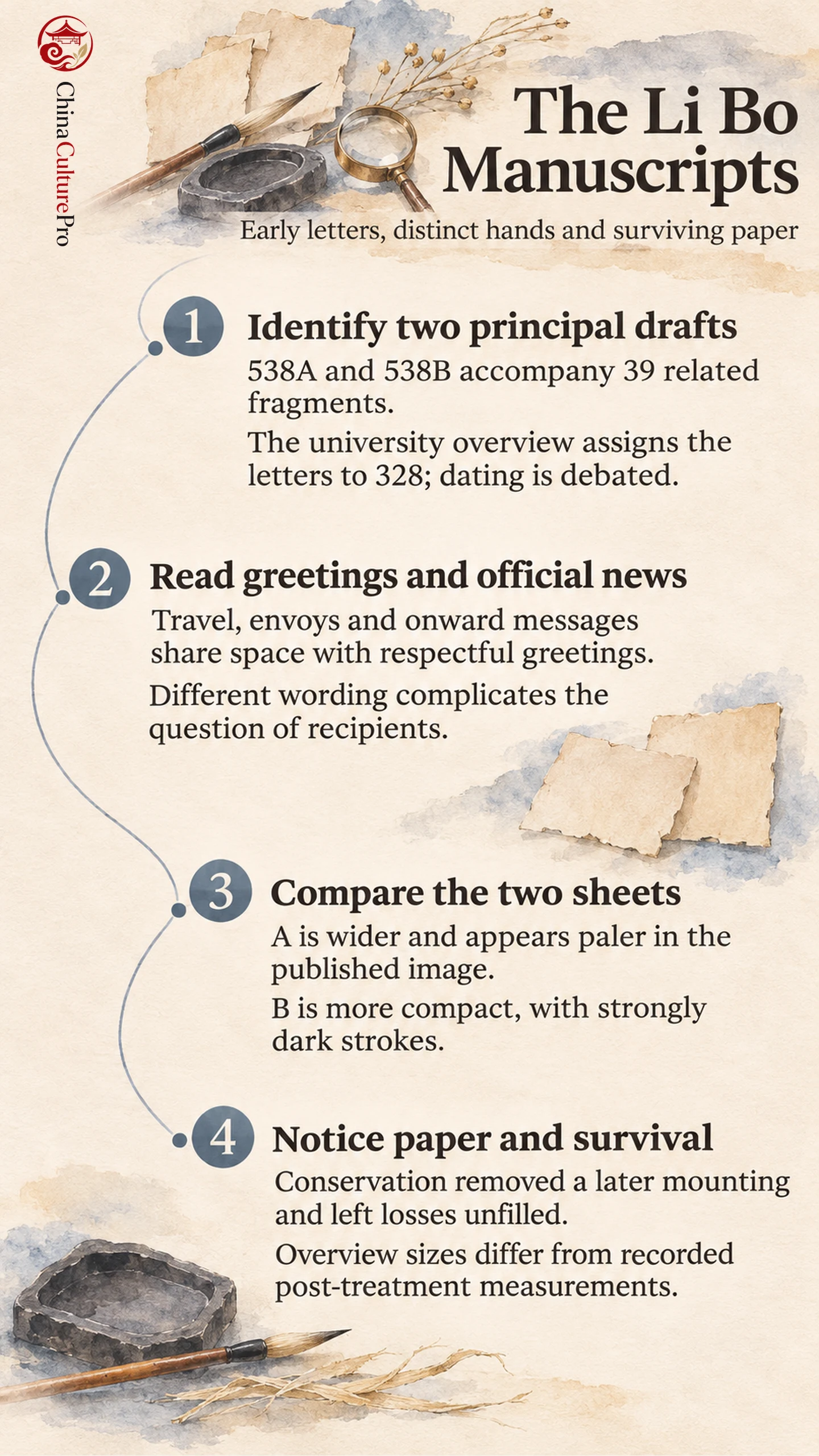
- Core objects: Two substantially complete letter drafts, 538A and 538B, accompany 39 related fragments.
- Date: The university overview assigns the letters to 328, although their precise dating has been debated.
- Best comparison: Look at the wider, paler A sheet beside the more compact, darker B sheet.
The political sender’s name does not establish that he personally wrote every surviving stroke.
These sheets bring official communication close to the scale of handwriting. Instead of a monumental inscription or an illustrated scene, the viewer encounters columns, uneven edges, changing ink and words arranged for correspondence.
Read the message and inspect the surface as separate tasks. The text explains why information traveled; the physical sheets show how that communication survives.
Identify the Two Letter Drafts
The documents were brought back by Tachibana Zuicho of the second Otani expedition in 1909 from the Lop Nor region. The university overview records the following dimensions. [1]
| Letter draft | Overview dimensions, height × width | Viewing distinction |
|---|---|---|
| 538A | 23.8 × 39.7 cm | Wider sheet with relatively pale writing in the published image |
| 538B | 23.8 × 28.5 cm | More compact sheet with conspicuously dark strokes |
Keep the A and B labels attached to their respective images. A single combined measurement would conceal the difference between these two objects.
The calligraphy guide supplies the wider visual vocabulary. Here, that vocabulary meets a document whose immediate purpose was communication.
The conventional year is an identification aid, rather than a substitute for a dated year written on the sheets. The letters give the fifth month and seventh day; their absolute year remains a scholarly question. [2]
Read an Official Message with Personal Greetings
The letters combine respectful greetings with news of travel and envoys. They refer to arrival at Haitou (海头, Hǎi Tóu) on the second day of the month and to sending a messenger onward. [2]
Respectful concern and administrative business share the same small document. Asking after the recipient’s circumstances helps sustain the relationship through which official information moves.
The two texts differ, including in the names of the recipient’s envoys. One scholarly interpretation reads their different handwriting as evidence of different secretaries and questions whether both addressed the same king. [2]
Treat the name associated with the correspondence, the person holding the brush and the intended recipient as three distinct questions. Similar wording alone does not settle all three.
The Silk Road history guide expands the setting for exchanges across the Western Regions. These letters make that broad history tangible through a particular need: finding out whether people and messages had arrived.
Compare the Writing of A and B
Begin at the right side and follow the vertical columns toward the left. The guide to reading Chinese calligraphy explains that orientation.
In A, compare the pale, fine strokes with the larger dark forms around the middle of the sheet. Notice that characters do not fill equally sized invisible boxes; some spread sideways while others remain narrow.
In B, the right-hand opening is strikingly dark. Smaller marks and additions sit beside more substantial writing. The irregular losses along the lower and right edges interrupt the field of columns.
Compare one dense area with a more open interval. This changes the viewing question from whether the sheet looks uniformly neat to how each written group occupies its available space.
The calligraphy-and-writing comparison develops that relationship. A working document can reward close looking without becoming a poem or a decorative painting.
Look at Paper, Damage and Conservation
The paper analysis tentatively identified ramie in tested fibers, while leaving open whether the entire material had the same composition. [1]
The history of paper in China provides context for this early writing surface. A plant-fiber identification should retain the limits of its test.
Conservation removed a later scroll mounting and old lining, used minimal reinforcement and left missing areas unfilled. The report gives post-treatment sizes of 24.0 × 39.6 cm for A and 23.6 × 28.5 cm for B. [3]
A later investigation identified small holes interpreted as possible traces of sewing. [4]
Edges, gaps and holes are therefore part of the evidence. Their survival lets a viewer ask questions that a neatly reconstructed rectangle would hide.
FAQs About the Former Liang Li Bo Manuscripts
Was Li Bo the Tang poet Li Bai?
No. This correspondence concerns a fourth-century official, centuries before the Tang poet.
Are these two drafts of one identical letter?
That should not be assumed: textual differences and handwriting have supported another interpretation involving different recipients and scribes.
Why do published measurements differ?
The overview and conservation report give separate measurements; the latter explicitly records the sheets after treatment.
出典
[1] Ryukoku University Digital Archives Research Center. Li Bo letter drafts: overview and paper analysis
[2] Taishan Yu, Sino-Platonic Papers 173. On Li Bo’s Documents, pp.101–109
[3] Sakata Bokujudo, hosted by Ryukoku University. Conservation of the two Li Bo letter drafts
[4] Ryukoku University. Silk Road paper culture: findings presented at the 2010 IDP symposium