


Quick Answer: What Is Dream of the Red Chamber?
Dream of the Red Chamber(红楼梦,Hónglóumèng), also known as The Story of the Stone, is an eighteenth-century Chinese novel associated with Cao Xueqin(曹雪芹,Cáo Xuěqín). It follows the young people of the wealthy Jia household, whose private hopes take shape amid family obligations and declining fortunes. Earlier manuscript versions and the 120-chapter printed edition help explain why readers sometimes talk about the novel’s ending in different ways. [1]
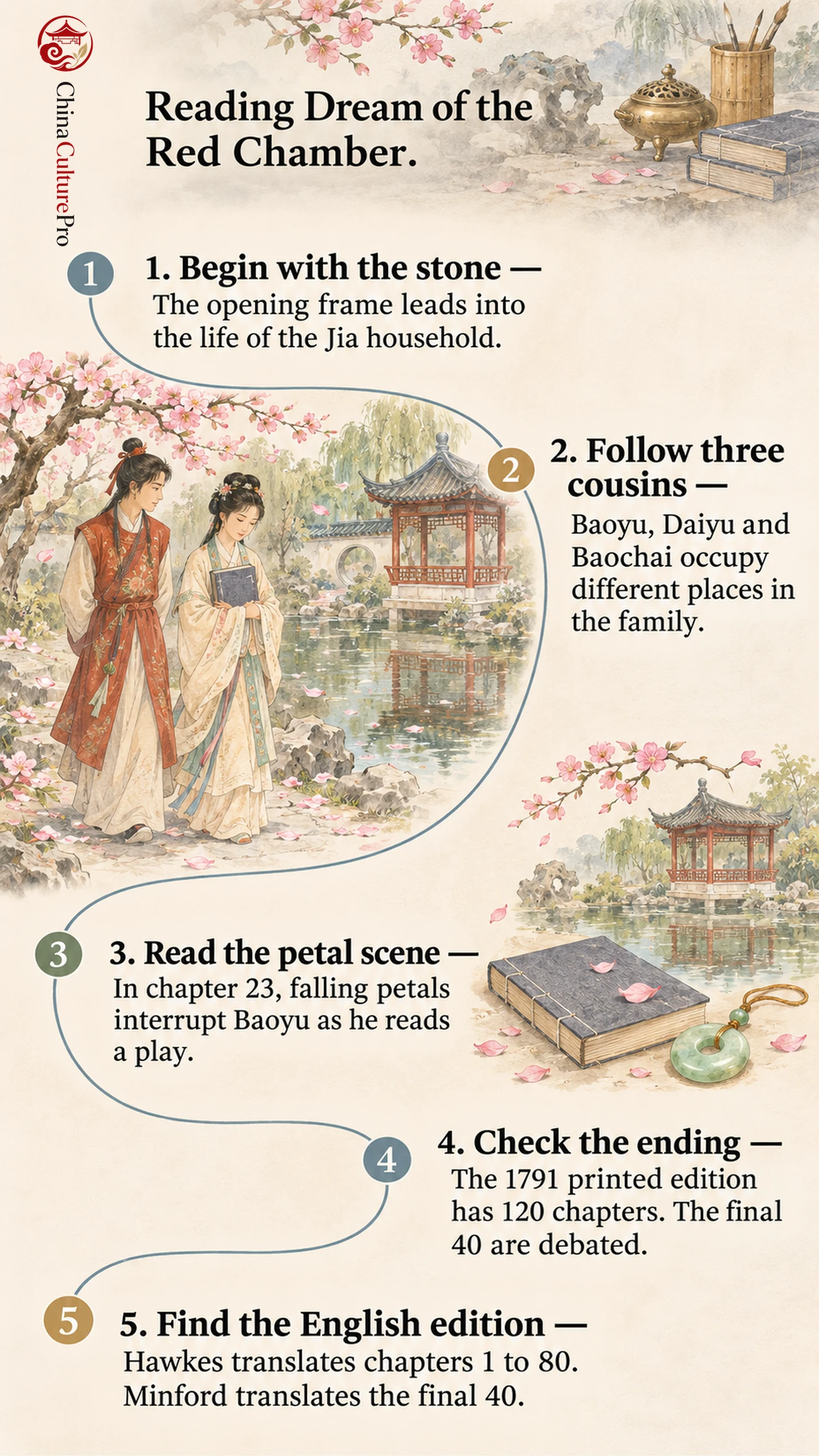
A falling shower of petals interrupts a boy reading in a garden. The scene is small enough to overlook in a novel that follows an entire household. Notice what its young people do with an afternoon and how much say they have over the rest of their lives.
The Stone and the Jia Family
The opening takes place far from the rooms and gardens of the Jia estate. A stone left over from the repair of heaven longs to enter the human world. The novel draws a connection between that stone and the jade in the mouth of a child born into the Jia family. Treat the opening as a frame for the experience that follows. It asks what the bustle of the household will look like once its pleasures and troubles have passed. [2]
The domestic story then comes into focus through visits, kinship and the work of running a large estate. When a young relative comes to stay, the rooms she passes through and the people she is taken to meet tell her where authority sits. The novel makes that knowledge matter. A young person’s wish can depend on decisions made in another room by someone with a different idea of what will serve the family. Its patient attention to domestic life sets it apart within the Four Great Classical Novels.
The Three Cousins and Their Household
The young cousins are the easiest names to learn first. Each has a different position in the extended family. Daiyu and Baochai enter as relatives from other branches of the extended family. Their ties to the people who house and support them shape what they can do. [3]
| The Three Cousins | Place in the story | What to watch for |
|---|---|---|
| Jia Baoyu(贾宝玉,Jiǎ Bǎoyù) | A son of the Jia household, born with jade in his mouth | How his interests and friendships fit his family’s expectations |
| Lin Daiyu(林黛玉,Lín Dàiyù) | A cousin who comes to live with her maternal relatives | What she expresses through poetry and shared reading |
| Xue Baochai(薛宝钗,Xuē Bǎochāi) | A cousin from the Xue family who stays with the Jias | How she reads a social situation and responds to it |
Keep a note of which family a new character belongs to and how they address the people around them. A kinship term can tell you more about a conversation than a second pass through a long list of given names. Notice, too, whose labor makes the cousins’ leisure possible. The people who carry messages and tend rooms have lives of their own, and their actions can change what others in the household learn.
What to Watch for in the Garden
The Jia family builds the Grand Prospect Garden(大观园,Dàguānyuán) for the visit of Jia Yuanchun, an imperial consort and Baoyu’s elder sister. The estate can display its standing through the garden, while the young residents later make parts of it their own through friendships and poetry. It helps to read each pavilion or path as a place where the characters can act a little differently from the way they would in front of senior relatives. [3]
In chapter 23, Baoyu is reading Romance of the Western Chamber when petals fall across him and his book. He puts some into the water. Daiyu suggests a different way to dispose of them and the two end up reading the play together. Their choices give the reader something concrete to follow before the larger questions of love and marriage come to the foreground. The encounter also shows how another work of Chinese literature gives two characters a language for what they are starting to feel. [4]
The First 80 Chapters and the Printed Ending
Early manuscript versions circulated before the novel appeared in print. Cheng Weiyuan introduced the first printed 120-chapter edition in 1791. The first 80 chapters are conventionally associated with Cao Xueqin. The authorship and development of the final 40 remain debated, so a description of what the printed ending does should be kept separate from any claim about what Cao intended to write. [1]
The edition matters especially when you discuss how the household story resolves. If a friend has read an abridgment or seen an adaptation, you may be remembering a different arrangement of scenes. A stage production can follow the central pair while giving less time to relatives and servants. Read the version you have on its own terms, and name it when comparing a scene with someone else’s account.
Choosing an English Translation
Penguin’s five-volume The Story of the Stone follows the 120-chapter version. David Hawkes translated chapters 1 through 80, which fill the first three volumes. John Minford translated the remaining chapters in volumes four and five. Use chapter numbers when comparing passages across editions, since titles, page numbers and the way names are spelled can differ. [5]
Read the opening frame once and then begin a short character list as the Jia family comes into view. Return to chapter 23 once you can place the cousins within the family. If the full cast still feels unwieldy, follow one room or one visit at a time. Who is expected there, who can come and go, and what can each person say in front of the others?
FAQs About Dream of the Red Chamber
Is The Story of the Stone the same book?
Yes. The Story of the Stone is an alternative title and the title used for Penguin’s five-volume English translation.
Do I need to read all 120 chapters?
The 120-chapter edition gives you the printed ending. You can read the first 80 as a substantial part of the work and treat the final 40 as a separate textual question.
Where can I find the flower-burial scene?
Start with the meeting over fallen petals in chapter 23. Daiyu’s concern for the flowers also takes poetic form later in the novel.
出典
[1] University of Minnesota. Authorship
[2] University of Minnesota. Jia Baoyu
[3] University of Minnesota. Cousins in the Garden
[4] University of Minnesota. Lin Daiyu and the Chapter 23 Text
[5] University of Minnesota. Englishing the Text