


Quick Answer: Who Is the Dragon-Horse?
The White Dragon Horse (白龙马, Báilóngmǎ) is a dragon prince who carries the Tang Monk (唐僧, Tángsēng) on his pilgrimage in Journey to the West (西游记, Xīyóu Jì). The bodhisattva Guanyin (观音, Guānyīn) saves the prince from execution and gives him a role in the quest for scriptures. The monk meets him on the road with Sun Wukong (孙悟空, Sūn Wùkōng), after the dragon eats the horse they started out with.[1][2][6]
- Identity: He is the son of Ao Run, the Dragon King of the Western Sea. Wukong calls him the third dragon prince.[1][3]
- On the road: He usually travels as a white horse. In chapter 30 he steps forward when the monk is in danger and the group has scattered.[2][4][6]
- At the end: The Buddha recognizes the horse’s service to both the monk and the scriptures.[5]
This account follows the novel, including the Dragon-Horse’s reward.
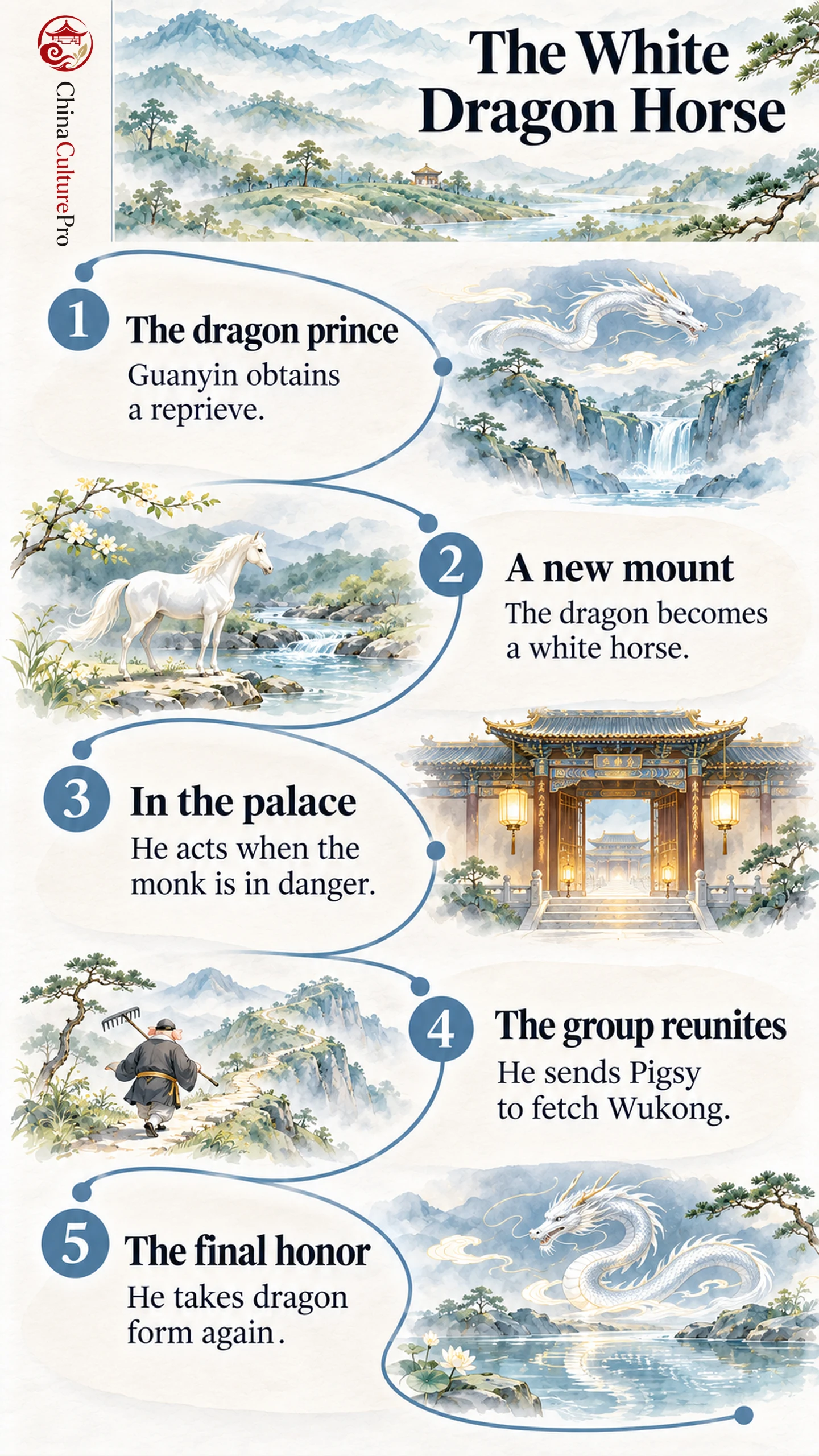
The Dragon-Horse is easy to spot in a picture of the pilgrims and easy to forget as a separate character. The novel sometimes makes his work visible by removing the people who usually speak for the group.
How the dragon prince becomes the monk’s horse
Guanyin meets the dragon prince before the Tang Monk does. He tells her that he set a fire that destroyed a precious pearl in his father’s palace. His father reported him to Heaven, and the Jade Emperor has sentenced him to die. Guanyin asks for the prince to be spared so that he can carry the scripture seeker. She leaves him in a ravine to wait for the monk.[1][6]
When the travelers reach the ravine in chapter 15, the hungry dragon comes out of the water and swallows the monk’s mount. Wukong challenges him and learns that the dragon was placed there by Guanyin. Her return clears up what neither side understood in the first encounter. The dragon learns that this is the scripture pilgrim he was ordered to wait for. Guanyin turns him into a white horse, giving the monk the mount he now needs.[2][6]
The scene joins the terms of the prince’s reprieve to an immediate need. The creature who interrupted the journey becomes the one whose work lets it continue. Chapter 23 reminds readers of that hidden identity when Wukong tells Pigsy exactly whom he is looking at.[1][2][3]
What he does when the other pilgrims are gone
In chapter 30, the Yellow-Robed Demon turns the Tang Monk into a tiger. Wukong has been sent away, and Sandy has been captured and Pigsy is away when the horse thinks through what to do. He takes the form of a palace woman, goes to the banquet and confronts the demon. His effort ends in a fight in which he is wounded. He returns to his stable and takes on his usual shape again.[4][6]
The episode gives him another decision. When Pigsy returns, the Dragon-Horse tells him what happened and urges him to fetch Wukong. The attempt to rescue the monk alone has failed, but the prince knows which member of the group can help. Readers looking for the moments when the horse speaks can start with that conversation. Pigsy is ready to give up the pilgrimage, and the prince persuades him that Wukong will come back if asked. The Journey to the West characters guide gives the other pilgrims’ roles and names.[4][7]
What his reward and television portrayal make visible
In chapter 100, the Buddha addresses the horse directly and recalls that he carried the monk west and the sacred scriptures east. He gives him the title Eightfold Heavenly Dragon Horse. The horse then enters a pool and takes on a dragon form again. In the final recitation he is honored as a dragon bodhisattva of vast strength. The chapter gives the work of carrying passengers and texts a place among the achievements of the talking pilgrims. Columbia’s ExEAS teaching guide emphasizes his quiet service, among the different qualities the pilgrim group needs to finish the journey.[5][6]
Television can make that hidden identity visible in a different way. CCTV identifies Wang Bozhao as the Little White Dragon of its 1986 Journey to the West. The broadcaster recalls his white costume and princely appearance. The name and pale costume connect a familiar mount to the figure an actor can play, whose shape stays hidden during much of the journey.[8]
FAQs About the Dragon-Horse
Is the White Dragon Horse the monk’s original horse?
The Tang Monk has a different mount when he arrives at the ravine. The dragon eats that horse, and Guanyin changes the dragon into the replacement.[2]
Can the Dragon-Horse speak?
Yes. He speaks to Guanyin before the journey and to Pigsy in chapter 30. During most of the expedition he appears as the monk’s quiet mount.[1][4][6]
What happens to the Dragon-Horse at the end?
The Buddha honors his service, and the horse takes on a dragon form again in chapter 100. The closing recitation includes him among the honored figures.[5]
出典
[1] Journey to the West. Chapter 8, Guanyin obtains a reprieve for the dragon
[2] Journey to the West. Chapter 15, the dragon becomes a white horse
[3] Journey to the West. Chapter 23, Wukong explains the horse’s identity
[4] Journey to the West. Chapter 30, the horse intervenes and speaks to Pigsy
[5] Journey to the West. Chapter 100, the pilgrims’ rewards
[6] Roberta E. Adams, Columbia ExEAS. Teaching the Pilgrim Characters, White Dragon Horse
[7] Journey to the West. Chapter 31, Wukong returns
[8] China Central Television. Wang Bozhao and the White Dragon in the 1986 series