
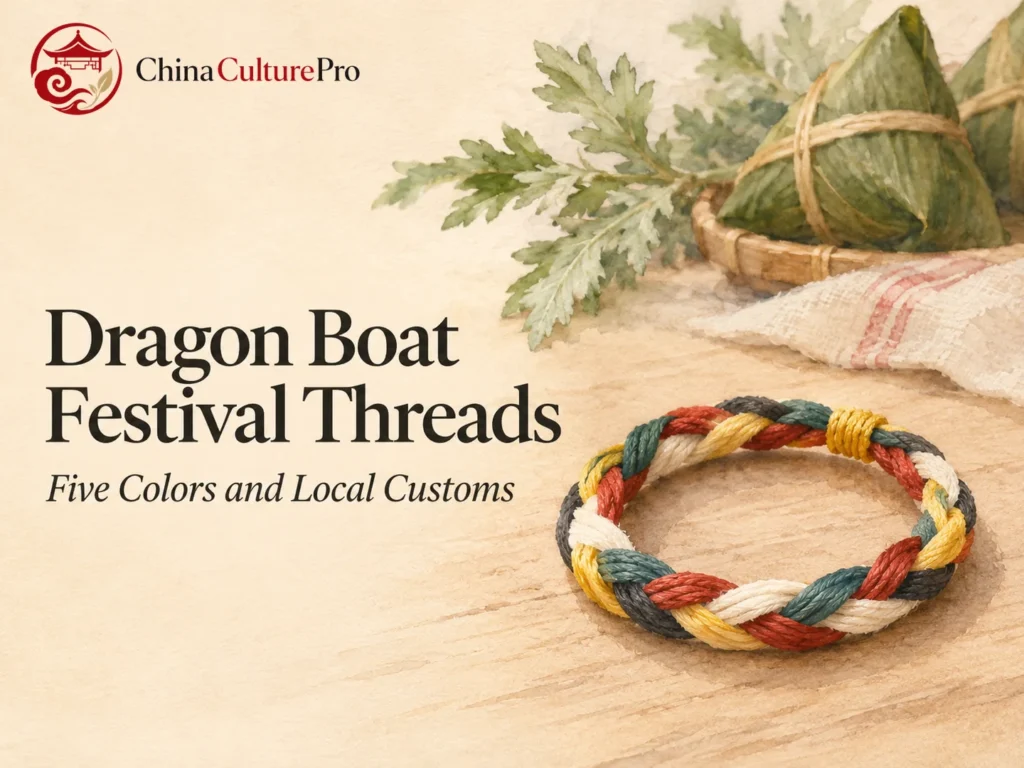

Quick Answer: What Are Dragon Boat Festival Five-Color Threads?
Five-color threads (五色丝, wǔsè sī) are a traditional adornment for the Dragon Boat Festival (端午节, Duānwǔ Jié), on the fifth day of lunar month five. Older accounts describe tying colored silk around the arm as a wish for protection. In some communities elders tie similar cords on children’s wrists or ankles. [1][2][3][4]
- Colors: One traditional set is blue-green (青, qīng), red, white, black and yellow. [2][3]
- Meaning: The threads can express a wish for safety or long life. [2][3]
- タイミング: Communities differ in when they put the cords on and when they take them off. [3][4]
Five-colored cord is one of several protective objects associated with the festival. [1][3]
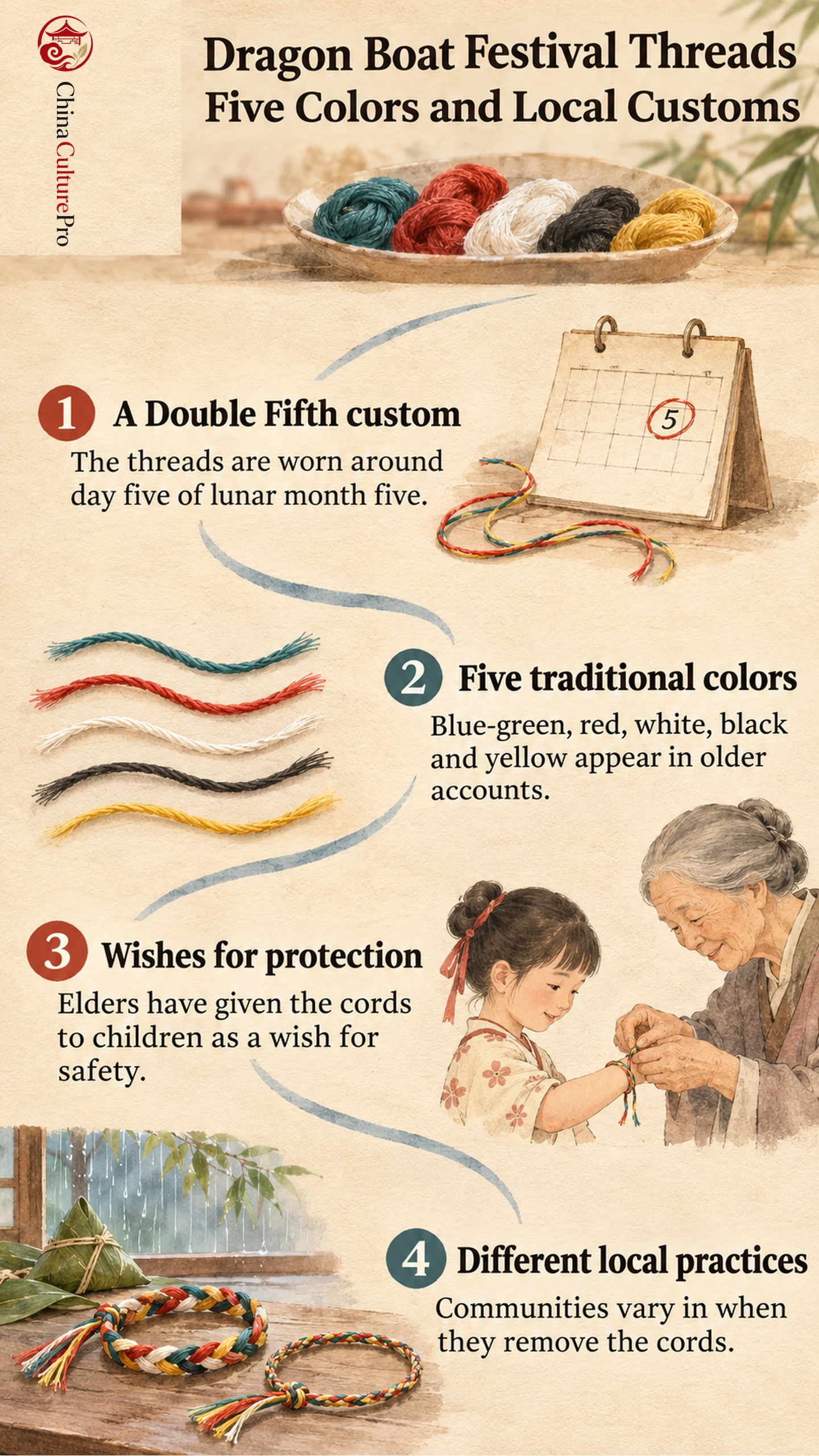
In a Dunhuang account, adults tie the colored cords while children sleep on the eve of the festival. By morning the children have a small gift that expresses a wish for a safe summer. [2][3][4]
What the Old Accounts Call the Threads
The Seasonal Records of Jingchu describes colored silk tied on the arm on the fifth day of the fifth lunar month. In its notes the cord has several names, including long-life thread (长命缕, chángmìng lǚ) and life-prolonging thread (续命缕, xùmìng lǚ). Those names preserve the wishes people attached to the practice. [2][3]
The threads belong among the protective customs of the Dragon Boat Festival, alongside objects such as aromatic plants and sachets. UNESCO’s account of the festival includes wearing five-colored silk and notes that celebrations vary by region. [1][3]
What the Five Colors Refer To
A note in the Seasonal Records of Jingchu assigns red, blue-green, white and black to the four directions and yellow to the center. The note mentions this palette while describing an ornament worn on the chest. The same five color names appear in scholarship on festival cords. The word qīng covers shades that English often names separately, so translations may give blue or green. [2][5]
The note helps explain why writers associated the five colors with a complete set of directions. A cord can draw on that association without giving every strand a separate meaning. [2][3][5]
When Families Put On and Remove the Cords
A Dunhuang cultural account describes adults tying cords around children’s wrists and ankles on the eve of the festival. It describes removal after the first heavy rain following the festival, when the water was believed to carry away illness. The rain supplies a local cue for the end of the custom. [4]
A study on China’s intangible cultural heritage platform describes Naxi families tying five-colored cotton cords called life-prolonging threads (续命线, xùmìng xiàn). In the custom it describes, children kept them until the end of a Torch Festival observance in lunar month six. [3][4]
FAQs About Dragon Boat Festival Threads
Are the threads always silk?
Several early accounts describe silk. The Naxi practice documented by China’s heritage platform uses cotton. [2][3]
Do children take them off on the same day everywhere?
The accounts differ. A Dunhuang example uses the first heavy rain after the festival. A documented Naxi custom keeps the cords until a festival in lunar month six. [3][4]
出典
[1] UNESCO Intangible Cultural Heritage. Dragon Boat Festival
[2] Zong Lin, Seasonal Records of Jingchu. Fifth Day of the Fifth Month
[3] China Intangible Cultural Heritage Digital Museum. Traditional Festivals and Ideas of Harmony
[4] Silk Road Dunhuang Cultural Expo. Dragon Boat Festival Customs in Dunhuang
[5] Lin Jifu and Zhou Man, China Intangible Cultural Heritage Digital Museum. The Cultural Traditions of the Dragon Boat Festival