


Quick Answer
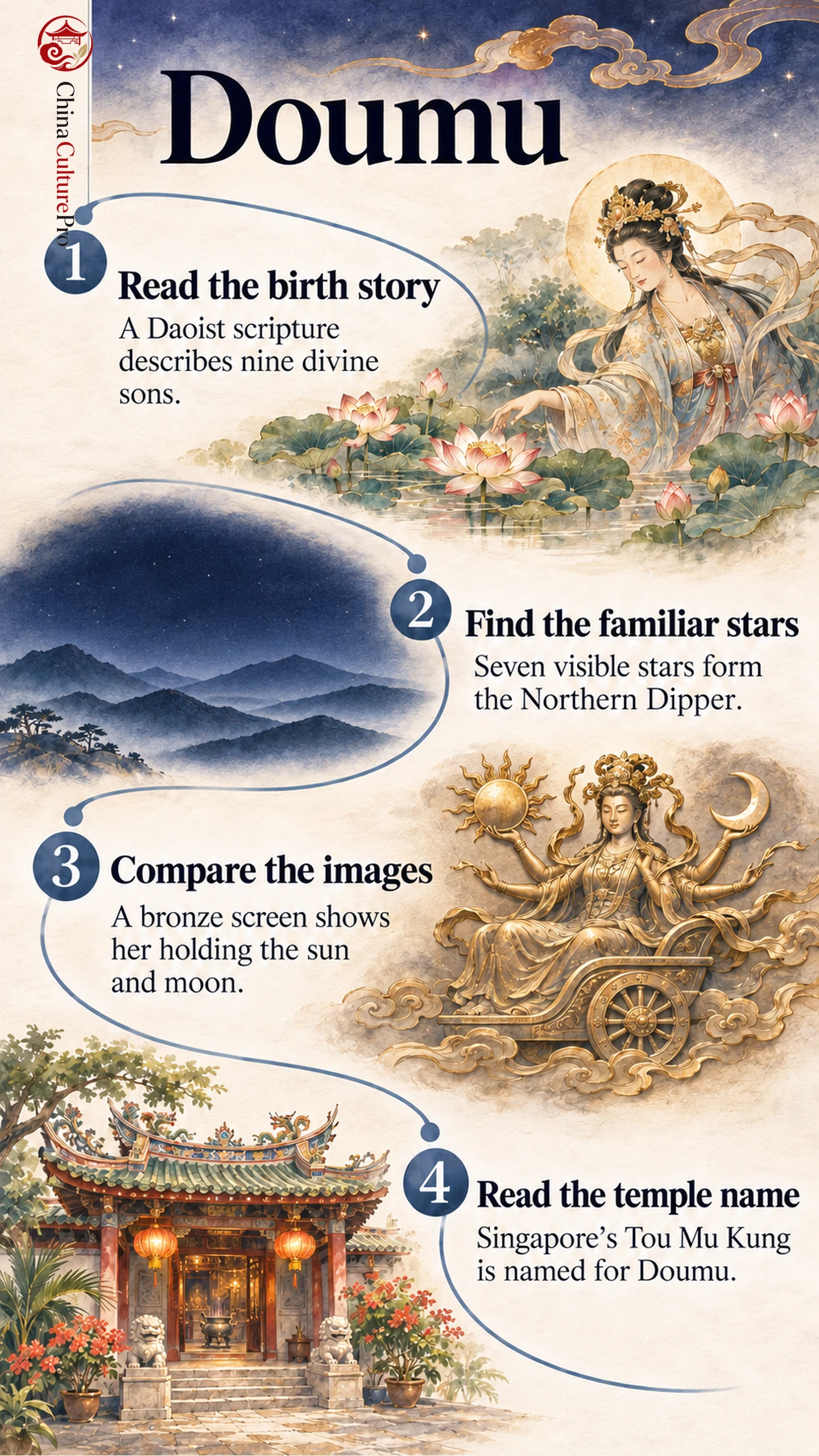
Doumu (斗姆, Dǒumǔ), the Dipper Mother, is a Daoist goddess associated with the stars of the Northern Dipper (北斗, Běidǒu). In one scripture she is the mother of nine divine sons, seven of whom correspond to the familiar Dipper stars. Devotees have appealed to her in hopes of longevity and protection from calamity.[1][2][3]
- Stars: The familiar Big Dipper is formed by seven visible stars.
- Images: Doumu can have multiple arms and hold the sun and moon.
- Worship: A temple named for her can also be a center for devotion to her sons.
Religious accounts differ in how they explain the number nine.[1][3]
A small gilded bronze screen shows Doumu at the center of a celestial procession. She rides in a chariot with the sun and moon among the objects in her hands. An animal head in the composition gives another clue to the history of the image.[4]
How Seven Stars and Nine Sons Fit Together
In a Daoist scripture about the origin of the Dipper, the Lady of Purple Radiance (紫光夫人, Zǐguāng Fūrén) has nine sons through a story involving nine lotuses. Seven correspond to the familiar Dipper stars. The other two receive distinct divine titles, the Celestial Sovereign and the Ziwei Emperor (紫微大帝, Zǐwēi Dàdì). The birth story treats the stars as a divine family.[1]
Another account describes the Nine Emperor Gods (九皇爺, Jiǔhuángyé) through the seven visible stars and two invisible assistants. These are ways of making sense of the number nine in worship. In astronomy, the familiar seven stars form an asterism within Ursa Major.[1][3]
Why Doumu Can Look Different Across Images
The gilded screen, dated approximately 1500–1700, depicts Doumu holding objects including a bow, a bell, the sun, and the moon. Its museum catalogue identifies a boar’s head with the Buddhist goddess of dawn, Marichi. The same figure therefore brings together a Daoist celestial retinue and a feature associated with a Buddhist goddess.[4]
A Dehua porcelain Doumu dated approximately 1700–1800 sits on a lotus with a third eye and eighteen arms. Songshan Fengtian Temple describes its own form with four heads and eight arms. The two sources show why the number of arms needs to be read with other attributes and the object’s setting.[2][5]
Where the Dipper Mother Is Honored
Songshan Fengtian Temple in Taipei marks Doumu’s sacred birth on the ninth day of the ninth lunar month. In Singapore, Tou Mu Kung takes its official name from Doumu, while its principal devotion is to the Nine Emperor Gods. The temple marks the close of their nine-day festival on that same lunar day.[2][3]
In Singapore the name Jiu Huang Ye can be read as “Nine Emperors” or “Ninth Emperor.” This helps explain why a place dedicated to the Dipper Mother’s offspring may describe its principal devotion in the singular. For the wider context of worship and divine offices, see religious Daoism.[3]
FAQs About Doumu
Why is Doumu called the Dipper Mother?
Her name and stories connect her to the Northern Dipper. In one Daoist scripture, seven of her sons correspond to its familiar seven stars.[1]
Is Doumu always shown with eight arms?
The number varies. A Taipei temple describes an eight-armed form, while a Dehua porcelain example has eighteen.[2][5]
What is the connection between Doumu and Marichi?
Some objects combine their visual traits. On the gilt bronze screen, the boar’s head is associated with the Buddhist goddess Marichi, and the celestial chariot centers on Doumu.[4]
出典
[1] Kew Ong Yah Temple. The Northern Dipper, Dipper Mother, and Nine Emperors
[2] Songshan Fengtian Temple. Mother of the Great Chariot
[3] Singapore National Heritage Board. Tou Mu Kung
[4] Asian Art Museum, San Francisco. Table screen depicting the Daoist deity Doumu and her entourage
[5] Asian Art Museum, San Francisco. The Daoist deity Doumu, Dehua porcelain