
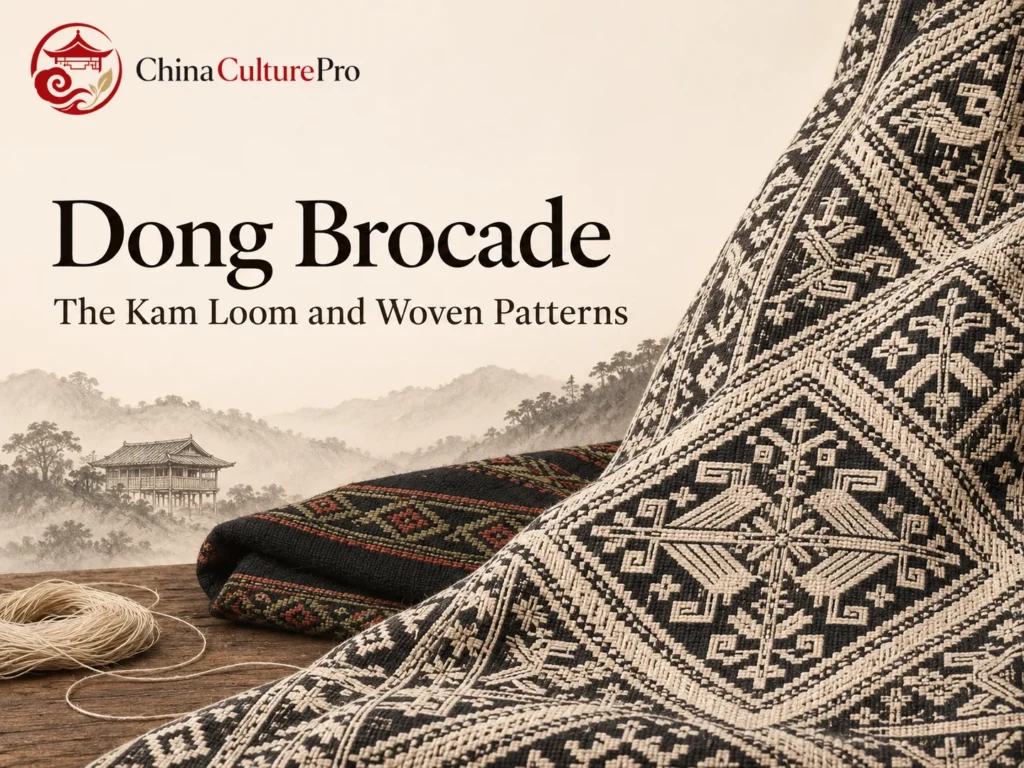

Quick Answer: What Is Dong Brocade?
Dong brocade (侗锦, dòngjǐn) is a patterned textile woven by Dong, also called Kam, communities. Tongdao in Hunan is a center of the craft. On a traditional loom documented there, additional crosswise threads make the design as the cloth is woven.[1][2]
- Materials: A cotton ground can carry cotton or silk pattern threads.[2]
- 外観: Tongdao examples include black-and-white and multicolored cloth.[1][3]
- Use: Woven designs appear on baby carriers and wedding bedcovers, among other objects.[2][3]
The national heritage listing for the Tongdao weaving tradition dates to 2008.[1]
A wedding bedcover can be read in two ways. From across the room you see the finished design. Up close you can follow the pattern threads across the fabric. The Dong loom described by the China National Silk Museum has separate controls for the ground and the patterned passages.
How the Slanted Dong Brocade Loom Works
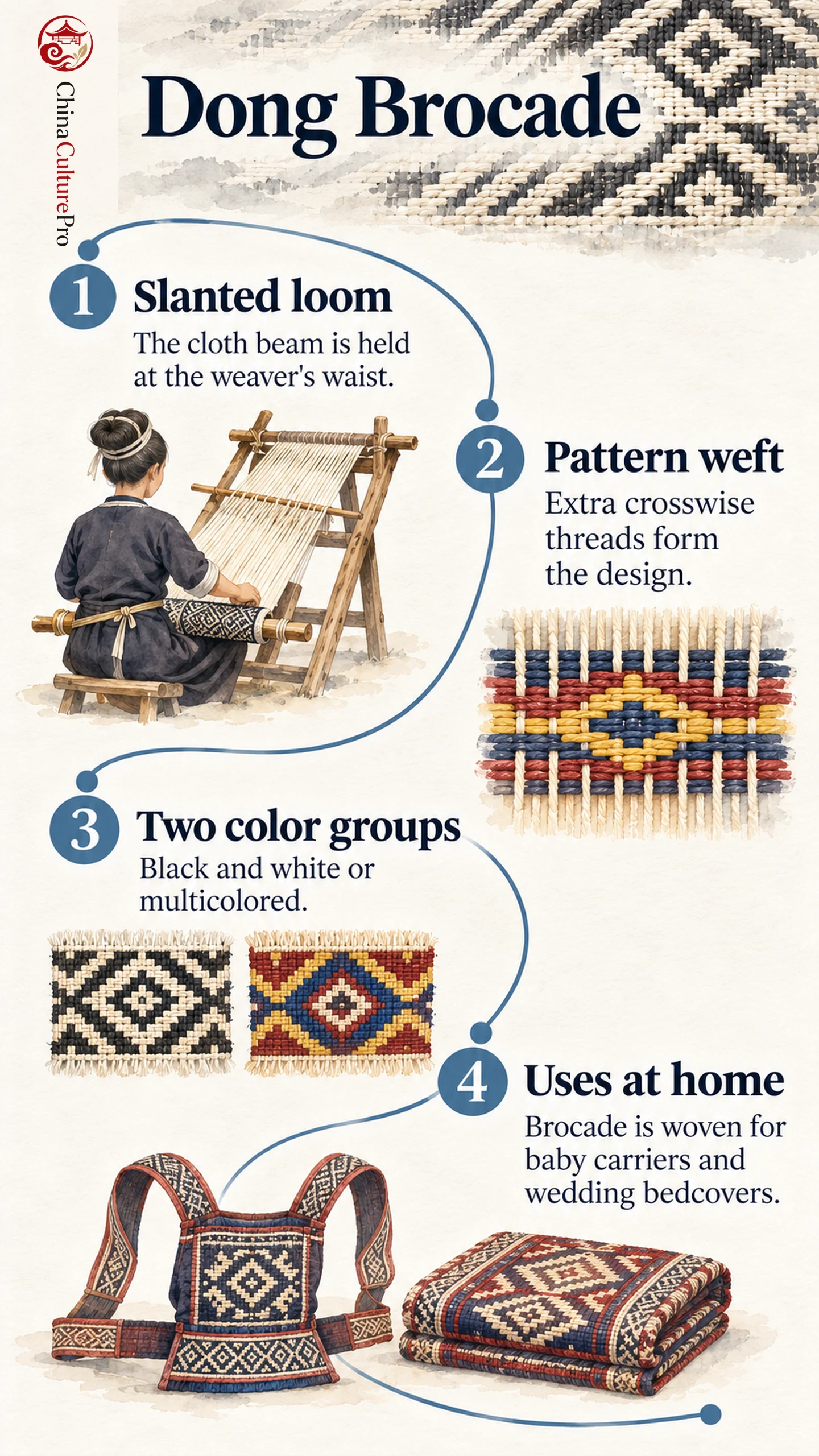
The China National Silk Museum describes a slanted loom (陡机, dǒujī) used around Tongdao and in parts of nearby Guizhou. The beam holding the lengthwise warp threads is fixed to the loom. The cloth beam is attached at the weaver’s waist, so the weaver can control tension with her body.[2]
Two cords at the feet serve different purposes. One lifts the ground heddle, a set of guides that lifts warp threads to open a passage for the ground weave. The other lifts the pattern heddle. Sticks above the warp store the thread selections needed for the pattern. An extra weft crosses the warp in those selected passages, adding visible color and shape as the ground is made.[2]
The museum compares the pattern storage to a loom used for Dai brocade in Yunnan. A repeated band calls for the same sequence of thread selections each time. The stored pattern lets the weaver return to those selections.[2]
Black-and-White and Multicolored Dong Brocade
Hunan’s account of Tongdao weaver Su Tianmei distinguishes black-and-white brocade (素锦, sùjǐn), made with black and white cotton threads, and multicolored brocade (彩锦, cǎijǐn), in which additional colors form designs with those threads. A black-and-white cloth can have a distinct woven design. Its contrast comes from the placement of the two yarn colors.[3]
The official heritage entry records preparation from cotton processing and spinning through dyeing, laying out the warp and weaving. Su Tianmei learned by watching and practicing with older makers in her community. In one account she recalls selecting the wrong number of threads as a young weaver, a detail that shows how much precision goes into a small woven figure.[1][3][4]
Brocade for Carriers, Bedding and Ceremonies
A baby carrier and a wedding bedcover serve different purposes, but both can use a cotton ground with a figured surface. The Hunan account also lists mats, headcloths, material for clothing and leggings as household uses. The finished object tells you how the textile was cut, joined and worn. The guide to traditional Chinese clothing explains how to separate fabric from garment shape.[2][3]
Some cloths also served funerary or ritual purposes. Hunan’s account distinguishes brocade placed in a coffin from cloths that could be hung or worn during ceremonies. The household, funerary and ritual labels describe where a textile was used. The black-and-white and multicolored labels describe its yarn and design. The two sets of labels answer different questions about the same object. Tujia brocade offers another regional example of woven textiles used in bedding and family life.[3]
FAQs About Dong Brocade
Is Kam brocade another name for Dong brocade?
Yes. Kam and Dong refer to the same people in this context. The China National Silk Museum uses both names in its description of the loom.[2]
Does Dong brocade contain silk?
It can. The loom description identifies cotton as the usual ground and cotton or silk as options for colored pattern wefts.[2]
Does black-and-white brocade have a woven pattern?
Yes. In Tongdao’s classification it uses black and white threads, which can form a design through their arrangement in the weave.[3]
出典
[1] China Intangible Cultural Heritage Digital Museum. Dong Brocade Weaving
[2] China National Silk Museum. Dong and Kam Brocade Loom
[3] Hunan Provincial People’s Government. Su Tianmei and Dong Brocade
[4] China Intangible Cultural Heritage Digital Museum. Handcraft Transmission in Local Customs