

Quick Answer: Why Does Shen Zhou Pair a Flower with Large Writing?
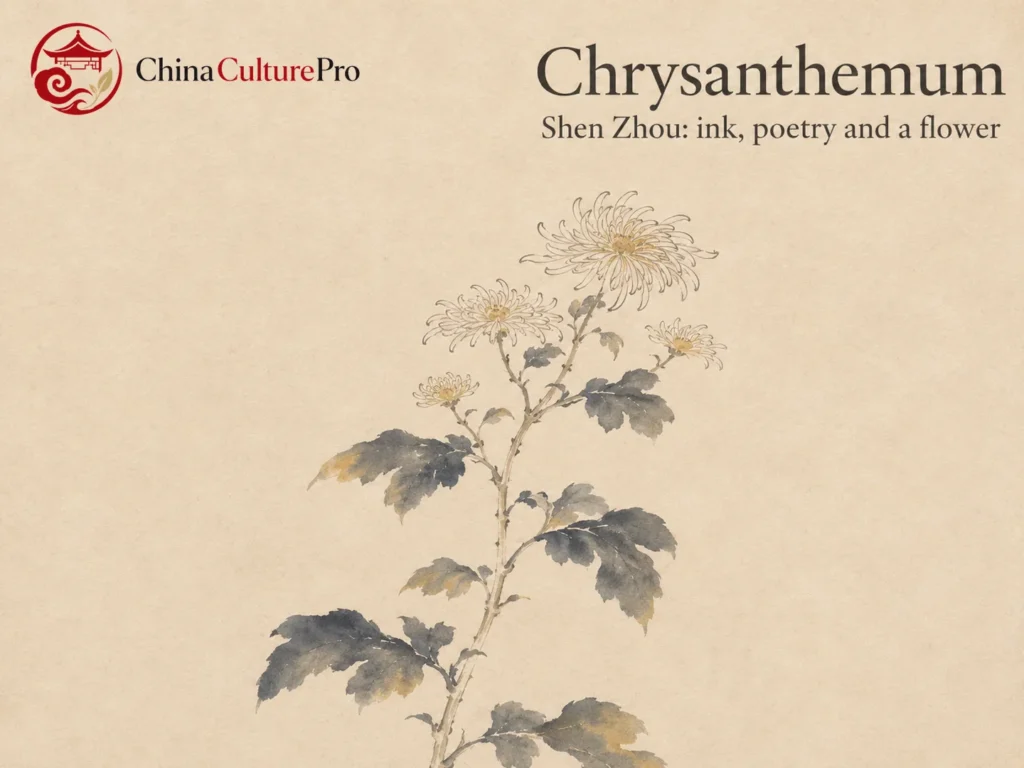
Chrysanthemum (墨菊, Mò Jú), by Shen Zhou (沈周, Shěn Zhōu), places a single ink-painted plant below a substantial poem in the artist’s own calligraphy. The writing is a major part of the composition.
- Collection: National Palace Museum, Taipei; identifier 故畫000449.
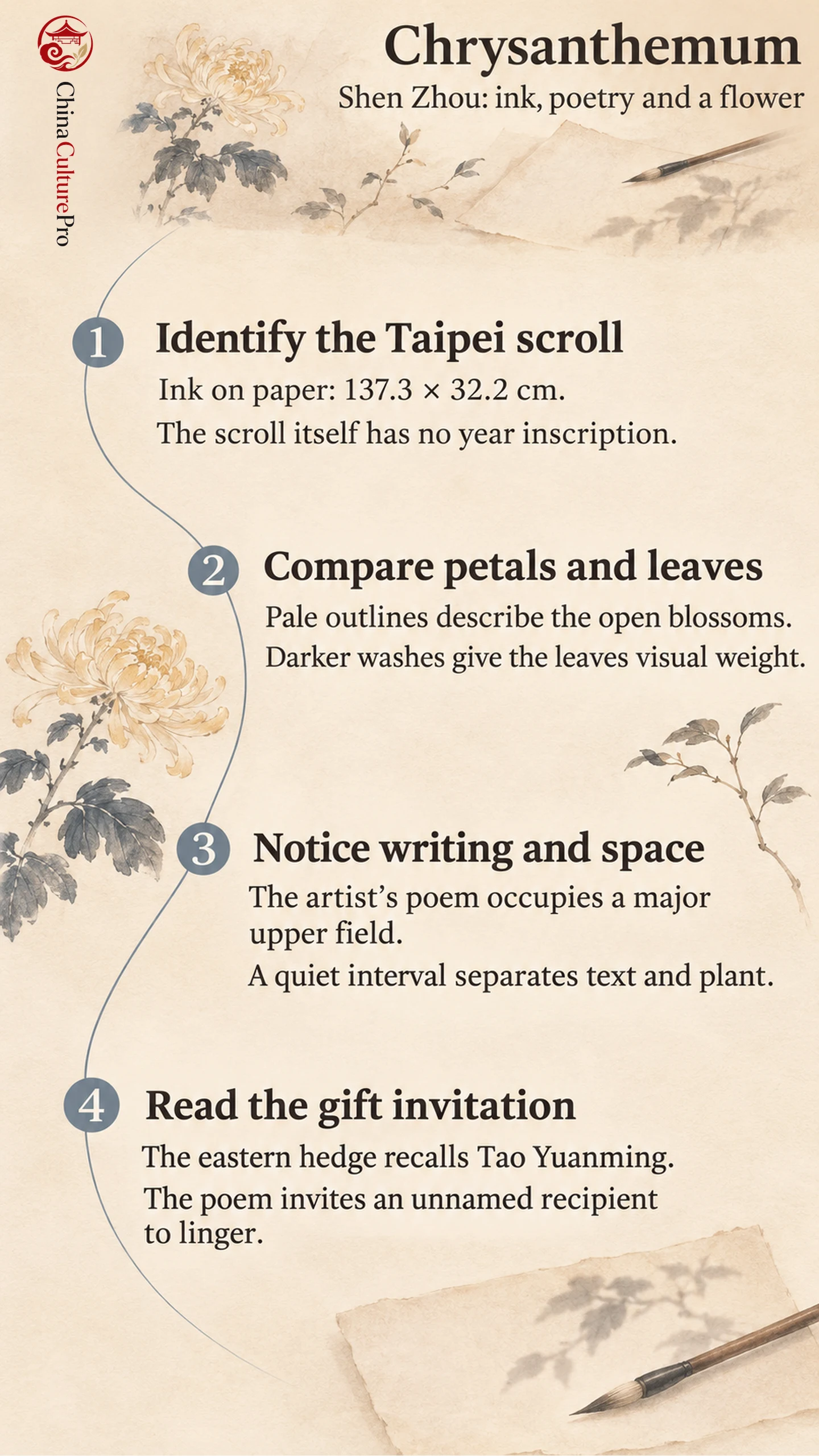
- Medium and size: Ink on paper, 137.3 × 32.2 cm.
- Look first: Compare the pale flower heads with the darker leaves.
- Then look upward: Notice the large written strokes and the quiet interval above the plant.
The work rewards looking at brush marks as both botanical description and written form.
The plant rises on a slender, lightly drawn stem. Its upper blossoms spread outward in fine pale lines, while darker leaves interrupt the ascent at uneven intervals. There is no elaborate garden setting around it.
Above, the poem occupies a conspicuous area of the narrow sheet. The eye can move between two different densities of ink: broad written characters in the upper field and the smaller, clustered marks of leaves and flowers below.
Identify the Narrow Taipei Scroll
The museum calls the work Monochrome Ink Chrysanthemums. It records a paper hanging scroll measuring 137.3 cm high by 32.2 cm wide, with Shen Zhou’s poem and signature. The work has no year inscription. Its Chinese catalog discussion tentatively places it near the artist’s 1494 Sketches from Life album. [1]
Treat that proposed connection as a comparison, not as a date visibly written on this scroll. The tall, narrow object should also remain distinct from an album leaf of a chrysanthemum by the same painter.
The bird-and-flower painting guide explains the larger subject category. A flower painting can give sustained attention to a single plant without depicting either birds or a complete garden.
Look at the whole sheet before enlarging a blossom. Its proportions make the interval between writing and plant especially conspicuous. A detail alone cannot show how much of the vertical field each occupies.
Compare Pale Petals with Dark Leaves
The heritage account emphasizes the plant’s tall posture and the stronger visual impact of washed-in leaves compared with lightly outlined blossoms. It places Shen’s work within expressive painting (写意, Xiě Yì), while also noting the observation underlying his treatment of flowers. [2]
Begin with one open flower head. Fine lines radiate outward, leaving much of the paper visible between them. Beside it, a leaf can appear as a broader, more continuous ink shape.
Compare neighboring leaves rather than treating them as identical dark accents. Some are more saturated; others show lighter interiors or separate strokes. Their irregular edges and changing directions prevent the stem from becoming a straight decorative border.
Now follow the stem upward from near the bottom. It is considerably paler than many leaves. At some points, the darker side growth makes the thin connecting structure easier to locate; elsewhere, it nearly disappears against the paper.
Compare the darkest leaf beside an open blossom with the pale stem below it. Each asks for a different degree of attention.
The painting-techniques guide develops the distinction between line and wash. Here, compare a petal’s narrow outline directly with a leaf’s wider ink area before applying a general label to the whole plant.
Give the Calligraphy Its Share of the Picture
The museum notes the unusual weight given to writing and painting, with a small interval between the two. The poem consists of four seven-character lines, although their placement on the sheet should be read as calligraphy rather than as a modern printed stanza. [1]
The written characters are larger than the flower’s individual marks. Some strokes broaden and settle firmly; others narrow, turn or extend. Even without reading Chinese, compare those changes with the leaves’ broad shapes and the petals’ thinner lines.
Look at the end of the inscription, where the artist’s name appears. Then follow the empty space down toward the topmost flower. The gap lets the two areas remain distinct within one narrow composition.
The inscriptions-and-seals guide explains why an inscription may do more than identify a painter. In this work, its scale and placement make it part of what the viewer sees, as well as something to read.
Keep the reddish collecting marks separate in your attention. Compare the artist’s dark writing with the plant below before examining individual collecting marks.
Read the Eastern Hedge and the Gift
The museum’s 2025 discussion connects Shen’s chrysanthemum poetry with Tao Yuanming (陶渊明, Táo Yuān Míng) and the poet’s eastern-hedge association. It also notes Shen’s own cultivation of chrysanthemums, bringing literary memory together with an interest in plants. [3]
The same exhibition text reproduces this scroll’s poem. In paraphrase, Shen presents an autumn chrysanthemum from the eastern hedge, evokes a delicate late-season presence and offers it to someone who should appreciate it while opening a wine vessel. The poem gives the painted flower a social life as a gift. [3]
That address changes the encounter. The plant is not simply an isolated specimen: a written voice asks another person to spend time with it. The wine belongs to the poem’s invitation, not to a pot visibly painted beside the stem.
The Tao Yuanming guide explores the literary background. The Chinese poetry guide provides a wider introduction to verse forms and reading context.
Return to the pale blossoms after reading the poem. Compare their restrained ink with the darker leaves and more emphatic writing. The poem’s invitation to linger gives the lightly drawn flower another reason to hold the viewer’s attention.
FAQs About Chrysanthemum by Shen Zhou
Was the scroll painted in 1494?
It is undated. The museum’s Chinese text proposes a connection with the 1494 Sketches from Life album; that is a suggested chronology rather than an inscribed year.
Does the pale ink mean the blossoms are white?
Pale ink describes their appearance within this monochrome painting. It does not, by itself, establish the original flowers’ botanical color or cultivar.
Does the poem name the person receiving the gift?
The recorded poem addresses a recipient but does not provide that person’s name. A particular friend’s identity should not be supplied without further evidence.
出典
[1] National Palace Museum. Monochrome Ink Chrysanthemums: digital collection record
[2] Bureau of Cultural Heritage, via National Cultural Memory Bank. Shen Zhou: Monochrome Ink Chrysanthemums
[3] National Palace Museum. Shen Zhou’s Observation of Nature: plants, Chinese exhibition text (2025)