


Quick Answer: What Are Suitable Chinese Wedding Wishes?
A straightforward Mandarin wedding wish is 新婚快乐 (traditional: 新婚快樂, xīnhūn kuàilè), wishing the couple happiness in their new marriage. A brief congratulation can be followed by a wish for their shared life. [6]
- Address the couple: Include both people when the message is for their marriage.
- Choose a meaning: Happiness, lasting harmony, united hearts and growing old together make different wishes.
- Keep it usable: One expression you understand can make a complete short greeting.
- Fit the setting: A spoken greeting, a card and a ceremonial speech need different amounts of wording.
The readings here are Mandarin. Regional languages, family customs and a couple’s own preferences can affect how a wedding message is written or spoken.
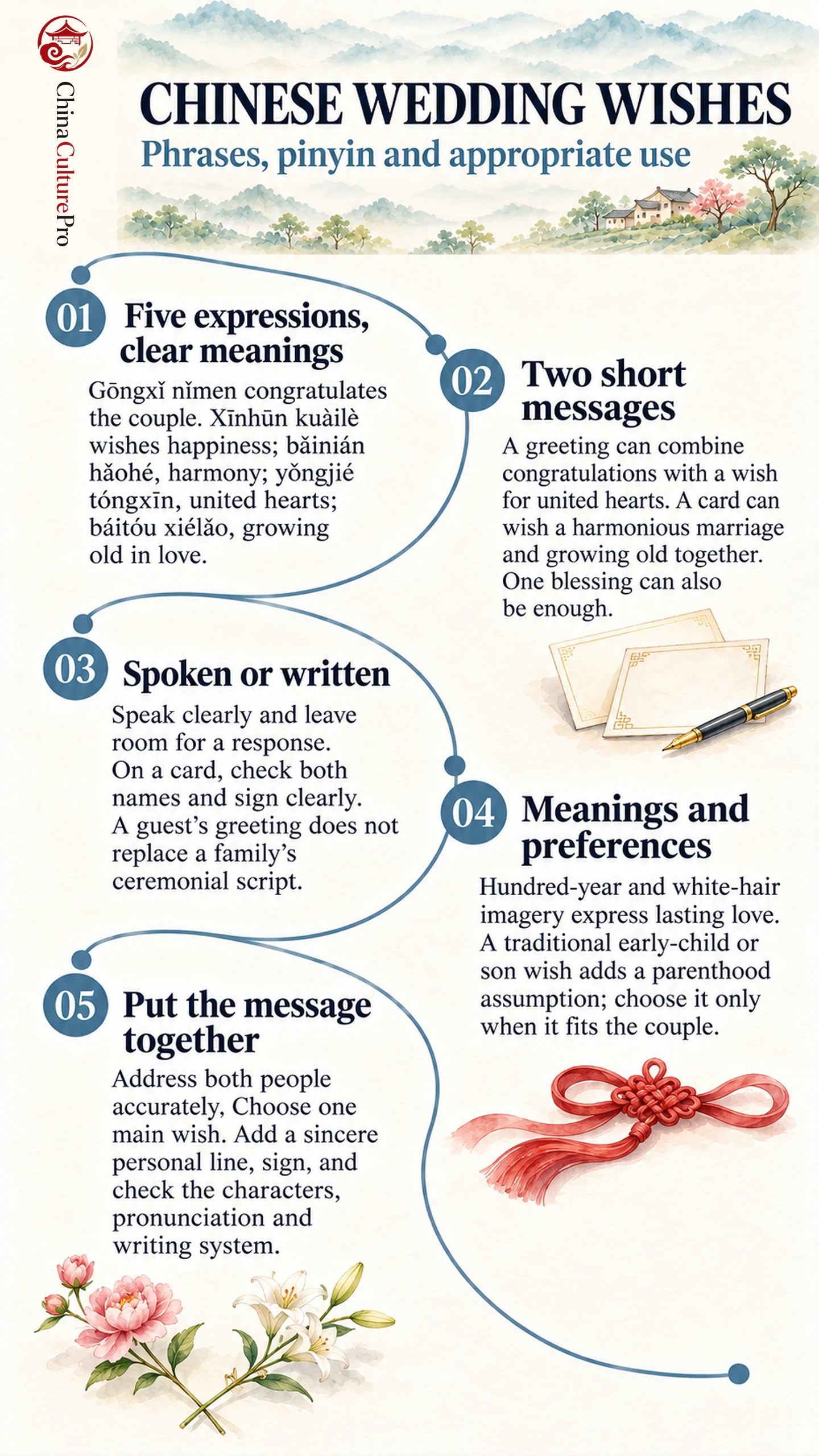
Wedding wishes congratulate two people while looking ahead to their life together. You do not need a catalogue of elaborate sayings to do that well. Start with the meaning you want to convey, then decide whether the message needs anything more personal.
The examples below cover a greeting at the wedding and a short written note. For the broader relationship between address and occasion, see Chinese greetings and etiquette.
Five Wedding Expressions with Pinyin and Meaning
The first expression congratulates the couple; the others make wishes about the marriage. Learn them as complete expressions, rather than selecting characters only for their decorative appearance.
| Expression and Mandarin pinyin | 意味 | What it emphasizes |
|---|---|---|
| 恭喜你们 (gōngxǐ nǐmen) | Congratulations to you both. | Acknowledging the couple’s happy news. [1] |
| 新婚快乐 (xīnhūn kuàilè) | Happiness in your new marriage. | The new marriage itself. [6] |
| 百年好合 (bǎinián hǎohé) | May you enjoy a long, harmonious marriage. | Lasting marital harmony. [3] |
| 永结同心 (yǒngjié tóngxīn) | May your hearts remain united forever. | Hearts remaining connected. [4] |
| 白头偕老 (báitóu xiélǎo) | May you grow old together in love. | A loving life together into old age. [5] |
The new-marriage expression is an established wedding formula. Learn that conventional wording as a whole phrase when you want to wish the newlyweds well. [2] For pronunciation notation, see pinyin.
Some writing changes with the script: 永结同心 becomes 永結同心, and 白头偕老 becomes 白頭偕老. The Mandarin readings in the table remain the same. Match the writing system the couple uses rather than mixing forms casually within a short card. [7]
Two Short Messages for the Couple
These examples combine familiar formulas into a complete greeting. They are suggested wording, not quotations from an actual wedding.
For a short greeting when meeting the couple:
恭喜你们!永结同心! (gōngxǐ nǐmen! yǒngjié tóngxīn!)
“Congratulations to you both! May your hearts remain united forever.” The opening acknowledges the occasion and the second sentence adds a wish for their future together. [1][4]
For a card emphasizing a long shared life:
祝你们百年好合,白头偕老! (zhù nǐmen bǎinián hǎohé, báitóu xiélǎo!)
“May you enjoy a long, harmonious marriage and grow old together in love.” Here, 祝你们 (zhù nǐmen) introduces a wish addressed to the couple. [3][5][6]
You can use just one of the blessings if that says what you mean. If you add a personal sentence, connect it to the couple you know rather than making the message longer with unrelated auspicious phrases.
Speaking at a Wedding and Writing on a Card
A brief congratulation and a wedding wish can suit the moment when you meet the newlyweds. [1] Say the words clearly and leave room for their response. A greeting at the reception does not need to become a speech, particularly when other guests are waiting to speak with them.
A card gives you room to name both people, write a personal line and sign clearly. Check their names against the invitation, including their preferred spelling and order. [7] The guide to Chinese wedding invitations explains the names and wording you may encounter.
Formal ceremonial roles can require fuller, family-specific wording. An ordinary guest’s wish does not replace those roles. If you have been asked to speak during a tea ceremony, consult the tea ceremony script guide and confirm the family’s preferred titles.
For a note accompanying a gift, keep your name readable and the wish short enough for the space. See Chinese wedding gifts for the gift’s separate cultural context.
Traditional Meanings and the Couple’s Preferences
The hundred-year imagery in a long-harmony wish expresses an enduring marriage. It is not a precise deadline. [3] The white-hair imagery in a growing-old-together wish similarly concerns lasting love through old age. [5] These meanings explain why the phrases can feel substantial even when they are only four characters long.
Another traditional expression, 早生贵子 (zǎoshēng guìzǐ), wishes for the early birth of a child, traditionally a son; the older wording is often rendered as wishing for a “noble son” soon. [2] It therefore adds a wish about parenthood, rather than simply repeating “happy marriage.” Use it only when you know that wish fits the couple’s preferences.
A wish about happiness or harmony lets you congratulate the marriage without making an assumption about children. You can respect a traditional expression’s meaning while choosing a different one for a particular couple.
For the wider event, see Chinese wedding traditions および wedding guest etiquette.
How to Put Your Wedding Message Together
Use these steps for a short note or a greeting you can practise aloud:
- Address both people accurately: Use the names and preferred forms shown on the invitation or supplied by the couple. Check the spelling rather than creating unfamiliar Chinese versions of their names.
- Choose one main wish: Select a greeting whose meaning fits the marriage and the relationship you have with the couple. Add another blessing only when it contributes a wish you want to make.
- Add a personal line and sign: Write one sincere sentence in a language you use with the couple, then sign clearly. Check the characters, pronunciation and writing system before sending or speaking.
FAQs About Chinese Wedding Wishes
Can I combine English with one Chinese wedding wish?
Yes. A personal note in English can end with a Chinese wish you understand. Use the language you normally share with the couple and keep the meaning clear. [7]
Is a new-marriage wish the same as an engagement congratulations?
No. The new-marriage wording concerns the marriage. You can congratulate an engagement as happy news without describing the couple as newly married; Mandarin congratulations covers the broader expressions. [1][2]
Do simplified and traditional characters have different Mandarin readings?
The corresponding forms shown here have the same Mandarin readings. That does not establish their pronunciation in another Chinese language: script choice and spoken language are different questions. [7]
出典
[1] ChineseClass101. How to Say Congratulations and Express Condolences
[2] Juliane House and Dániel Z. Kádár. Learning Chinese in a Study Abroad Context: The Case of Ritual Congratulating
[3] Ministry of Education, Taiwan. Concise Mandarin Chinese Dictionary: 百年好合
[4] Ministry of Education, Taiwan. Concise Mandarin Chinese Dictionary: 永結同心
[5] Ministry of Education, Taiwan. Concise Mandarin Chinese Dictionary: 白頭偕老
[6] SayMei. Chinese Wishes for Every Occasion
[7] Stellar Chinese. Congratulations in Chinese, from Wedding Cards to Big Promotions