


要点:伝統的な中国の時刻制度はどのように機能していた?
Chinese timekeepers read time from the position of a shadow, the level of water or the progress of a slowly burning trail. Each instrument worked under different conditions.
- A shadow gives the time of day. A sundial (日晷, rìguǐ) uses the shadow of a rod and markings on a dial. It needs direct sunlight and the right alignment. [1]
- Flow keeps time without sunlight. A water clock (漏刻, lòukè), also called a clepsydra, tracks water entering or leaving a vessel. A marked scale or a floating indicator translates a level into a reading. [2]
- Burning measures an interval. An incense seal (香篆, xiāngzhuàn) uses a prepared trail of incense powder. The distance an ember has traveled helps a reader estimate elapsed time. [3]
The object alone does not tell you how long a division lasted. Read its scale and identify the conditions under which it was meant to work.
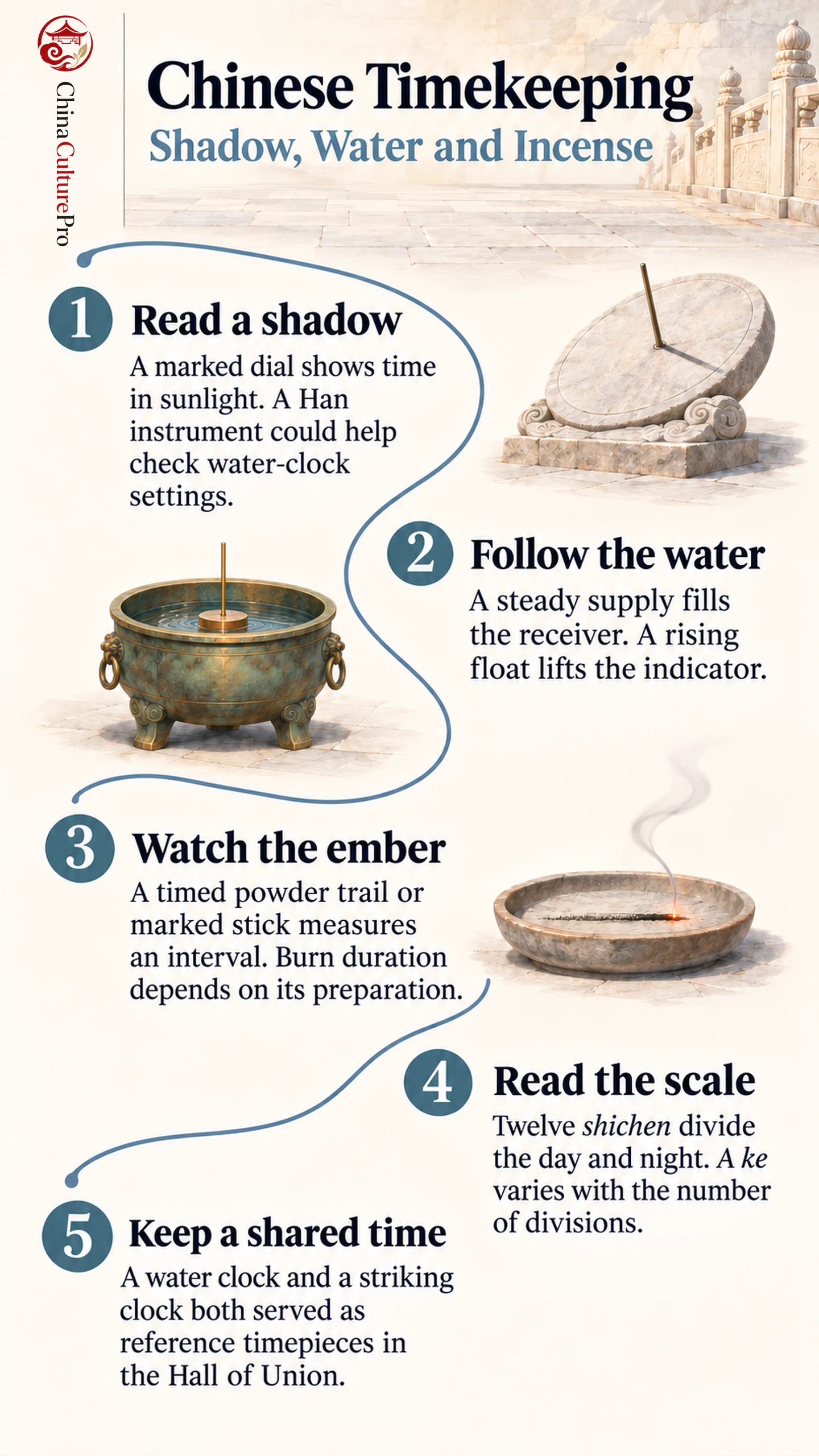
A round sundial on a palace terrace looks like a clock face. The numbered marks on a square Han stone served a different purpose. Reading those two objects side by side shows why understanding a timekeeper starts with the question it was built to answer.
Sundials and the Moving Shadow
On a familiar palace sundial, a metal rod called a gnomon stands perpendicular to a round stone dial. The dial itself tilts on its base. When sunlight strikes the rod, the shadow crosses engraved time marks as the Sun appears to move. The alignment matters because the positions of the marks only work for a dial set up as intended. Cloud, deep shade and darkness interrupt the reading. [1]
A surviving Han sundial uses a square stone with a circular pattern of radiating lines and holes. There are 69 numbered marks on the object. The original rods are missing. One interpretation reconstructs a horizontal instrument whose rods were aligned with sunrise and sunset to determine daylight length. A timekeeper could use that reading to adjust a water clock for the changing balance of day and night. [4]
The useful distinction is between reading a time and measuring a duration. A water-clock attendant who knew the length of daylight could change how the clock accounted for daytime and nighttime as the seasons shifted. [4]
Water Clocks and the Problem of Steady Flow
As water leaves a simple vessel through an opening, its level drops. A lower water level exerts less pressure at the outlet, so the flow slows unless the device compensates for it. Regulating the water supply keeps each equal rise of the float closer to an equal interval. [4][2]
A four-vessel bronze clepsydra cast in 1316 during the Yuan dynasty shows how the parts worked together. Water passed downward through three vessels before reaching the receiver. An overflow hole near the top of the third vessel let excess water escape so the level supplying the receiver could remain steady. Water collecting in the lowest vessel lifted a float and its wooden indicator. The timekeeper read the top of the rising indicator against a fixed scale. [2]
A water-powered clock could also use flow to move machinery. The Song-era astronomical tower of Su Song (苏颂, Sū Sòng) used a mechanism that released a waterwheel in increments. That is a different design from a clepsydra whose float shows the reading directly. Both depend on controlling the effect of flowing water. [5]
Incense Clocks and Measured Burning
A powder clock begins with a path shaped by a stencil. A single glowing front advances along the path. Someone who knows the intended burn rate can tell roughly how much of the interval remains by looking at the unburned portion. Different stencils can make paths for different durations. A lattice lid on one surviving Chinese incense clock limits drafts while letting smoke escape. [3]
A marked incense stick can also measure elapsed time as the burning front reaches successive marks. Its value as a clock comes from an expected rate of burning and a known starting point. Length, material and airflow can all affect the result. A stick made for fragrance or offering does not have to match the burn time of a stick prepared for timing. [3][6]
Incense timing was used in temples, government offices and scholars’ studies. It suited tasks that needed a span of time to be measured indoors, without a view of the Sun. The use of incense for fragrance or offering could occur in the same settings. [3][6]
Time on the Scale: Shichen and Ke
A shichen (时辰, shíchén) is one of twelve periods that divide a full day and night. In the familiar twelve-part division it spans two modern hours. The twelve Earthly Branches (地支, dìzhī) name the periods. They appear on the scale of the 1316 clepsydra, making the height of the float legible as a time of day. [2][7]
A ke (刻, kè) was a smaller time unit whose length depended on the division in use. If the day is divided into 100 equal parts, each is 14 minutes and 24 seconds. With 96 equal parts, each is 15 minutes. The Han stone pattern is consistent with a hundred divisions, while a 1644 horizontal sundial in the Qing court used 96 and included seasonal lines related to the 24 solar terms. The seasonal marks relate to the solar year, while hour lines mark the course of the day. [4][8][7]
How Different Clocks Worked Together
The copper clepsydra and striking mechanical clock in the Hall of Union served as reference timepieces in the Forbidden City. Their presence in the same room shows how different mechanisms could share an institutional job. Both helped set a common reference for other clocks across the palace. [9]
Placement could give an object a second meaning. On a palace terrace, a sundial might stand near an official capacity measure. The pair presented the court’s authority over the standards by which people measured time and quantities. That setting links the instrument to palace layout and ceremonial space as well as to the movement of a shadow. [1]
FAQs About Chinese Timekeeping Instruments
How did ancient Chinese timekeepers work at night?
A clepsydra could be read without the Sun as long as its flow and scale stayed usable. Timed incense could also track a span after dark. A sundial needed a visible solar shadow. [1][2][3]
How long was a shichen?
In the twelve-part system, one shichen covers two modern hours. It is a named division of the day, distinct from smaller divisions called ke whose duration could vary by system. [7]
How long is one stick of incense?
There is no universal conversion from one stick to minutes. A timed stick needs a known burn duration for its particular form and conditions. A reference to “one stick of incense” in a story therefore gives an approximate interval unless the writer also specifies the timing convention. [3][6]
出典
[1] The Palace Museum. Sundial
[2] National Museum of China. Bronze Clepsydra
[3] Science Museum Group. Chinese Incense Clock
[4] National Museum of China. Han Sundial
[5] Science Museum Group. Scale Model of Su Song’s Water-Balance Escapement
[6] Silvio A. Bedini. The Trail of Time: Time Measurement with Incense in East Asia
[7] Zeng-Hui Hwang, Tsung-Yi Lin and Hong-Sen Yan. Reconstruction Designs of an Early Chinese Astronomical Clock with a Waterwheel Steelyard Clepsydra
[8] The Palace Museum. New Method Horizontal Sundial
[9] The Palace Museum. Hall of Union