


Quick Answer: How Do Chinese Families Mark the Seasons at Home?
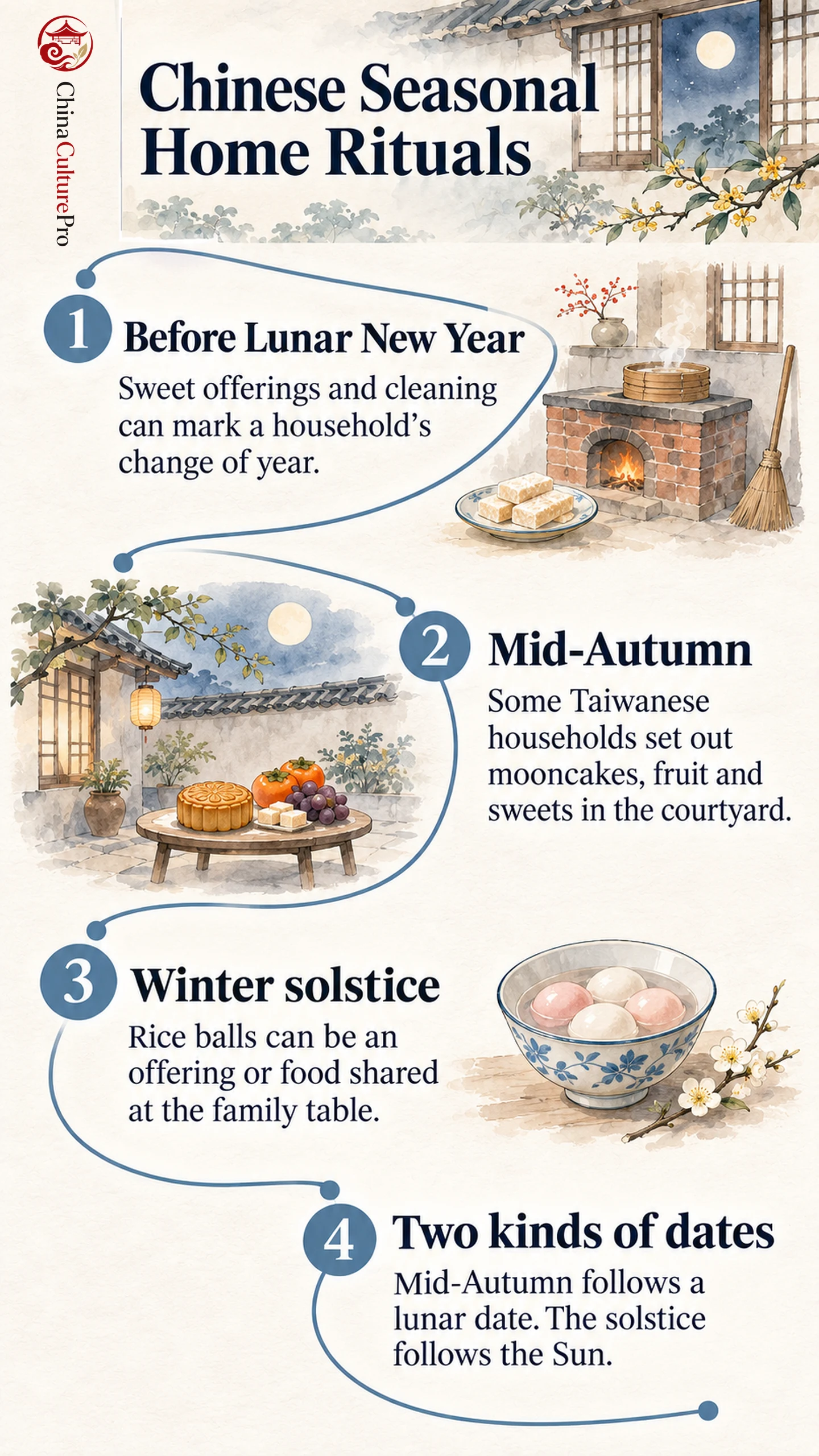
In Chinese seasonal customs, ordinary places such as the stove, the doorway and the family table can take on a ritual role. Some families prepare the home before Lunar New Year, set out food for Mid-Autumn, or make offerings and share rice balls at the winter solstice.[1][2][3]
- Stove and doorway. Cleaning and preparing decorations can mark the change of year.[1][4]
- Courtyard or open space. Some Taiwanese families formerly set food out for the moon.[2]
- Family table. Winter solstice food can be offered and later shared.[3]
The customs vary with region, belief and what a family chooses to observe.
A bowl of rice balls can be a seasonal meal or part of an offering. Its role depends on where it is placed, whom it is meant for and when the family eats it. The sequence of offering and sharing can tell you more about the event than the dish alone.[2][3]
Before New Year: The Stove and the Door
In a documented Taiwanese tradition, households send off the Kitchen God (灶神, Zàoshén) on the twenty-fourth day of the twelfth lunar month. In the associated story, the deity goes to report on the household. Sweet foods such as malt candy express the wish that the report will be favourable.[4][5]
Cleaning the home can also mark the change of year. A Taiwanese account describes clearing dust from images and tablets after the deity’s departure. Other accounts describe preparing the door with fresh couplets for the holiday. One action concerns the shrine inside the home. The other prepares the threshold where visitors will arrive.[1][5]
Mid-Autumn: Setting Out Food Under the Moon
Mid-Autumn falls on the fifteenth day of the eighth lunar month. A Taiwanese account of earlier moon worship (拜月, bàiyuè) describes families setting mooncakes, fruit and sweets in their courtyard at night. The offering moved into the courtyard on the night of the festival.[2][6]
People can still share mooncakes and watch the moon when they do not set out an offering. Mid-Autumn moon worship explains the devotional meaning of that older practice.[2][6]
Winter Solstice: Offerings and the Family Table
In some Taiwanese homes, sweet rice balls (湯圓, tāngyuán) were among the offerings to deities and ancestors for the winter solstice. An older custom included children shaping coloured rice dough into little chickens, dogs or other animals while adults rolled the balls.[3]
The seasonal dishes changed what families set out at the household altar. Winter solstice traditions across Chinese communities show how foods and family practices vary by place.[3]
FAQs About Chinese Seasonal Home Rituals
Do these customs follow a single kind of calendar?
Mid-Autumn follows a date in the lunisolar calendar. The winter solstice is a solar term, determined by the Sun’s yearly cycle. A family may observe both kinds of dates.[6][7]
Does sharing festival food mean a family holds an offering rite?
Food can be shared as part of the festival even when a household has no offering rite. Mid-Autumn mooncakes are one example.[2][6]
出典
[1] Columbia University, Asia for Educators. Lunar New Year: Cleaning and Preparing the Home
[2] Taiwan Historica. Mid-Autumn Mooncakes and Moon Worship
[3] Taiwan Historica. Winter Solstice Rice Balls
[4] Taiwan Historica. Sending Off the Kitchen God
[5] Taiwan Historica. Sending Off the Gods and Cleaning the Home
[6] Hong Kong Education Bureau. 中秋節
[7] UNESCO. The Twenty-Four Solar Terms