

Quick Answer: What Is the Difference Between Manhua and Donghua?
Manhua (漫画, mànhuà) are comics. Donghua (动画, dònghuà) means animation. English-language fans often use these words for Chinese comics and Chinese animation, while the Chinese terms can refer to works from other countries too. The simplest way to tell the formats apart is to look at how the story is delivered.[1][2]
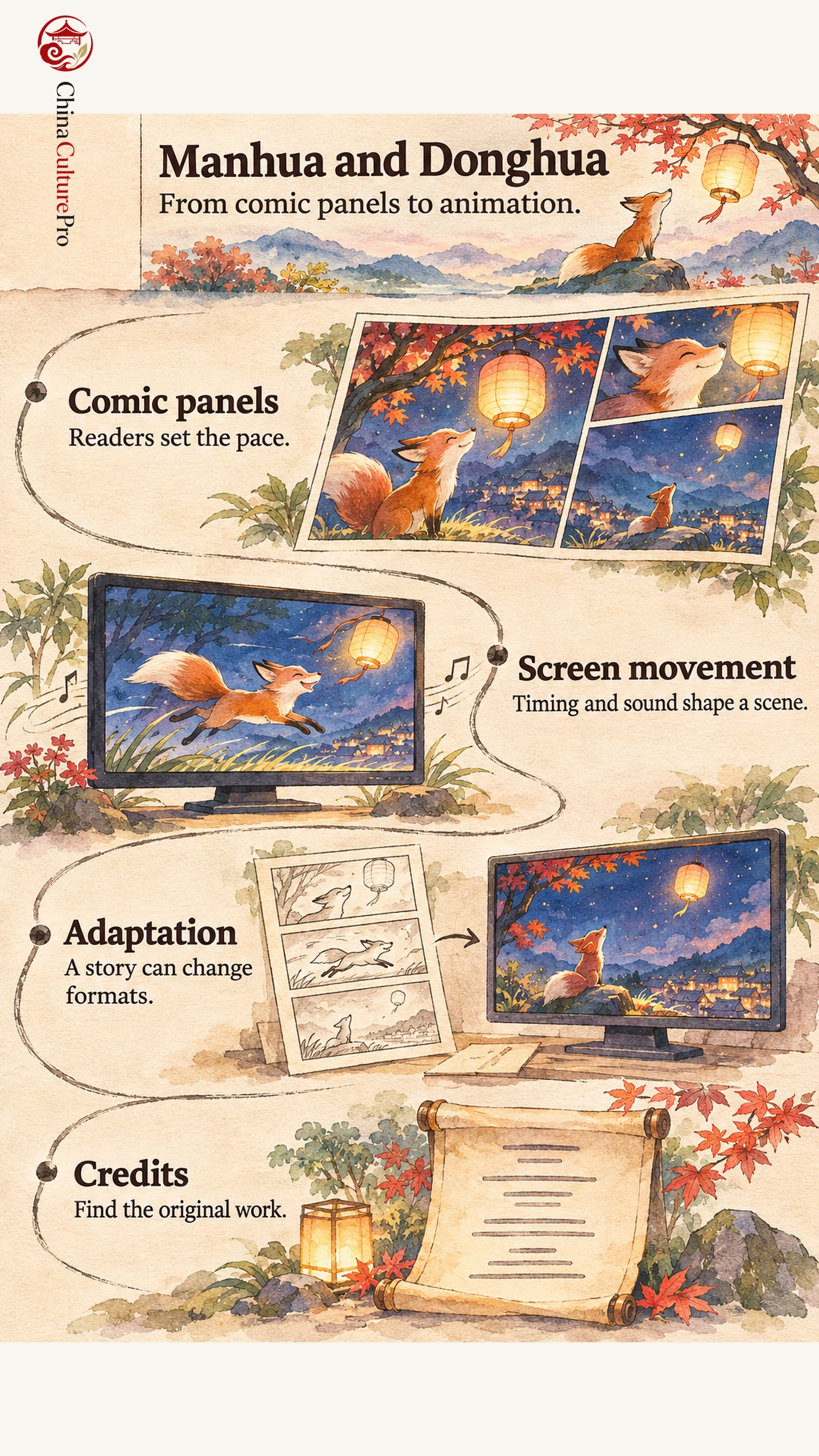
- Manhua: You read still panels and control how quickly you move through the story.
- Donghua: You watch a sequence unfold in time, with choices about movement, sound and editing.
- Adaptation: A comic and an animated series can share a title and characters while telling the story at different speeds.[3][4]
Check whether the listing counts chapters, pages or episodes.
You search for a title and find both numbered chapters and a season of episodes. The title alone may identify a story shared by several works. The format and credits tell you whether you are looking at a comic, an animated version or another adaptation.[3][4]
How Manhua Tells a Story on the Page
In a comic, the panels break action into selected moments. A close view of a hand opening a door can occupy an entire page, while several panels on the next page can cover a conversation. Readers supply the motion between those images and can pause or turn back at any point.
Page layout varies by publisher and edition. Digital comics may also use a long vertical sequence with gaps that control what appears as you scroll. That layout is one choice within Chinese comics. The guide to Chinese webtoons and manhua explains how format labels overlap.
How Donghua Sets the Pace on Screen
In animation the makers set the timing. A pause before a line of dialogue, the speed of a character’s step and the sound that follows a cut become part of the storytelling. The word donghua can cover many production techniques, from drawn movement to computer animation.[2]
That range also includes forms such as Chinese ink wash animation, which brings the texture and open space of brush painting into a moving image. An animation catalogue may apply the same label to films made with very different materials.[2]
What Happens When a Comic Becomes a Series
The Outcast (一人之下, Yī Rén Zhī Xià) offers a concrete example. Production credits identify Mi Er’s comic as the original work, and the animated first season is listed as a 12-episode release beginning in 2016. Look for that same original-work credit when two listings share a title.[3][4]
An adaptation can combine several short chapters, move a revelation to the end of an episode or hold on a reaction that occupies a single panel in the comic. To compare a scene, match the event and characters first. A chapter number and an episode number can refer to different points in the plot.
What Dongman Means in Listings and Fandom
Dongman (动漫, dòngmàn) is commonly used for a broader field that includes animation and comics. You may see it on a site or in an event name that covers both. To identify an individual work, look for its format label and credits. For comparisons within comics, the distinction between Chinese manhua and Japanese manga concerns a different question.[1]
FAQs About Manhua and Donghua
Is Manhua a Genre?
Manhua describes a medium that can contain comedy, historical fiction, fantasy or many other genres. The genre comes from the story’s subject and conventions.[1]
Do All Donghua Start as Manhua?
An animated work can tell an original story or adapt another source. A credited comic provides one possible source, as in The Outcast.[2][3]
What Should I Read or Watch First?
If you want the source story, check the original-work credit. If you want the performances, voices and music of a particular version, start with its first episode.
出典
[1] Chen Yan. An Etymological Study of the Terms Dongman, Donghua and Manhua
[2] Daisy Yan Du. Katong, Meishupian, and Donghua: On Terms of Chinese Animation
[3] DMM Pictures. Hitori no Shita: The Outcast production credits
[4] Bilibili. The Outcast first season