

Quick Answer: What Is a Jade Cong?
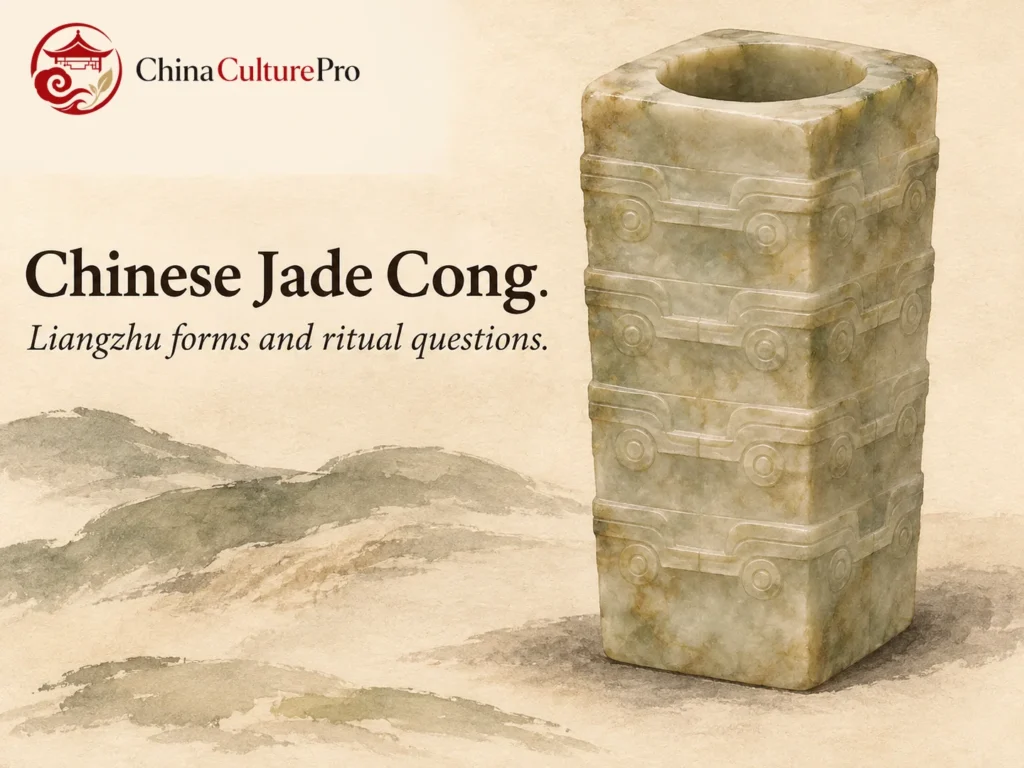
Cong(琮,cóng)is the name used for an early Chinese jade tube whose familiar form combines a squared exterior with a circular bore. A Liangzhu example at the Metropolitan Museum, dated around 2400 BCE, has a gently tapering body and small mask-like designs at its corners.[1]
- The shape: Look at the outer walls and the opening together.
- The decoration: Carved faces can wrap across corners and repeat in bands.
- The evidence: Burial settings support a ceremonial context, while precise functions remain debated.
The rounded bore and squared exterior are visible facts. A complete explanation of their original religious meaning requires evidence beyond the shape alone.

Viewed from above, a jade cong presents a circle within a squared outline. Turn it toward a corner and small carved eyes may become easier to recognize; step back and the repeated bands form a vertical pattern. These objects belong to Liangzhu culture, where worked jade carried substantial social and ceremonial importance.
Square Walls, Round Bore and Different Proportions
The exterior and interior make different shapes. The Met’s example has squared walls around a round tube, with a body that narrows slightly downward.[1] Its apparent solidity from the side changes when the viewer can see through the central opening.
Proportions vary considerably. The Smithsonian’s jade study discusses compact, carefully finished examples alongside much taller forms, some made with greater emphasis on scale than minute workmanship.[2] A tall multi-banded cong and a low, broad one should not be expected to share identical proportions.
The bore continues through the jade form, unlike the closed base of an ordinary vase. Its geometry is therefore a useful first distinction, even when a museum uses the broad category “ritual object.”
The material also deserves attention. Historic examples are often catalogued as nephrite. The guide to Chinese jade carving explains why shaping and finishing stone must be considered alongside the finished outline; polish does not reveal how much material was removed.
Faces Across Corners and Bands of Carving
On many cong, a face is organized around a corner. Looking only at one flat wall may divide the design, while turning toward the corner brings its paired features together. Repeated horizontal divisions can then stack these motifs along the body.
The Smithsonian describes masks with raised eyes, pupils and bar-like mouths, as well as bands that may suggest a headdress.[2] These are descriptions of visible features and proposed readings, rather than the recovered name of an ancient figure.
A particularly elaborate example is the broad cong from Fanshan tomb 12, often called the “King of Cong.” Zhejiang Museum curator Zhang An’an’s account describes complete human-and-animal compositions in recessed channels and simplified versions around the projecting corners.[3]
The elaborate compositions and abbreviated eyes-and-bars motifs belong to the same object. Here, “simplified” describes the carving’s organization, rather than a less important purpose.
Fanshan Burials and a Particularly Elaborate Cong
The Fanshan example has an excavated context. It was recovered in 1986 from tomb 12 and is identified in the museum account as M12:98.[3] Its later nickname should be distinguished from the archaeological information recorded about it.
In an original interview, excavation leader Wang Mingda recalled that the tomb contained six cong. The unusually elaborate example lay near the head, while the others occurred around the chest and abdomen.[4] This is evidence from one burial, not a prescribed arrangement for every Liangzhu tomb.
Wang interprets the elaborate imagery and concentration of jade within a framework of belief and authority.[4] His explanation connects close study of an excavated group with larger questions about society. It remains an archaeological interpretation, rather than a written statement left by the person buried there.
The nickname “King of Cong” praises the object’s exceptional character. It does not identify a named king or supply a biography for the tomb’s occupant.
Ritual Interpretations and Questions Still Open
Why make such a complex jade form? Its materials, labor and burial contexts support interpretations involving social status and ceremony. The difficulty is moving from that general importance to one precise ceremony or belief.
Toledo Museum of Art explicitly qualifies the familiar cosmological reading: interpreting the square and circle through earth and heaven draws on later texts.[5] The later tradition adds a historical layer; it is not direct testimony from Liangzhu society.
The number of bands raises a similar problem. Liangzhu Museum’s discussion of cong notes competing interpretations of the tiers, including rank and transmission across generations, while acknowledging that the question is unsettled.[6] Counting bands therefore does not produce a reliable social rank on its own.
It is useful to keep a description and an interpretation side by side. “A face wraps around this corner” is an observation. Identifying that face as a particular deity, or assigning every tier a fixed meaning, requires further support.
Later Objects, New Materials and Changing Names
The recognition of cong as Liangzhu artifacts also has a modern history. Liangzhu Museum highlights archaeological work at Caoxieshan in 1973 as important stratigraphic evidence for their much earlier date, after older classifications had associated such objects more generally with later periods.[6] Excavated context helped revise the dates assigned to familiar collection objects.
Later objects can recall the form while serving a different purpose. The National Palace Museum in Taipei catalogues a Southern Song Longquan celadon as a cong-shaped vase: it has a squared column-like body but a closed base, rounded neck and foot.[7] It is a ceramic container, distinct from the earlier jade tube.
The name itself needs historical care. Xie Mingliang’s research on cong-shaped bottles examines the changing understanding of the term and form in later writings.[8] A modern catalogue name does not establish that Song users employed the same label or understood the Neolithic object’s original role.
For comparison, jade bi discs present another enduring form with changing interpretations. With both kinds of object, material, date, excavated context and later reception help explain more than resemblance alone.
FAQs About Jade Cong
Is a jade cong a vase?
The early jade tube has a through-bore. Later ceramic objects called cong-shaped vases are containers with a base.
Do the carved faces identify a known deity?
Their precise identities remain uncertain. Visible features can be described more confidently than a specific divine name.
Does every tier indicate a rank?
No fixed tier-to-rank system has been established. Interpretations of the divisions remain debated.
Does the square-and-circle form prove its original meaning?
No. Familiar heaven-and-earth explanations rely on later interpretations and need that chronological qualification.
出典
[1] Metropolitan Museum of Art. Liangzhu Ritual Object: Square Exterior, Round Bore and Corner Masks
[2] Smithsonian National Museum of Asian Art. Jades for Life and Death: Cong Proportions and Masks
[3] Zhang An’an, Zhejiang Provincial Museum, hosted by Shanghai Museum. Jade Cong from Fanshan Tomb 12, M12:98
[4] Zhang Yuhuan, China News Service, Interview with Wang Mingda. Excavating and Interpreting the Fanshan Cong
[5] Toledo Museum of Art. Cong with Stylized Mask Motifs: Later Cosmological Interpretation
[6] Liangzhu Museum. Cong Forms, Archaeology and Changing Interpretations
[7] National Palace Museum, Taipei. Southern Song Longquan Celadon Cong-Shaped Vase
[8] Xie Mingliang, National Palace Museum Research Quarterly. The Changing Forms and Interpretation of Cong-Shaped Bottles