
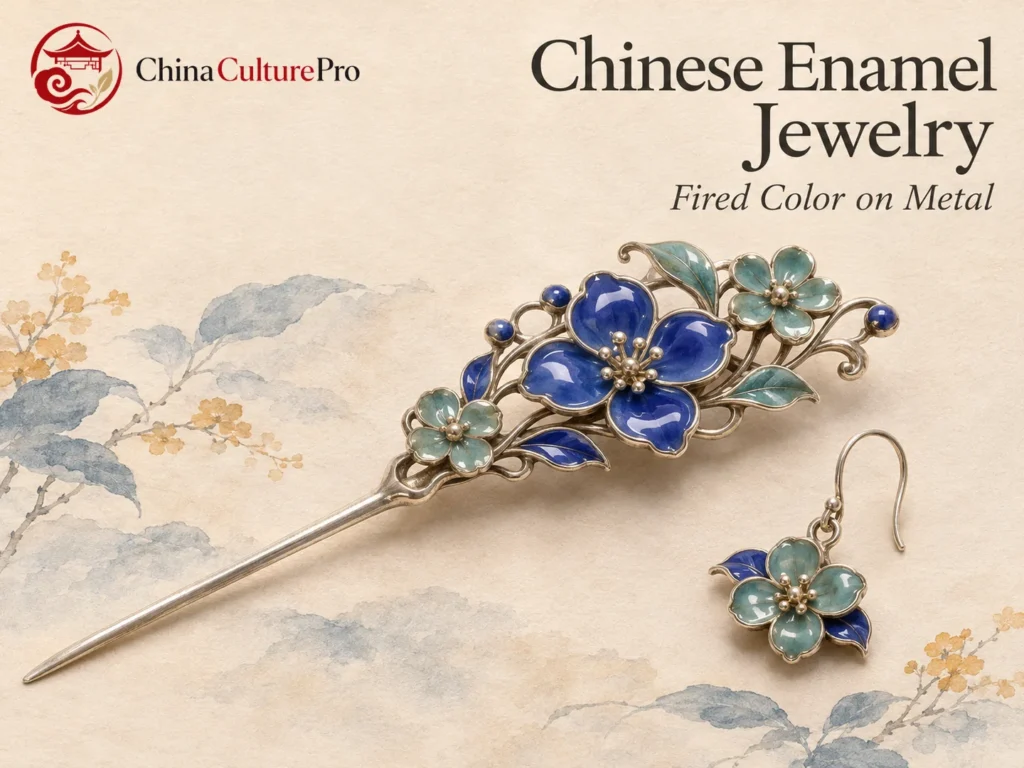

Quick Answer: What Is Chinese Enamel Jewelry?
Enamel, called falang (珐琅, fǎláng) in Chinese, gives a metal ornament color through a glassy layer fused by firing. Some makers enclosed color within metal boundaries, while others painted enamel designs on a prepared surface.[1][2]
- Metal: A Qing earring is cataloged as silver and enamel.[4]
- Technique: A nineteenth-century court necklace is cataloged specifically as painted enamel.[6]
- Other materials: A similarly bright hair ornament can contain blue feather and separate glass pieces.[7]
Check how the colored surface was made before assigning a type of enamel.

A colored flower on a silver ornament could be fused to the surface, set into a fitting or made from a different material. In a close view, follow the edge of one colored area and compare it with the recorded medium.
How Color Is Fused to Metal
In cloisonné, thin strips attached to the metal form cells for enamel. In champlevé, glassy color fills recesses in the metal itself. Both can leave visible metal around a colored area. The guide to Chinese cloisonné and champlevé follows that distinction on historical vessels.[1]
For one Chinese painted enamel process, makers fired a pale enamel ground on copper, added colors to the smooth surface and fired the decoration. This process developed at the Qing court under the Kangxi emperor in the context of European painted enamel techniques. A painted motif can be formed without the separate strips used to contain cloisonné color.[2]
Compare an Earring, a Pin and a Necklace
One Qing earring measures 8.9 centimeters high and is cataloged as silver and enamel. A Chinese hairpin dated around 1900 measures 15.2 centimeters long and lists silver, metal and enamel. It also has an inscription cast on the back. In both records, the word enamel identifies a material without specifying how it was applied. Compare these objects with other fittings in the Chinese earrings history guide.[4][5]
A nineteenth-century Chinese necklace measuring 127 centimeters is cataloged as painted enamel. The record names the process here. The earring and hairpin records leave the application method open. For the beaded forms and materials worn with Qing dress, see Chinese court necklaces.[6]
Read Transparent Enamel on Metal
Transparent enamel lets the metal below remain visible. Studies of Qing enamel distinguish work that coats a large surface from transparent enamel used on smaller areas of metal ornament, often termed shaolan (烧蓝, shāolán). A colored detail can therefore cover only a small part of a metal ornament.[3]
Look for the design underneath a colored layer in a close-up. If the underlying metal carries texture or detail, transparency can keep that work visible. Check the technical description before using a single color or shiny finish to identify the enamel.[3]
Tell Enamel From Feather and Separate Inlays
On a nineteenth-century swallow hair ornament, the blue comes from kingfisher feathers set on a metal support. Glass, pearls and rubies are listed separately from the feather material on the same object. The Chinese diancui guide explains why the fine feather surface can look blue within metal outlines.[7]
When a label lists both glass and enamel, check where each is used. A shaped glass piece can be held as an inlay, while an enameled area is fused to the object. A close-up of the edge and the catalog medium together give more information than color.[1]
FAQs About Chinese Enamel Jewelry
Is every enamel ornament cloisonné?
Cloisonné names a process that uses attached metal partitions. Painted enamel and champlevé can produce colored areas by other methods.[1][2]
Can Chinese enamel jewelry be silver?
Yes. A surviving Qing earring is cataloged as silver and enamel, and a hairpin made around 1900 also lists silver and enamel.[4][5]
Is a blue hairpin always enameled?
A blue surface can be feather decoration, as on a nineteenth-century swallow ornament. Confirm the material in the record for the piece.[7]
出典
[1] Victoria and Albert Museum. A Guide to Metalworking Techniques
[2] The Palace Museum. Painted Enamel on Metal
[3] The Palace Museum Journal. Research on Qing Transparent Enamel in Guangdong
[4] Smithsonian National Museum of Asian Art. Qing Silver and Enamel Earring
[5] National Gallery of Victoria. Chinese Hairpin, 2018.1283
[6] The Metropolitan Museum of Art. Mandarin’s Necklace, 24.80.324
[7] The Walters Art Museum. Swallow-Shaped Hair Ornament