

Quick Answer: What Are Chinese Diaspora School Traditions?
Chinese diaspora communities have organized schools to teach Chinese literacy, support links with relatives and give children a place to meet. The schools took different forms. Vancouver’s Mon Keang School taught in Cantonese, Singapore’s Chinese High School (华侨中学, Huáqiáo Zhōngxué) offered secondary education, and many British community schools run classes outside the regular school week. [1][2][4]
- Who founded them: An association might provide rooms, teachers and funding, as it did at Mon Keang in Vancouver. [1]
- What they taught: The language used to teach a lesson, the written characters pupils studied and the subjects taught could vary by school. [1][2][5]
- What to check today: Ask whether a program is a supplementary class or a full-time school, and which spoken language and written script it teaches. [3][4][5]
The name Chinese school can refer to several different institutions. Start with the place, date and timetable.
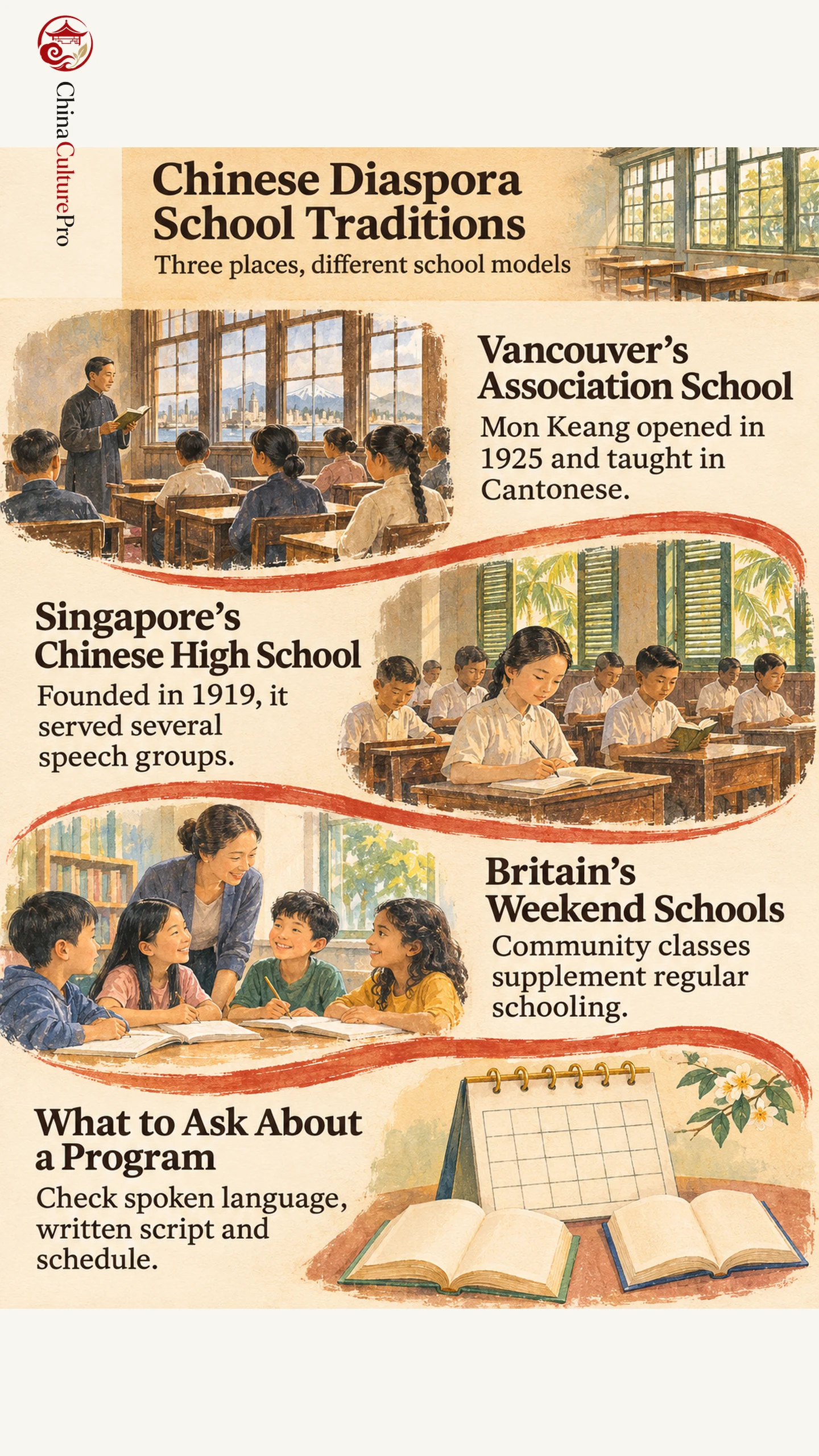
A classroom above an association hall in Vancouver, a secondary school in Singapore and a weekend class in Britain all grew from efforts to educate children in Chinese. One belonged to a neighborhood association, one offered full secondary schooling and one meets alongside the regular school week. Put the schools side by side and you can see how migration, public education and home languages shaped the classroom. [1][2][4]
Vancouver: When an Association Built the Classroom
Wong Kung Har Tong, now the Wongs’ Benevolent Association, founded Mon Keang School in Vancouver in 1923 and opened it in 1925. Its classrooms occupied the top two floors of the association’s Chinatown building. The school taught in Cantonese and offered Chinese cultural subjects. Parks Canada records that it was the first Chinese-language school in Canada with a high school division. [1]
The school opened while Canada sharply restricted Chinese immigration. Parks Canada explains that a Chinese-language education could prepare children to study or live in China and to work in businesses connecting Canada with Asia. For families staying in Vancouver, it also gave children a local place to study Chinese. The school’s address shows how Chinese diaspora associations used their own buildings to provide educational and social services. [1]
Parks Canada notes that the association added two floors after purchasing the building in 1920. The assembly hall occupied the top floor. In this case the same address accommodated both education and the association’s larger community life. [1]
Singapore: Chinese as the Language of Secondary Education
Tan Kah Kee founded the Singapore Nanyang Overseas Middle School in 1919. It offered four years of secondary education and served students from different Chinese speech groups. The school moved to Bukit Timah in 1925 and became The Chinese High School. Students in a Chinese-medium school studied subjects through Chinese as the main language of instruction. The language had a different role from the Chinese taught as a subject in a supplementary class. [2][3]
Singapore later moved to a unified school language stream. The Singapore Chinese Cultural Centre dates the phasing out of the old Chinese-medium school system to 1987. It describes the Special Assistance Plan as a way some schools carried forward Chinese educational traditions within a bilingual system. The Chinese High School received that designation in 1979 and later merged into Hwa Chong Institution in 2005. A family record from before that transition may use Chinese school in a different sense from a present-day program listing. [2][3]
Britain: Why Families Built Weekend Chinese Schools
Researchers submitting evidence to the UK Parliament describe Chinese community schools as part of a wider movement for complementary education. Families and local organizers provide language and literacy classes alongside mainstream schooling. The same evidence describes shared activities through the UK Association for the Promotion of Chinese Education, including annual competitions. This puts students in contact with peers beyond their own classroom. [4]
Cantonese was the most common Chinese home language reported by pupils in a 2009 study of six complementary schools in England. That finding describes those pupils and schools at the time of the study. The school’s spoken language therefore matters if the goal is to talk with a grandparent who uses Cantonese or another variety at home. The guide to Chinese diaspora languages explains where those differences come from. [4][6]
How to Understand a School’s Language and Curriculum
Start with what students are expected to do. A heritage-language class may work on conversation with family, on reading and writing, or on both. Ask which language teachers use for explanations and which students are encouraged to speak. Then ask whether the program teaches simplified or traditional Chinese characters. Spoken language and written script are separate choices. [1][4][5]
Next, look at when lessons happen and who runs them. A community class may meet outside a child’s regular school hours, while a historical Chinese-medium school might have provided the child’s whole secondary education. For a family record, the year, building and sponsoring association help determine which model an old school name refers to. The wider Chinese diaspora culture guide explains how schools fit alongside associations and other institutions. [1][2][3][4]
FAQs About Chinese Diaspora School Traditions
Did Chinese diaspora schools always teach Mandarin?
Teaching languages varied. Parks Canada records that Mon Keang taught in Cantonese. A school’s location, date and community are better clues than its name alone. [1][4][5]
What does a complementary Chinese school do?
It supplements the education students receive elsewhere, typically with language and literacy classes. British community schools have also organized activities that bring pupils together across schools. [4]
Were historical Chinese-medium schools the same as weekend Chinese classes?
A Chinese-medium school could use Chinese to teach a full secondary curriculum. A weekend class adds Chinese language and culture to a student’s regular schooling. [2][3][4]
出典
[1] Parks Canada. Mon Keang School National Historic Site
[2] Singapore Ministry of Education Heritage Centre. The Chinese High School
[3] Singapore Chinese Cultural Centre. The Evolution of Singapore’s Chinese-Medium School System
[4] UK Parliament, written evidence CAU0020. Evidence on Chinese Language Education
[5] National Heritage Language Resource Center. Chinese Immigrants and Heritage Schools in the United States
[6] Ada Mau, Becky Francis and Louise Archer. Mapping Politics and Pedagogy