

Quick Answer: What Is Chinese Cursive Script?
Chinese cursive script (草书, cǎoshū) is a family of brush-written forms in which strokes can be shortened, combined or omitted according to established conventions. The results often look fluid. Readers learn to recognize the abbreviated forms as well as the movements that connect them. [1][2][3]
- Structure: Several strokes can become one continuous mark. [1]
- Range: Early letter forms and expansive Tang scrolls can both belong to the cursive family. [2][3][4][5]
- Reading: A transcription can help match unfamiliar marks to individual characters. [1][4][5]
A fluid line is one clue. A change in the structure of a character is often more useful for telling cursive from more legible joined writing. [1][2]
When a black line crosses several familiar-looking shapes, it can be tempting to count each visible mark as a stroke or a character. The conventions of cursive make that unreliable. Look for the parts a calligrapher has compressed and the movements that carry one form into another.
How Cursive Forms Keep Their Meaning
In an example by Wen Peng, the two characters for chrysanthemum appear in one sweeping movement. The two characters are 菊花 (júhuā). In standard script the forms have twenty strokes in the museum’s comparison. The continuous line works because readers can recognize conventions for the shortened forms. The speed or sweep of the brush is only part of what the reader needs to see. [1]
In running script, a connecting line can link strokes while leaving much of the character’s usual form visible. Cursive can substitute a different abbreviated structure. The families can shade into each other, so compare several characters before naming a work’s script. A wider comparison appears in the Chinese calligraphy styles guide. [1][2]
Draft, Modern and Wild Cursive
| 表現形式 | Historical meaning | Example or visual cue |
|---|---|---|
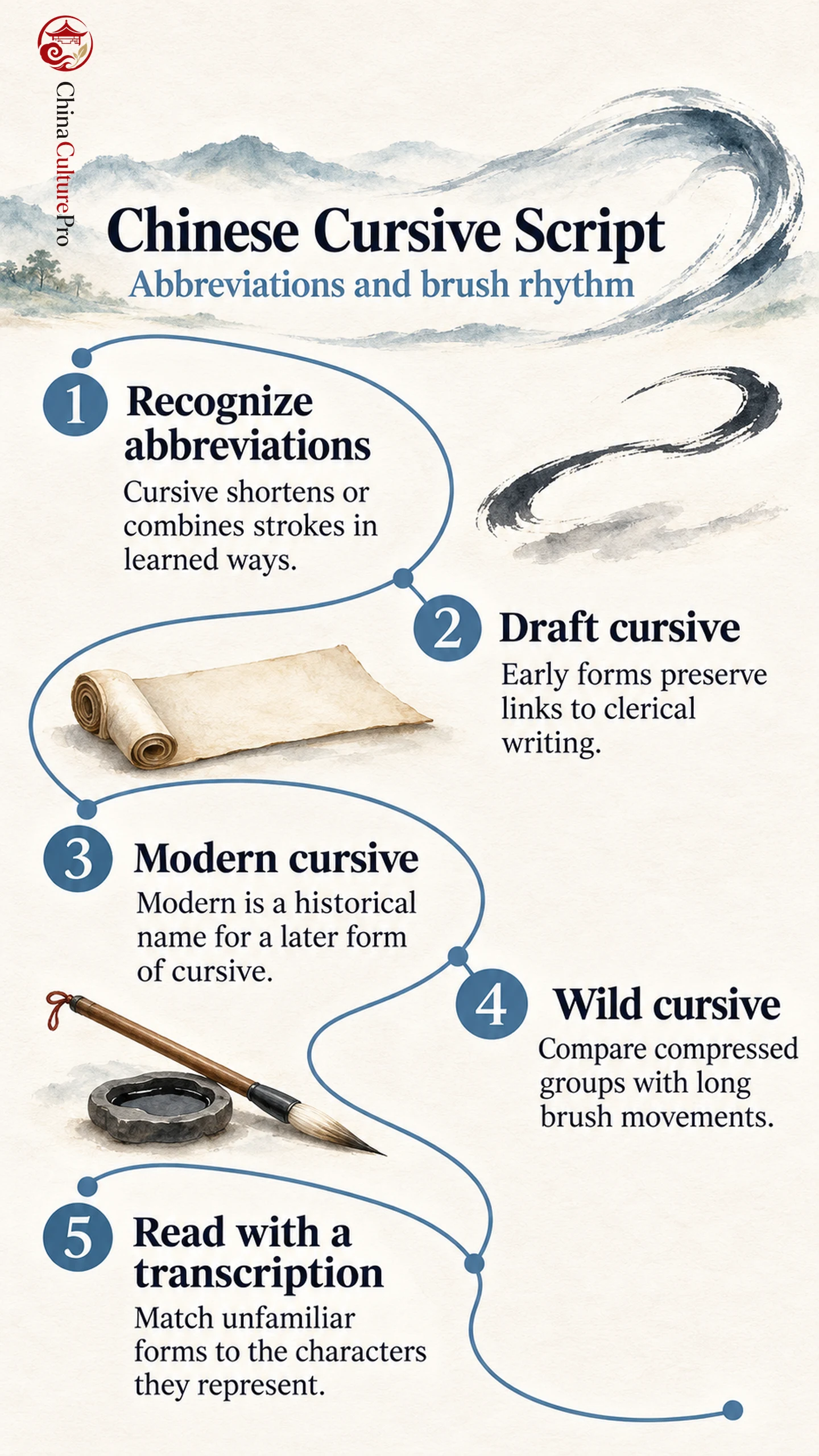
| Draft cursive (章草, zhāngcǎo) | Early abbreviated writing associated with clerical forms | On the Seventeenth Day preserves letters by Wang Xizhi in later rubbings. Look for shortcuts within characters. [2][3] |
| Modern cursive (今草, jīncǎo) | A historical name for later cursive, not a reference to today’s writing | Compare the connected and compact forms in the 687 Treatise on Calligraphy by Sun Guoting (孙过庭, Sūn Guòtíng). [2][4] |
| Wild cursive (狂草, kuángcǎo) | An expressive approach associated with Tang writers, including Zhang Xu | In Autobiography by Huaisu (怀素, Huáisù), look at the contrast between compressed groups and long brush movements. [2][5][6] |
The three terms help organize a varied history. They describe forms and approaches, while an individual object can combine different degrees of abbreviation and connection. [1][2]
Reading Rhythm in Two Tang Scrolls
Sun’s Treatise on Calligraphy is a text about the art written in cursive. It is dated 687. Its main writing area measures about 9 meters long and 26.5 centimeters high. The long paper scroll lets you compare recurring shapes across an extended discussion. It presents the author’s ideas about writing through the same medium the ideas describe. [4]
The scroll cataloged as Huaisu’s Autobiography is dated 777. Its main writing spans about 7.55 meters, and further paper carries later commentary. Some later writing appears even on the main sheet. The text starts with his account of studying writing and meeting earlier masters, then incorporates praise by others. Compare the smaller, closely gathered forms with longer marks that carry across more of the surface. The rhythm is easier to judge when you view a run of columns before isolating one mark. The guide to reading Chinese calligraphy gives a way to make that comparison. [5]
FAQs About Chinese Cursive Script
Can Chinese Readers Read Cursive Script?
Reading modern Chinese helps, but the abbreviated forms can take separate study. A transcription can help you match a particular mark with the character it represents. [1][4][5]
How Does Cursive Differ From Running Script?
Running script usually preserves more of the recognizable character structure. Cursive can combine or omit strokes using learned forms. A flowing line alone is therefore a poor way to tell them apart. [1][2]
Does Wild Cursive Mean Writing Without Rules?
It allows wide variation in movement, size and spacing. The writing still relies on conventional abbreviated forms, which let an experienced reader follow the text. [1][2][5]
出典
[1] Smithsonian National Museum of Asian Art. Cursive Script
[2] ChinaCulture.org. 中国書道
[3] The Metropolitan Museum of Art. Wang Xizhi: On the Seventeenth Day
[4] National Palace Museum. Sun Guoting: Treatise on Calligraphy
[5] National Palace Museum. Huaisu: Autobiography
[6] The Metropolitan Museum of Art. Mastering the Art of Chinese Painting