

Quick Answer: How Was Chinese Cotton Printed?
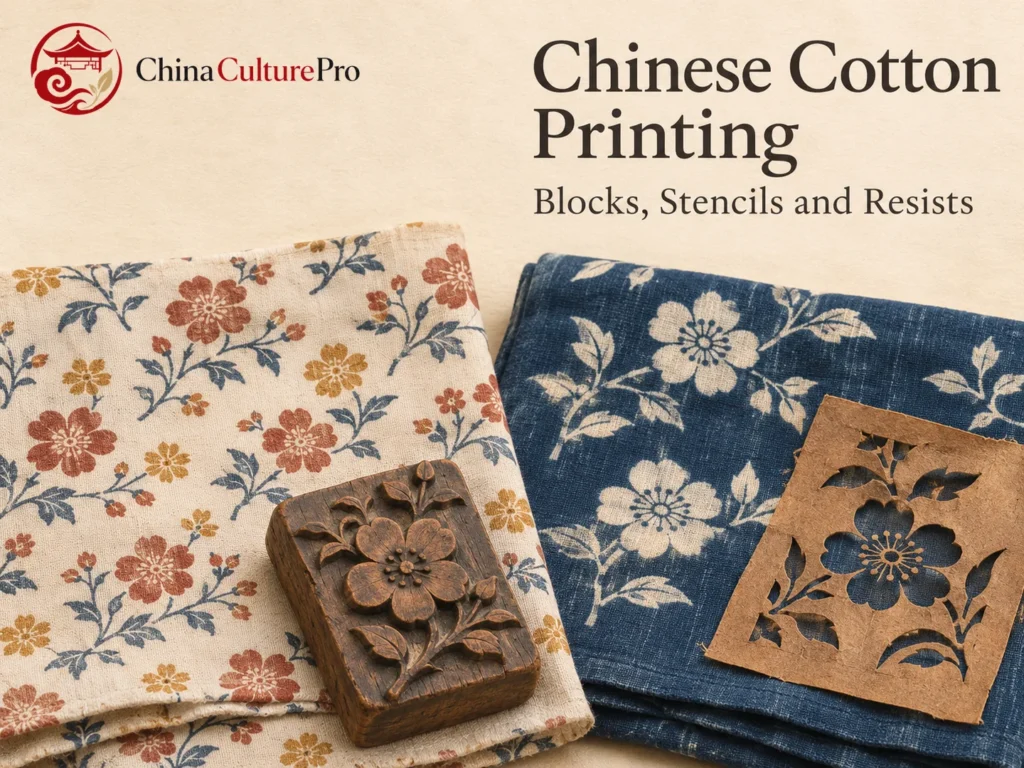
Chinese cotton printing includes several ways of patterning woven cloth. A wooden block can transfer color. A cut stencil can apply paste to protect selected areas before dyeing. The tool and what it carries tell you how the pattern forms.[2][3]
- Handheld blocks: Uyghur makers in Xinjiang stamped designs on woven cotton.[2]
- Brush printing: A documented Shanghai method placed the cloth over a large carved board.[1]
- Stencil resist: In traditional blue calico, paste protects parts of the cotton in the dye bath.[3]
Look for the maker’s process before treating every printed cotton as the product of the same tool.

A bird, flower or geometric repeat can be added to cloth in more than one way. Start with a simple question about the pattern. Did the tool transfer the color, or did it help keep dye away from the fabric?
Compare Stamping and Brush Printing
In Xinjiang Uyghur block printing, separate relief-carved wooden stamps transfer motifs to cotton. The maker builds up a larger design by placing these impressions next to one another. A border and a field can require different arrangements of repeated units.[2]
In nineteenth-century Shanghai, a process called shua yinhua (刷印花, shuā yìnhuā), or brush printing, worked with the board held flat. One surviving 70-by-49-centimeter board has a floral and bird design on one face and a geometric design on the other. Workshop notes describe dye on the block, cloth laid over it and rubbing or brushing to transfer the design. The board stayed on the work surface while the printer handled the cloth and brushes.[1]
See How Paste and Wax Reserve a Pattern
For Chinese blue calico, cut oiled paper guides the application of paste to cotton. Indigo reaches the parts of the cloth left uncovered. The pasted areas emerge lighter once the resist is removed. A design can reserve a pale motif against blue or reserve more of the ground to leave a blue motif on pale cloth.[3]
Wax also blocks dye. In a documented Guizhou demonstration, beeswax drawn onto cloth kept indigo from reaching the covered areas. In Chinese clamp-resist dyeing, pressure between carved boards protects parts of the cloth. The protected areas in these examples look pale for different reasons.[5][6]
Read the Pattern on a Wrapping Cloth
A nineteenth-century Qing dynasty cotton wrapping cloth measures about 110 by 113 centimeters. Two pairs of stylized badgers appear at opposite corners. Its catalog identifies resist and stencil dyeing. Each pair is positioned near a corner of the nearly square cloth, apart from its counterpart across the diagonal.[4]
A Shanghai gazetteer from 1871 associated brush-printed cotton with quilts and wrapping cloths. These uses help explain why a print can have an expansive repeat or strong border. Chinese cotton textile history traces the households and workshops that produced those fabrics.[1]
Use the Record to Identify the Technique
Trace the edge of one motif and compare it with its next repeat. If the outline shifts at a regular interval, mark where the design repeats before checking the catalog for the tool. To distinguish a reserved motif from directly applied color, look for process words such as stamp, brush print, paste resist or wax resist in the record.[3][6]
Keep the pattern, the ground fabric and the process separate when reading a label. “Cotton” identifies the fiber. A phrase such as “resist and stencil dyeing” describes the patterning and may leave the exact paste or dye unspecified.[4]
FAQs About Chinese Cotton Printing
Is blue calico block printed?
Traditional blue calico can use a stencil to apply resist paste before indigo dyeing. A carved stamp that transfers color to cotton works differently.[2][3]
What was printed cotton used for?
Shanghai records name quilts and wraps. The large designs fit household cloths that could be spread out or folded.[1]
How does clamp-resist differ from block printing?
In clamp-resist, paired boards press the fabric to keep selected areas pale. In a direct print, a tool transfers color to the areas that form the motif.[2][5]
出典
[1] National Museums Scotland. The Material Lives of Ordinary People: Rare 19th-Century Chinese Cotton
[2] National Museum of China. Study of Uyghur Block Printing in Xinjiang
[3] National Museum of China. Cotton Cloth and Blue Printed Textiles
[4] The Metropolitan Museum of Art. Wrapping Cloth With Paired Badgers
[5] China Intangible Cultural Heritage Network. Wenzhou Blue Clamp-Resist Dyeing
[6] スミソニアン国立アジア美術館。 Batik and Botanic Dyes