


Quick Answer: What Does Emptiness Do in Chinese Painting?
Leaving blank (留白, liúbái) is the deliberate use of unmarked areas in Chinese painting and calligraphy. In a landscape, the visible marks give the blank its role. A viewer may see water, distance or a shift in attention in an area with very little ink.[1][2][5]
- Depiction: A pale interval between inked riverbanks can read as the water itself.
- Connection: Light washes and soft edges can join distant hills and nearer forms through mist.
- Attention: A small figure or boat can pull the eye across an otherwise open surface.[1][2][3]
The same light area can do more than one job. Its effect depends on where it sits and what borders it.
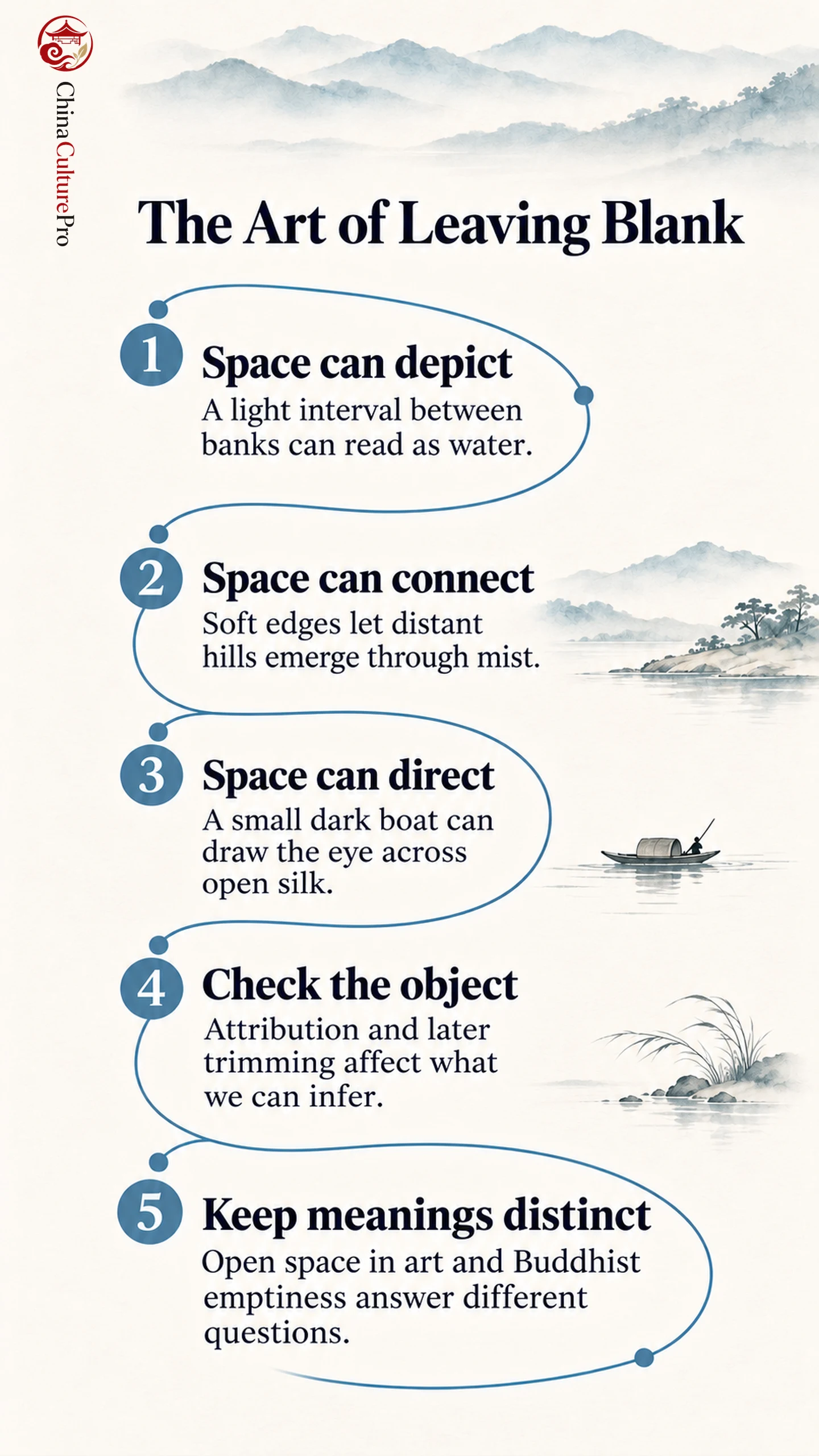
The quickest way to see what an empty area contributes is to look at its edge. A firm shoreline gives a light interval a different job from a hill that seems to dissolve. The examples below also show why the painting’s material and later treatment matter when we ask how much of that effect the artist planned.
When Unmarked Paper Becomes Water
In Rongxi Studio, painted by Ni Zan (倪瓒, Ní Zàn) in 1372, an expanse separates the foreground bank from the distant shore. The nearer trees and vacant pavilion give the eye a place to start. The opposite shore supplies another limit, so the gap between them reads as a stretch of water. A river can occupy a substantial share of the painting while needing little description in ink.[1]
The gap also establishes a distance the eye must cross. Imagine the two banks moving closer together while the trees and pavilion stay the same size. The depicted objects would still be recognizable, but the sense of separation would change. That makes the interval part of the composition rather than leftover paper.[1]
The painting and its inscription also have different dates. Ni Zan painted the scene in 1372 and inscribed it for its recipient two years later. The inscription belongs to a later moment in the object’s history. Looking at the river interval within the pictorial field and assessing how text and image now share the scroll are separate tasks.[1]
How Pale Washes Connect Near and Far
Some apparent blanks contain diluted ink. In Pure and Remote View of Streams and Hills, attributed to Xia Gui (夏圭, Xià Guī), varying washes help create depth and atmosphere. Nearer forms may have distinct outlines, while light ink and softened edges let distant forms emerge more gradually.[3]
This example is a handscroll, so the viewer can encounter its landscape section by section. An interval can slow the eye before another cluster of marks comes into view. On a reproduction that shows the whole scroll at once, that rhythm can be harder to notice. The distinction between a faint wash and uncovered paper is one of the things a close view of Chinese painting techniques makes clearer.[3]
What the Solitary Angler’s Blank Silk Can Tell Us
The Southern Song work Solitary Angler on a Wintry River, attributed to Ma Yuan (马远, Mǎ Yuǎn), is a different case. A small boat and a single angler hold the eye against a wide expanse of silk. The light space gives the figure’s scale and solitude much of their force. It offers few points of reference, which makes the slight signs of water near the boat carry more weight.[2]
The work as it survives has its own history. It is currently understood to have been cut from a larger work. The spare composition is therefore real as an experience of the surviving object, while the exact format and the full distribution of blank space in the earlier object remain uncertain. Two questions deserve separate answers: what the present silk makes us see, and what the surviving evidence lets us attribute to the painter.[2]
Where Buddhist Emptiness Enters the Discussion
Buddhist emptiness (空, kōng) is a doctrinal term. In many Buddhist discussions it concerns how phenomena lack independent, fixed existence and arise through conditions. The observation that a blank gains meaning from neighboring marks can make the comparison inviting. The two uses nevertheless address different objects of inquiry. One describes how a composition works, and the other concerns how things exist or appear.[4][5]
A reader interested in the philosophical sense can compare Zhiyi’s account of emptiness and the Three Truths. For a particular painting, first identify what the open area depicts or organizes. An interpretation about a painter’s beliefs requires evidence from the painting, its inscriptions or the historical record. The presence of open space alone leaves that question unresolved.
FAQs About Chinese Aesthetics of Emptiness
Is leaving blank the same as negative space?
They overlap when a viewer describes open areas around painted forms. Leaving blank also calls attention to the act of reserving part of the painting or calligraphy surface.[5]
Does the blank have to be white?
No. Bare paper or silk can be warm in color. Reproductions change the apparent brightness of both the support and the lightest areas of ink.[2][3]
What should I look at before interpreting an empty area?
Look for what touches it, such as a bank, a boat or a pale outline. Then read the museum record to see whether the work has been trimmed or remounted.[1][2]
出典
[1] National Palace Museum. Rongxi Studio
[2] Tokyo National Museum. Solitary Angler on a Wintry River
[3] China Online Museum. Xia Gui: Pure and Remote View of Streams and Hills
[4] Oxford Bibliographies. Emptiness (Śūnyatā)
[5] eScholarship. The Concept of Liúbái in Chinese Art