
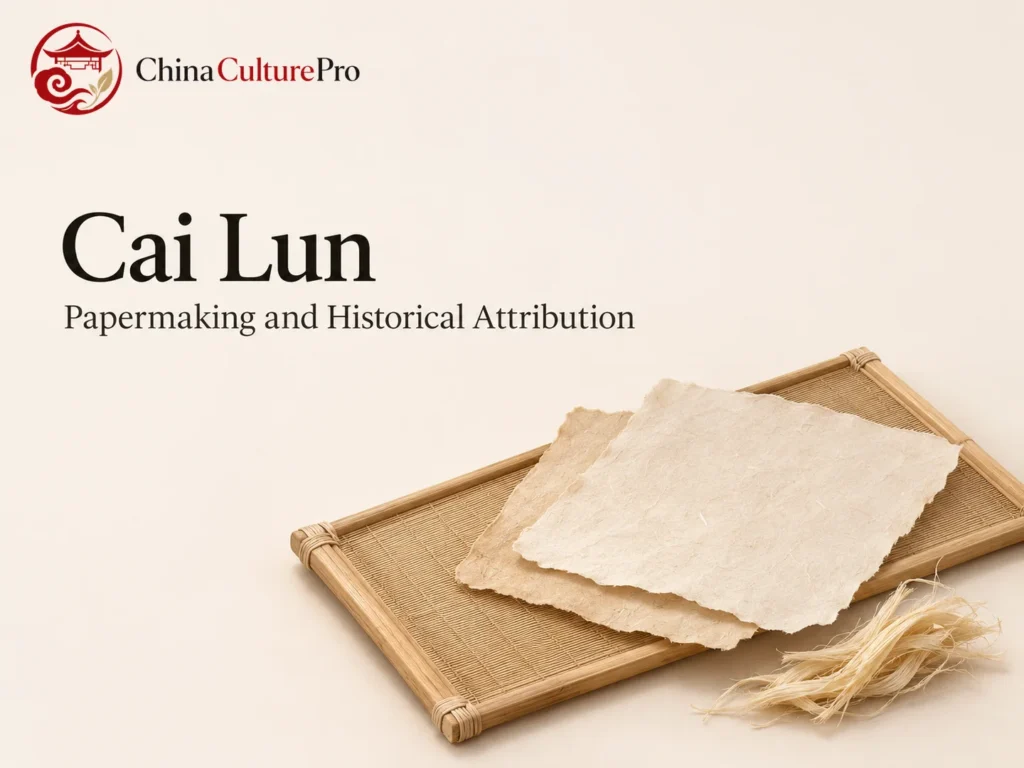

Quick Answer: What Did Cai Lun Do?
Cai Lun (蔡伦, Cài Lún) was an Eastern Han court official credited in a later history with presenting papermaking improvements in 105 CE. Archaeological finds from the Western Han indicate that paper was already in use. The date marks a recorded court presentation in a longer history of making paper.[1][2][3][4][5]
- Historical record: The biography credits Cai Lun with making paper from several sources of fiber and presenting it to the emperor.
- Earlier evidence: Paper fragments from excavated contexts date to the Western Han, before 105.
- Process: Paper is formed by bringing dispersed fibers together into a sheet.
- Attribution: The court record preserves a name and date, while objects document practices that can predate the record.[1][2][3][4][6]
The court date and the date of the earliest surviving objects can differ.
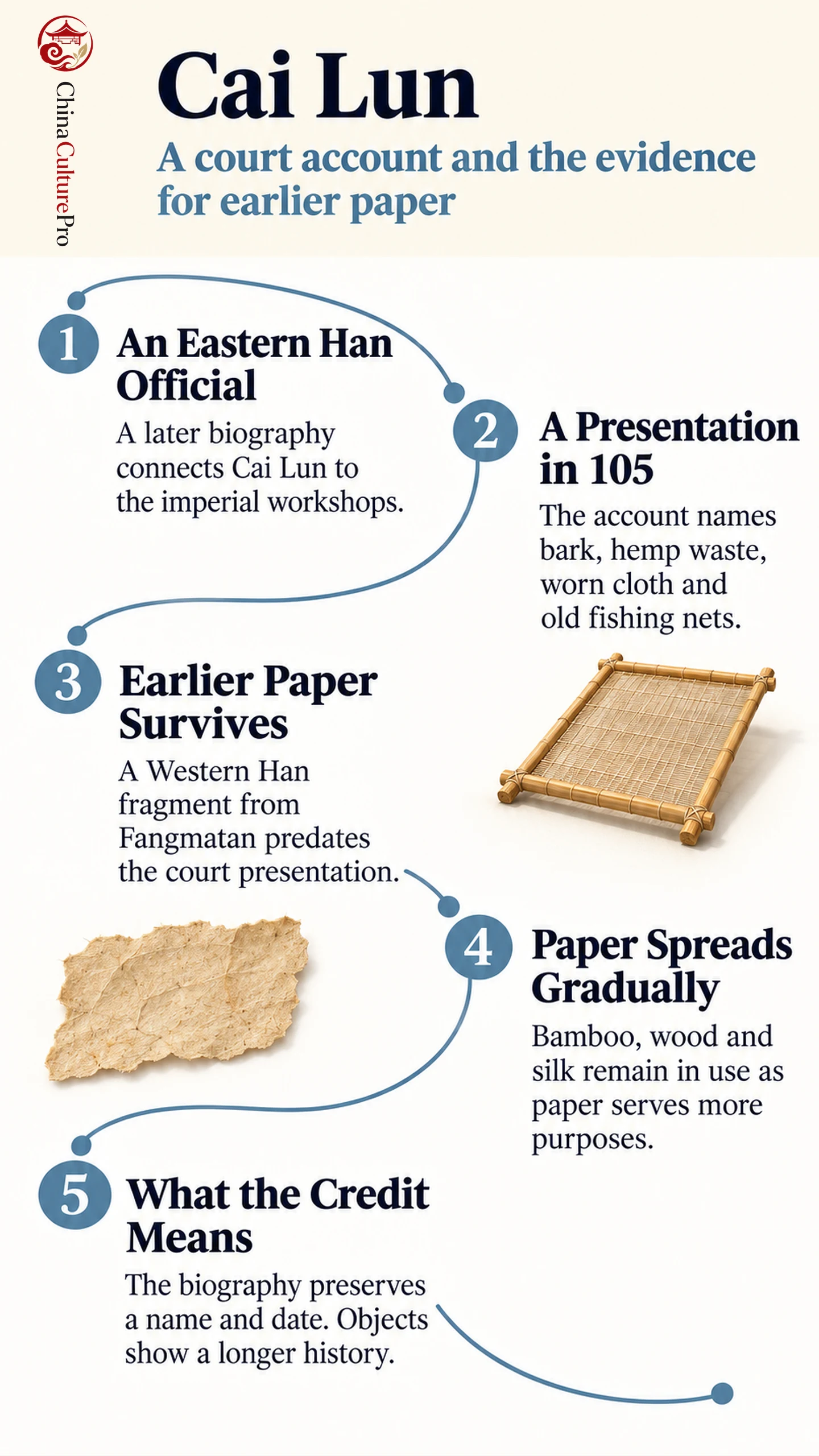
One story about early paper begins in the palace, with an official presenting a material to the emperor. Another begins in a tomb in Gansu, with a fragment identified as part of a paper map. The two pieces of evidence answer different questions. The biography identifies a person and a presentation. The excavated fragment helps establish an earlier use of the material.[1][4][5]
Cai Lun and the Eastern Han Court
Cai Lun served as a eunuch official during the Eastern Han dynasty. His biography in the Book of the Later Han (后汉书, Hòu Hàn Shū) connects him with the work of the imperial household and its workshops. That setting gave an official access to skilled people, materials and a way to present an improvement to the court.[1][2]
The biography was compiled after the Eastern Han. Its purpose was to record the life of an official and the contribution for which he was remembered. It names the official who presented the paper. The workers who prepared the fibers and formed the sheets are much less visible in the text.[1][8]
What the Record Says About 105 CE
The account names tree bark, hemp waste, worn cloth and old fishing nets as materials used to make paper. It says Cai Lun presented the result to Emperor He in 105 CE and received imperial approval. These are details from the transmitted account. The list includes both raw plant material and used objects that could provide fibers.[1][2][3]
A sheet of paper forms when fibers dispersed in water are brought together into a thin layer and dried. The properties of the result depend on the material and how the fibers are prepared and formed. The biography identifies sources of fiber and the presentation. It gives only limited detail about the equipment or sequence of workshop decisions behind the sheets.[1][3]
The Evidence for Earlier Paper
A fragment from a Western Han tomb at Fangmatan (放马滩, Fàngmǎtān), near Tianshui in Gansu, has been identified as part of a map drawn on paper. Its date comes from the archaeological context rather than a date written on the fragment. That context places it before 105 CE. The fragment is evidence that people were using a paper surface before the presentation described in Cai Lun’s biography.[4][5]
Other fragments have prompted discussion about dating and what qualifies as paper. A flattened mass of plant fibers can be difficult to distinguish from a deliberately made sheet when only a small piece survives. Researchers consider fiber structure, the object’s context and any traces of use. The broader history of paper in China includes those differences among finds.[3][5][6]
What Changed as Papermaking Spread
Paper entered a world where people already wrote on bamboo, wood and silk. Those surfaces remained in use alongside it. The importance of paper grew as papermakers worked with different sources of fiber and made sheets suited to more uses. A sheet could take over some tasks from older writing surfaces while those surfaces remained useful for others. Wider adoption depended on what producers could make and what writers could obtain.[2][3][8]
繁体字 Xuan paper (宣纸, Xuānzhǐ) is an example of a distinct later craft with its own raw materials and methods. Its use in Chinese calligraphy shows how makers and artists value particular properties of a sheet. The tradition documented in Jing County, Anhui, uses bark from the blue sandalwood tree and rice straw. That combination belongs to this later craft and should be kept separate from the materials named in Cai Lun’s biography.[7]
Why Cai Lun Still Gets the Credit
A name and date make a technological change easy to describe. Cai Lun’s court position and the surviving biography gave later readers a specific event to associate with papermaking. Lists of the Four Great Inventions helped keep the association familiar.[1][4][8]
Among Chinese historical figures, Cai Lun shows why an attribution is most informative when it identifies what the source actually records. The account credits an official and a presentation. The excavated paper documents earlier use. Read together, they place the official’s contribution within a technology that had already begun to develop.[1][3][4][5][8]
FAQs About Cai Lun
Did Cai Lun invent paper?
The Book of the Later Han credits him with presenting an improvement in 105 CE. Archaeological finds show that paper was already in use during the Western Han.[1][3][4][5]
What materials does the historical account name?
It names tree bark, hemp waste, worn cloth and old fishing nets. The materials provided fibers for papermaking.[1][2][3]
What evidence is there for paper before 105 CE?
A fragment found in a Western Han tomb at Fangmatan has been identified as a paper map. Researchers have also studied other early fiber fragments, some of which are harder to classify.[3][4][5][6]
出典
[1] Book of the Later Han. Biography of Cai Lun
[2] Academy of Chinese Studies. Papermaking
[3] BioResources. A Review on Early Writing Materials
[4] Hong Kong Government Information Services. An Early Paper Find on Display
[5] University of Chicago Press. Cartography in China
[6] Kagakusi Kenkyu. Scholarly Disputes on Paper before Cai Lun
[7] UNESCO Intangible Cultural Heritage. Traditional Handicrafts of Making Xuan Paper
[8] Paper and Biomaterials. Transmutation of Cai Lun’s Image