


Quick Answer: What Is a Jingchuang?
A Chinese Buddhist sutra pillar (经幢, jīngchuáng) is an upright monument bearing a sacred text. Many examples are carved in stone with an eight-sided shaft, an ornamental base and a carved top.[2][3][4]
- Writing: A pillar can carry a dharani (陀罗尼, tuóluóní), a sacred verbal formula, along with a scripture, preface or dedication.[1][3]
- Shape: A shaft can have written faces, while parts above and below it carry carved figures and decorative motifs.[3][4]
- Evidence: A rubbing can preserve the carved letters and images on paper. Its date may differ from the date of the stone.[4]
Look for the written faces and any dedication when a tall monument resembles a small pagoda.
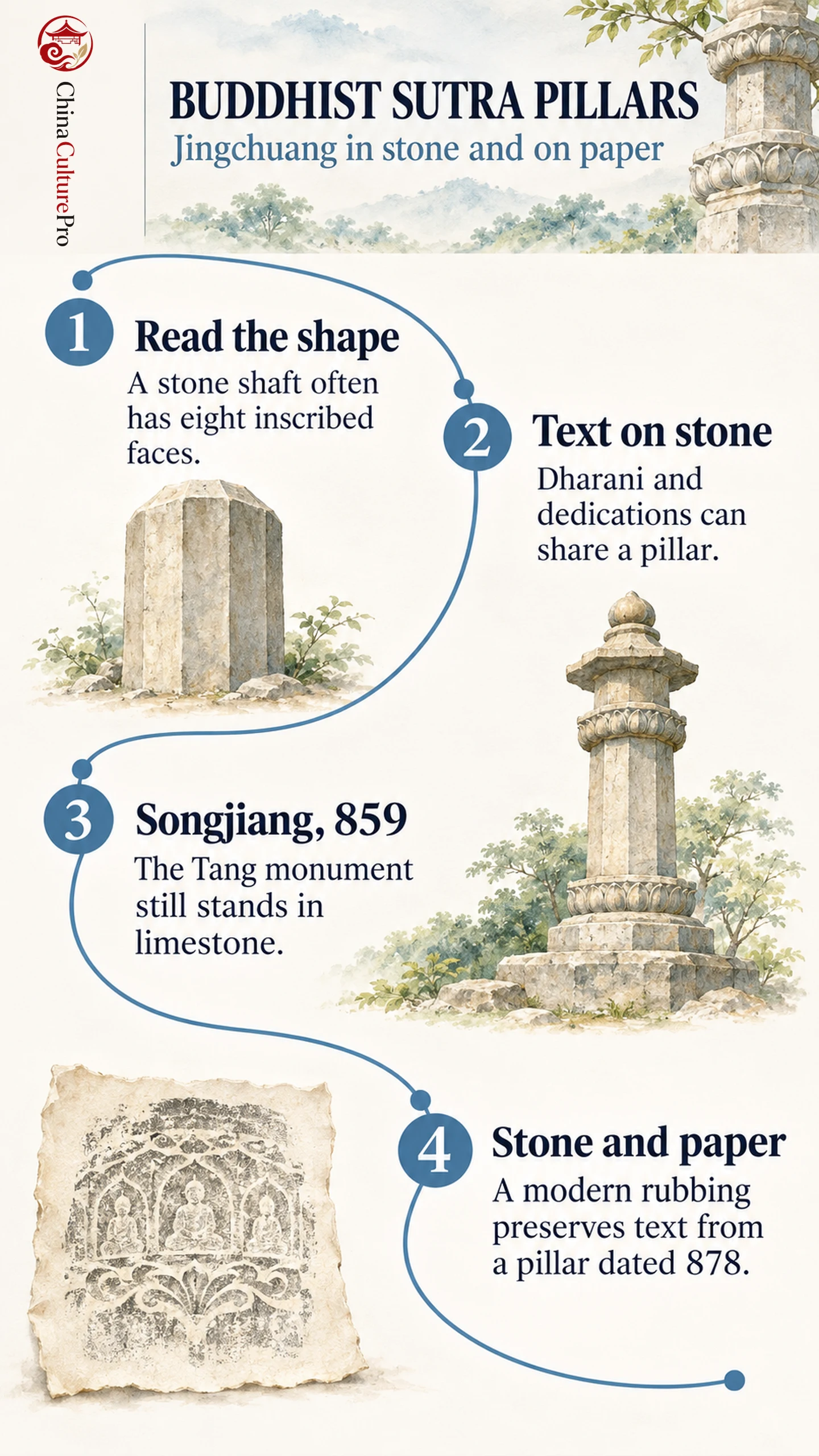
One Tang pillar still stands in Songjiang. A modern ink rubbing at Princeton preserves details from another Tang pillar. The standing monument shows how the parts stack. The rubbing makes small marks beside the engraved text easier to examine.
How to Recognize the Pillar
Start with the base, shaft and upper ornaments. The words can continue across several facets. On the Songjiang monument, the tiers include canopy forms, carved lotus motifs and Buddhist figures. The decorative petals can recall Buddhist lotus pedestals. A stepped silhouette can resemble a pagoda, so the inscription and the object’s documented function are more useful than its outline alone. Compare the forms in stupas and Chinese pagodas.[3]
Why Put a Dharani on Stone?
One frequent inscription was the Ushnishavijaya Dharani (佛顶尊胜陀罗尼, Fódǐng Zūnshèng Tuóluóní). Texts and traditions ascribed religious benefits to encountering the formula in material form. Some described the pillar’s shadow or dust in these terms. In this setting an engraved formula was understood to convey religious benefit even when nobody was reciting it. This is one example of how texts took material form in the history of Chinese esoteric Buddhism.[1][2]
Read the Stone and the Rubbing
Songjiang, 859
The Songjiang district catalogue dates its limestone pillar to 859. The monument rises to about 9.3 metres in its surviving form. Its eight faces carry the scripture and preface, as well as a record of the monument’s construction. Look for where the written register stops and the sculptural tiers begin.[3]
A Tang Pillar Dated 878
The Princeton object is a modern ink rubbing of a pillar dated 878. Below the Buddha figures, Chinese characters represent the sounds of a Sanskrit dharani. Smaller writing gives pronunciation guidance. The rubbing preserves these details on a flat surface. Here the impression records an existing stone surface. Compare that process with printing a scripture from woodblocks.[4]
FAQs About Buddhist Sutra Pillars
Is a dharani pillar the same as a pagoda?
Some pillars have several tiers and can resemble small pagodas. A dharani pillar’s engraved formula and columnar structure are important clues to its purpose.
Is all the writing a translation from Sanskrit?
An inscription may include Chinese texts and a phonetic transcription. The Princeton rubbing preserves characters used for the sound of a Sanskrit formula.
Why do museum labels give two dates?
One date can refer to the carved monument and the other to the paper rubbing taken from it.
出典
[1] Paul Copp. The Body Incantatory: Spells and the Ritual Imagination in Medieval Chinese Buddhism
[2] Youn-mi Kim. A Ritual Embodied in Architectural Space: The Ushnishavijaya Dharani and Yingxian Timber Pagoda from the Liao Empire
[3] Shanghai Songjiang District Government. Songjiang Cultural Sites: The Tang Sutra Pillar
[4] Princeton University Art Museum. Dharani Pillar Inscribed with Buddhas and the Usnisa-vijaya Dharani