
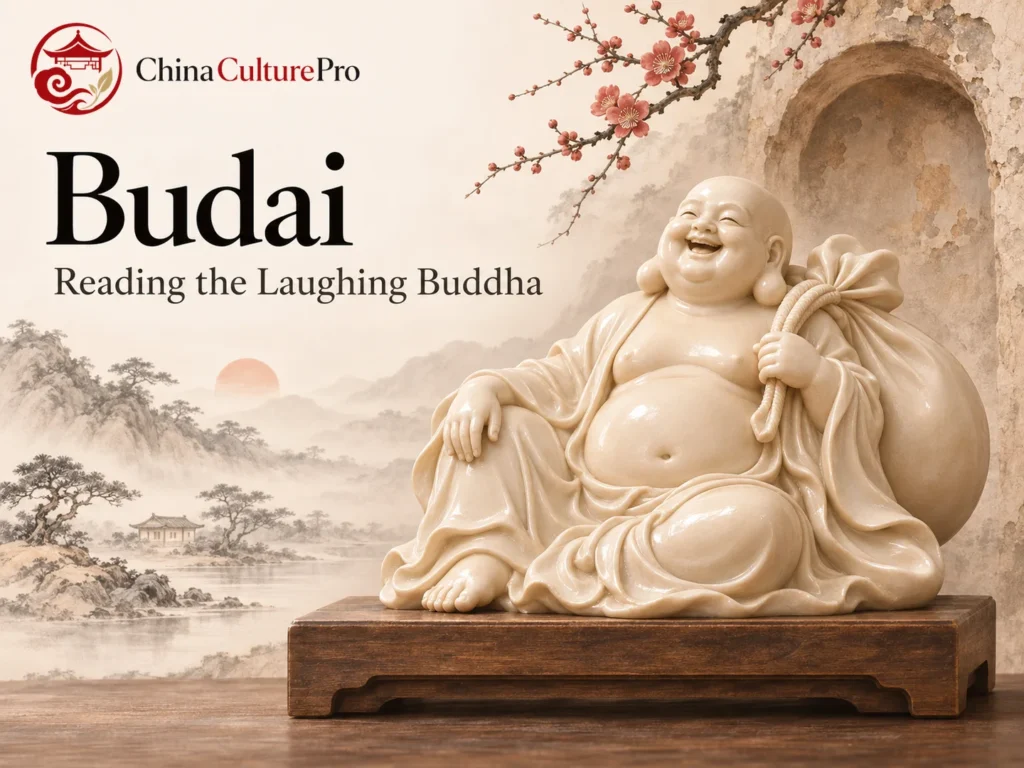

Quick Answer: Who Is Budai?
Budai (布袋, Bùdài), the “Laughing Buddha,” is a Chinese Buddhist figure based on stories of a wandering monk. His nickname means “cloth bag” and refers to the sack he carries in many images.[1][3]
- The monk: Early accounts call him Qici (契此, Qìcǐ) and associate him with the Fenghua area of present-day Zhejiang.[1][2]
- The religious figure: Chinese Buddhist tradition came to regard Budai as an appearance of Maitreya (弥勒, Mílè), the future Buddha.[1][5]
- Common clues: Look for the cloth sack, a rounded belly and open robes. A broad smile is familiar, but the facial expression varies.[3][4]
The monk’s nickname, the stories about his life and the objects made after his death each tell a different part of Budai’s history.
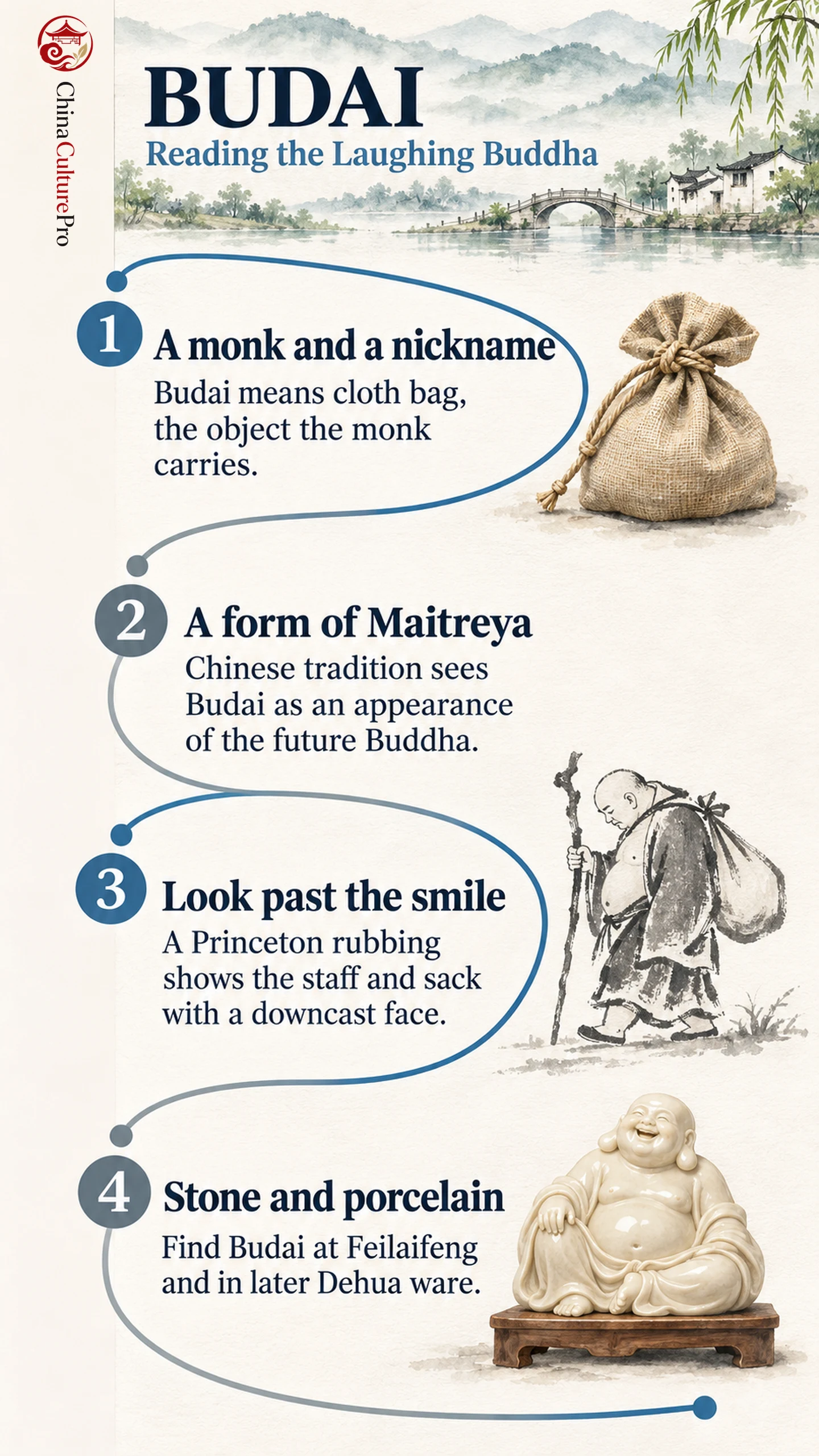
The name “Laughing Buddha” can make a smile seem like the feature to look for first. An image preserved in a Princeton rubbing shows how useful the bag can be when the face looks quite different.
From a Wandering Monk to an Image of Maitreya
Buddhist biographies describe Qici as a monk associated with Fenghua who lived around the turn of the tenth century. A Song record of Chan Buddhist transmission tells of a verse attributed to him near his death and takes it as a hint of his connection to Maitreya. These stories help trace the rise of Budai as a religious figure.[1][2]
The cult of Maitreya was already present in China centuries earlier. An inscribed gilt bronze at the Met, dated 486, shows Maitreya as a standing Buddha in long robes. Compare its proportions with the rounded belly and open robe that identify Budai in later Chinese images.[3][5]
What to Look for in Chinese Images of Budai
A Staff and Bag in a Rubbing
In Princeton’s Budai with Staff and Bag, the robed figure looks downward and carries a staff with a large sack. The stone carries an inscription dated 1088. The museum dates its paper rubbing to the late nineteenth or early twentieth century. The later rubbing preserves the Song image without being a Song sheet of paper.[3]
A Laughing Figure Among Luohan
At Feilaifeng (飞来峰, Fēiláifēng) in Hangzhou, a Southern Song carving sets a smiling Budai in the center of a rocky niche. He is surrounded by eighteen luohan (罗汉, luóhàn), or arhats. The size and central position make Budai the focus of this Buddhist assembly. The Eighteen Luohan have their own history as a group in Chinese art.[1]
A Small Figure in Dehua Porcelain
The Met’s seventeenth- to eighteenth-century Budai carries the sack under his arm. The museum identifies the ivory-glazed figure as Dehua ware from Fujian. It is a smaller example of how the same attribute survives across different materials, from a stone niche to Chinese porcelain.[4]
FAQs About Budai
Is Budai the historical Buddha?
Budai is based on stories of a Chinese monk from around the tenth century. The historical Buddha, Shakyamuni, lived in South Asia much earlier.
Why are some Maitreya statues shaped like Budai?
Chinese Buddhists came to regard the monk as a manifestation of Maitreya. The cloth-sack monk became one recognizable way to represent the future Buddha.
Is Hotei the same figure?
Hotei is the Japanese name for Budai. In Japan he also became one of the Seven Gods of Good Fortune.[6]
出典
[1] Qing Chang. Indigenizing Deities: The Budai Maitreya and the Group of Eighteen Luohans in Niche No. 68 at Feilaifeng
[2] Albert Welter. Borderland Complexes and Translocations
[3] Princeton University Art Museum. Budai with Staff and Bag
[4] The Metropolitan Museum of Art. Buddhist Monk Budai
[5] The Metropolitan Museum of Art. Buddha Maitreya (Mile)
[6] The Metropolitan Museum of Art. Hotei