


Quick Answer: What Is Beijing Douzhir?
Douzhir (豆汁儿; dòuzhīr), also written douzhi, is Beijing’s sour fermented mung bean drink. It comes from the processing tradition behind mung bean starch and noodles; the familiar cooked serving is gray-green and strongly aromatic.[2][4]
- Ingredients: Mung beans and water form the base; fermentation gives the liquid its sour character.
- Method: Producers grind, filter, ferment and separate the bean slurry, then heat the drink for serving.
- Pairing: Jiaoquan (焦圈; jiāoquān), crisp fried dough rings, and shredded salted vegetables make the traditional accompaniment.
- Variation: Bowls can differ in sourness and aroma between producers; the drink is not defined by one fixed home recipe.[3][5]
The process below explains the craft. It is not a timed home-fermentation formula, and a raw product should not be confused with a finished cooked drink.
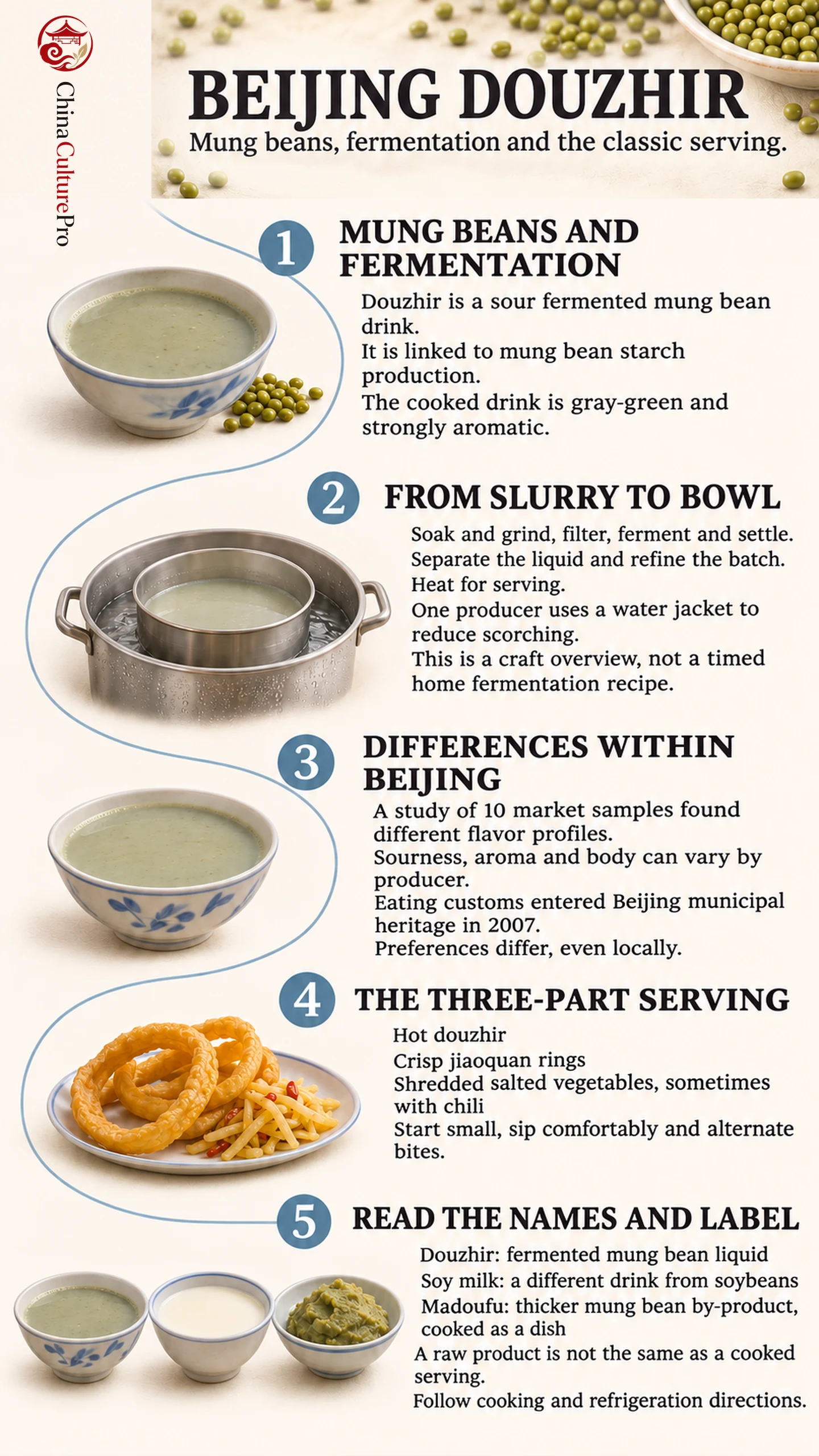
Douzhir is easier to understand as part of a small meal than as a challenge to finish a pungent beverage. The sour liquid, crisp ring and salty pickles provide different tastes and textures. Its place in Beijing cuisine also reflects a history of turning the products of everyday food processing into valued snacks.[1]
Mung Beans, Starch and Fermentation
The main raw material is mung bean, not the soybean used for ordinary soy milk (豆浆; dòujiāng). It is associated with liquid remaining during mung bean starch or noodle production. That relationship does not make a spoiled batch suitable to drink.[1]
Acid develops through fermentation. Research on traditional douzhi processing identified acid-producing bacteria during the settling stage, showing that this is more than simply leaving ground beans to separate. The sourness is part of a microbial process, rather than vinegar necessarily being added to the finished bowl.[2]
The solid starch and the liquid drink are different products from the same processing stream. A contemporary producer report also describes a shift from starch-led production toward making the drink as the main product. That helps explain how douzhir can retain its historic identity while being made deliberately for today’s customers.[4]
For other examples of deliberate food fermentation, see Chinese fermented foods. Each product has its own ingredients and production controls; one familiar fermentation does not provide a universal recipe for another.
How Producers Make and Heat Douzhir
The traditional sequence involves more than soaking beans and heating the water. Research and a local craft account describe these broad stages:[2][3]
- Prepare and grind: Soak the mung beans, remove the skins and grind them with water into a slurry.
- Filter: Remove the coarse material from the liquid mixture.
- Ferment and settle: Add a starter to the filtered liquid and allow fermentation and separation to develop.
- Separate and refine: Recover the relevant liquid fraction and continue the producer’s fermentation and separation process.
- Heat for serving: Cook the prepared liquid to produce the familiar hot bowl.
Old slurry (老浆; lǎojiāng) can serve as a starter to adjust a batch. Its amount belongs to the producer’s controlled method; this overview does not supply a household fermentation schedule.[3]
Heating methods also differ. One official culinary account describes adding fermented douzhi to boiling water, bringing it back to the boil and then keeping it warm. A firsthand report shows a producer using a water-filled outer vessel around the inner cooking bucket to reduce scorching from residual starch. These are documented techniques, not grounds for a blanket claim that douzhir must never boil.[4][8]
Why Bowls Differ between Shops
Gray-green color and a sour fermented character are useful expectations, but not a precise flavor specification. A sensory study of ten douzhi samples sold in Beijing found distinct flavor and taste profiles, with similarities between some samples. Heating also changed aspects of their flavor-related composition.[5]
For a first tasting, compare the sourness, aroma and body of the actual bowl rather than assuming that the strongest-smelling one is the most authentic. Neither enthusiasm nor dislike is universal: firsthand customer interviews include regular drinkers and visitors who find only a few sips enough.[4]
Its cultural recognition concerns more than a recipe. Beijing’s municipal heritage notice of 2007 lists the customs of eating douzhi among its folk-custom projects. This is a city-level heritage listing, not a claim that every bowl follows a nationally standardized formula.[6]
The Traditional Three-Part Serving
The classic serving brings three components together:[3]
- Hot douzhir: The sour fermented mung bean drink supplies the liquid part of the serving.
- Jiaoquan: Crisp fried dough rings provide a crunchy contrast to the drink.
- Shredded salted vegetables: A small dish of pickles adds salt and sometimes chili heat.
Start with a small serving if the flavor is unfamiliar. Let a hot bowl cool enough to sip comfortably, then alternate the drink with bites of the crisp ring and pickles. The point is the contrast, rather than finishing the liquid quickly. The Beijing jiaoquan guide explains the fried accompaniment, while Chinese breakfast places the set beside other regional morning meals.
If buying douzhir to take home, check whether it is a raw product requiring cooking or an already cooked product with reheating directions. Keep perishable purchases refrigerated and follow their label. General food-safety guidance calls for refrigeration within two hours, or one hour above 90°F (32°C); fermentation is not a reason to leave a purchased drink out indefinitely.[9]
Douzhir, Soy Milk and Madoufu
The following names refer to different foods, even though English descriptions sometimes blur them together.[1][7]
| 料理名 | 意味 |
|---|---|
| Douzhir | A fermented mung bean liquid associated with starch production, heated for the familiar bowl serving. |
| Soy milk | A drink extracted from soybeans; ordinary soy milk is a different preparation from fermented mung bean douzhir. |
| Madoufu (麻豆腐; mádòufu) | A thicker by-product from mung bean processing, prepared as a separate cooked dish rather than served as the drink. |
For the soybean beverage, see Chinese soy milk and breakfast traditions. On a menu, madoufu identifies the separate cooked dish, not a thicker serving of the drink.[1]
The broader Chinese drinks guide offers other beverage choices if you want to compare familiar bean drinks with this fermented Beijing specialty.
FAQs About Beijing Douzhir
Is douzhir made from soybeans or dairy milk?
Its traditional base is mung beans and water, rather than soybeans or dairy milk. Check a packaged product’s full ingredient list.[2][7]
Can raw douzhir be treated as a ready-to-drink beverage?
Do not assume so. A raw product and the cooked bowl are different stages. Choose the cooked serving or follow the purchased product’s cooking and storage directions.[8][9]
Do all Beijing residents like douzhir?
No. It has devoted drinkers, but the sour fermented flavor also divides local opinions. Liking or disliking it is a matter of preference, not a test of belonging.[1][4]
出典
[1] Beijing Municipal Government portal. Old Beijing and the Use of Food By-Products
[2] Ding Yuzhen and colleagues, Food Science. Processing Technology of Beijing Traditional Food Douzhi
[3] Beijing Tourism official portal. Beijing Flavors: Experiencing Local Culture through Food
[4] CCTV News, hosted by Beijing Daily. A Guide to Beijing Breakfast, Starting with Douzhir
[5] Liu Wenying and colleagues, Food Science. Sensory Characteristics of Beijing Douzhi (Fermented Mung Bean Juice)
[6] Beijing Municipal Government, China Intangible Cultural Heritage Digital Museum. Second Batch of Beijing Municipal Intangible Cultural Heritage
[7] UN Food and Agriculture Organization. Soymilk and Related Products
[8] Beijing Tourism official portal. Dongcheng Flavors: Intangible-Heritage Foods
[9] US Food and Drug Administration. Safe Food Handling