


Quick Answer: Who Is Ao Bing?
Ao Bing(敖丙,Áo Bǐng)is a dragon prince whose role changes substantially between a classical Chinese novel and modern animated films.
- Family: He is associated with the East Sea Dragon King’s household.
- Classical role: His confrontation with another young supernatural figure has serious consequences.
- Modern role: Later films give him a much larger continuing story and a changed relationship with his opponent.
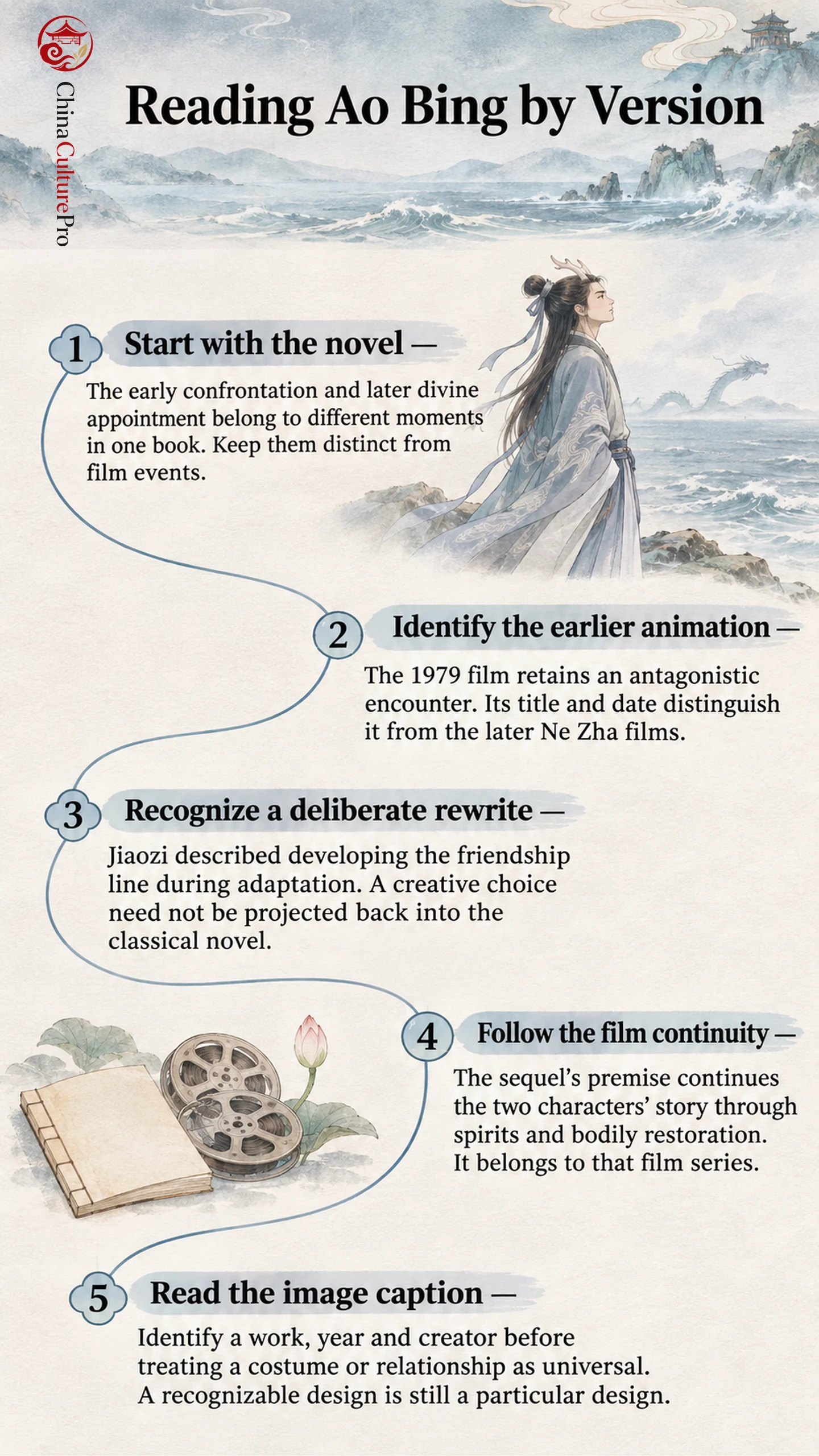
A claim about Ao Bing needs its version attached. A modern friendship, appearance or origin should not automatically be treated as a feature of every earlier account.
The same dragon prince can appear as an opponent in one story and a companion in another. Ao Bing makes this especially clear. This guide follows his role across the classical narrative and named animated retellings, providing context for readers exploring Chinese animation and mythology.
Ao Bing in Fengshen Yanyi
Fengshen yanyi(封神演义,Fēngshén yǎnyì), often called Investiture of the Gods, presents Ao Bing’s confrontation with Nezha(哪吒,Nézhā)in chapter 12. He is the third son of Ao Guang(敖光,Áo Guāng), the East Sea Dragon King. His death intensifies the conflict between the two households. In chapter 99, Ao Bing’s name appears in the divine appointments as the Huagai star.[1]
The late appointment and the earlier encounter belong to the same novel, but they are different moments in its structure. Neither should be confused with a modern film’s method of restoring a character’s body. Ao Bing is a literary prince, not an identified historical person.
For the other side of the encounter, see Nezha’s story and traditions. Familiarity with that figure can help, provided details from different versions remain separated.
The Confrontation in the 1979 Animated Film
The 1979 animation commonly known in English as Nezha Conquers the Dragon King keeps an antagonistic confrontation. The China Movie Channel’s film record describes Ao Bing coming as the Dragon King’s son and being killed, followed by escalating conflict with the dragon rulers.[2]
The film is an adaptation, not a substitute edition of the novel. Its selection and arrangement of events shape how the audience understands the quarrel. Recognizing its date also prevents an easy mistake: the 1979 film and the 2019 Ne Zha are different works, even when English titles and character names overlap.
A memorable screen version remains one version of the character.
The 2019 Rewriting of a Familiar Rivalry
Director Jiaozi addressed this change in a 2019 interview with iQiyi Entertainment. He said Ao Bing had initially been conceived as an antagonist who died, but revisions developed a friendship line in keeping with the film’s concern with resisting labels. His account identifies the relationship as a creative decision made during adaptation.[3]
That explanation is more useful than retroactively making friendship the classical version’s hidden premise. It lets readers appreciate the new characterization on its own terms. It also distinguishes the filmmaker’s stated approach from subsequent fan interpretations of the relationship.
The film’s character introduction retains his identity as the East Sea prince while presenting his encounter as a revelation of character. A familiar family position can coexist with a substantially rewritten role.[4]
Ao Bing’s Continuing Role in Ne Zha 2
The 2025 sequel continues the modern film’s storyline. Distributor CMC Pictures describes both central figures surviving as spirits after heavenly lightning, with Taiyi attempting to rebuild their bodies using a precious lotus. Ao Bing’s continuing presence is part of that film continuity.[5]
This premise is enough to establish a difference without recounting every later turn. It concerns two characters whose physical existence must be restored, not simply the novel’s list of divine titles. Treat the shared name as a connection between works rather than permission to combine their plots.
The distributor’s brief account establishes this premise; it does not settle every later motive or interpretation.
Recognizing the Version Behind an Image
When an image catches your attention, identify its work before using it as evidence about the character. A film still belongs to a particular production; an illustrator can choose another costume or bodily form; fan art may explore a relationship beyond what a film explicitly establishes.
Useful clues include the caption, production title, year and accompanying explanation. Hair color, horns or a weapon can help recognize a design, but recognition of one design does not establish a universal ancient description.
For a wider view, explore donghua and Chinese animation. Ao Bing’s changing role is an example of adaptation in action: recognizable characters can carry substantially revised relationships and narrative purposes.
FAQs About Ao Bing
Is Ao Bing the Dragon King’s son?
Yes, he is the East Sea Dragon King’s third son in the novel’s account.
Are Ao Bing and Nezha always friends?
No. Their relationship differs between the classical confrontation and modern film retellings.
Does Ao Bing die in the novel?
Yes, in the early encounter. His name also appears later among the divine appointments.
Are his blue hair and weapons ancient fixed features?
No single modern character design establishes a fixed appearance for every version.
出典
[1] Chinese Text Project, Primary Chinese Text. Fengshen Yanyi: Chapter 12 and the Novel’s Later Divine Appointments
[2] China Movie Channel. Film Database: Nezha Conquers the Dragon King, 1979
[3] iQiyi Entertainment, Interview with Jiaozi. Six Things behind the Making of Ne Zha, 2019
[4] T&B Media Global. Ne Zha, Acquired Title and Character Introduction
[5] CMC Pictures. Nezha 2: Official Synopsis